MILLION Luxury compares Miami, New York and Los Angeles through a value focused lens for ultra affluent buyers. Rather than chasing headlines, we examine price per square foot, space for the dollar, daily lifestyle, architecture, amenities, tax climate and exit liquidity. The result is a grounded framework that clarifies how each city rewards capital differently. For South Florida based clients considering a Manhattan pied a terre, a Los Angeles estate or a deeper commitment to Miami, this guide helps align budget, lifestyle and long term strategy.
For many of our clients at MILLION Luxury, the decision is not whether to own in Miami, New York or Los Angeles, but how to allocate capital and time between all three. Each city is a global brand in its own right, with a distinct way of expressing luxury and, crucially, a very different interpretation of value. The same eight figure budget can buy a Park Avenue aerie above Central Park, a glass walled Bel Air compound or a waterfront villa facing Biscayne Bay, and each will feel like a completely different universe.
In this editorial we look beyond headlines and trophy sales and focus on what discerning buyers actually experience on the ground: price of entry, space for the dollar, daily lifestyle, architecture and services, tax and policy considerations and exit liquidity. We treat flagship condominium towers in each market as bellwethers for broader value, while acknowledging that Los Angeles and Miami in particular still derive much of their mystique from ultra private single family estates.
The lens is intentionally South Florida centric. For a buyer anchored in Brickell or along Miami-beach, the question is usually not whether New York or Los Angeles are appealing, but whether the incremental cost, complexity and tax drag truly justify a second or third home. Understanding how these three markets stack up helps clarify whether to concentrate holdings in one city or curate a portfolio of complementary lifestyles.
On pure sticker price, Manhattan remains the most expensive of the three. In the prime neighborhoods that matter most to global buyers - Central Park facing corridors, Tribeca, SoHo and the most desirable stretches of the Upper East Side - contemporary new build condos and immaculate pre war co operatives routinely ask well into the multi million range. For genuinely best in class inventory, price per square foot commonly starts around two thousand five hundred to three thousand five hundred dollars and can push significantly higher in Billionaires Row towers where scarcity, skyline views and private club style amenity suites justify yet another premium.
Los Angeles tells a different story because land and privacy are the core luxuries. Citywide, median prices hover in the mid six hundreds per square foot, but that number is almost meaningless at the top of the market. In Beverly Hills, Bel Air and the better parts of the Hollywood Hills, thoughtfully renovated villas and contemporary compounds often command twelve hundred to fifteen hundred dollars per square foot, while ultra bespoke architect designed estates can leap far beyond that when lot size, architecture and views align. The recent record setting two hundred ten million dollar sale of an oceanfront Malibu estate underlines just how far the market will go for a singular property with acreage, security and unbroken Pacific horizon.
Miami still offers the clearest arithmetic value. In coveted neighborhoods such as Miami-beach, Coral Gables and the more established parts of Brickell, the entry point for serious luxury typically begins around three million dollars for a well located condo or single family home and climbs rapidly for new waterfront product. Yet recent global wealth reports indicate that approximately one million dollars buys close to twice as much prime space in Miami as it does in New York, with roughly fifty eight square metres in Miami versus around thirty four in Manhattan. The gap is even more pronounced in the ultra prime segment, where Miami waterfront penthouses and villas can still offer six or seven bedrooms and private docks at prices that would barely secure a four bedroom apartment overlooking Central Park.
Trophy transactions tell their own story. New York continues to hold the national price record with a roughly two hundred thirty eight million dollar penthouse at 220 Central Park South. Los Angeles now boasts the most expensive home in California history after the two hundred ten million dollar Malibu sale. Miami has rapidly joined this nine figure conversation with a recent one hundred twenty million dollar Star Island transfer setting the Miami Dade record and an emerging pipeline of Indian Creek and Palm Beach County listings testing two hundred million dollars. The narrative is clear. New York remains the benchmark at the very top, Los Angeles has proven it can match Manhattan on absolute pricing when land and architecture warrant it, and Miami delivers the greatest physical volume per dollar while steadily closing the prestige gap.
For a ten million dollar budget, that translates into markedly different realities. In Manhattan it might secure a three to four bedroom apartment in a top tier building, perhaps with a partial park view and an amenity slate that rivals a grand hotel. In Los Angeles, ten million dollars might buy a five bedroom hillside home on a generous lot with a pool, guest house and meaningful privacy. In Miami, the same sum can often stretch to a panoramic bayfront penthouse or a new construction waterfront home with yacht dockage and extensive outdoor entertaining space. Value, quite simply, begins with the scale and setting each market can deliver at the price point.
New York offers a density of culture and opportunity that no other American city can replicate. For many clients, the value of a Manhattan residence is measured less in square footage and more in the ability to step out of the lobby into a world of museums, galleries, Michelin starred restaurants and boardrooms. The archetypal lifestyle is vertical and service led. Think discreet attended lobbies, private elevators, resident only dining rooms and wellness floors, all wrapped around a schedule filled with deals, philanthropy and evening performances. Outdoor space is precious, often limited to a terrace or shared roof garden, but the emotional dividend of a Central Park facing living room in a winter sunset remains hard to quantify.
In Los Angeles, the home itself becomes the primary stage set for life. The most coveted addresses in Beverly Hills, Holmby Hills, Brentwood and the Malibu bluffs are defined by their seclusion. Long private drives, double gates, topography and mature landscaping work together to create a sense of arrival and separation. It is common for estates to include full scale gyms, screening rooms, professional grade kitchens, wellness spas and flexible staff quarters so that virtually every need can be met without leaving the property. Cars replace elevators as the connective tissue of daily life and socialising revolves around private dinners, poolside afternoons and carefully curated gatherings that keep the guest list tight and cameras at bay.
Miami occupies a hybrid position that increasingly appeals to globally mobile entrepreneurs and families. Brickell and Downtown offer a dense urban skyline with fine dining, office towers and private members clubs within a few walkable blocks. A short drive away, Oceanfront condos in areas like Miami-beach deliver a resort atmosphere with beach clubs, marinas and cabanas at water level. The indoor outdoor rhythm is effortless, from breakfast on a balcony looking toward Biscayne Bay to late night galleries and lounges in the Design District. Add Florida s lack of state income tax and a pragmatic business environment, and the lifestyle calculus tips further. For many buyers who split their time between cities, Miami functions as the place where work, leisure and wellness compress into a single, sun soaked routine.
Architecturally, New York is a study in contrasts between venerable pre war buildings and flamboyant contemporary towers. Along 57th Street, ultra slender supertalls rise with glass walls and ambitious structural engineering, while limestone clad addresses by leading classical firms evoke a more club like sensibility. Interiors at the top of the market favour rich but restrained materials, highly tailored millwork and quietly sophisticated technology. Amenity suites compete in breadth and polish, offering residents everything from twenty five metre pools and private cinemas to sommelier led wine rooms and full time concierge desks capable of handling everything from travel logistics to in residence spa appointments.
Los Angeles leans into architectural individuality. From low slung mid century pavilions perched above the city to muscular contemporary compounds carved into canyon walls, the best homes here belong to specific architects and landscape designers rather than to a single skyline. Glazed walls retract to erase boundaries between interior and exterior, infinity pools appear to drop into city lights and mature planting screens homes from neighbouring sight lines. Because so many clients are public figures, security design is integral. Sight lines, gate placement and guard facilities are considered as carefully as pool orientation or kitchen layout, and the overall result is less a house than a private resort set within the hills.
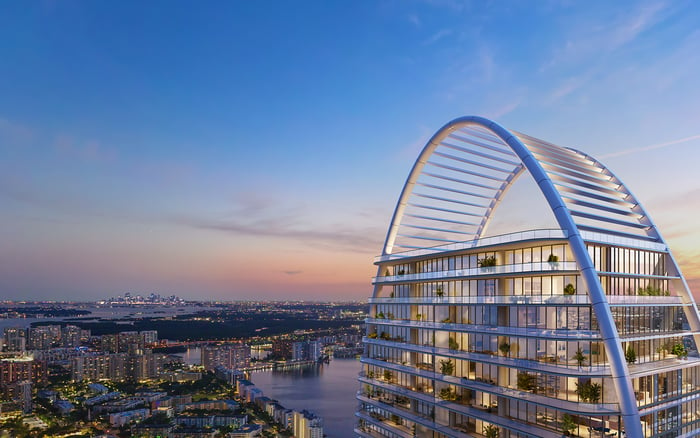
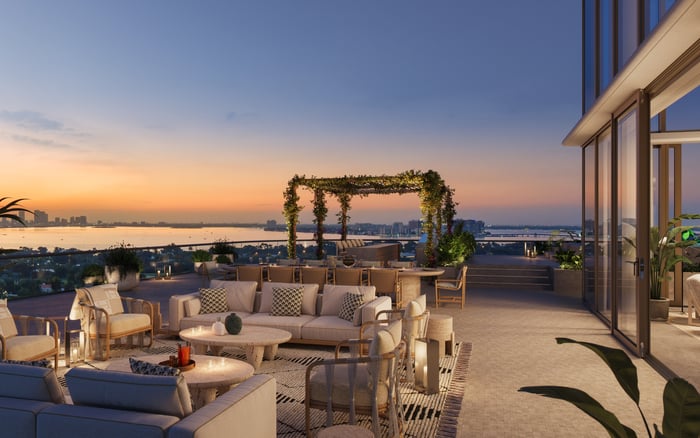
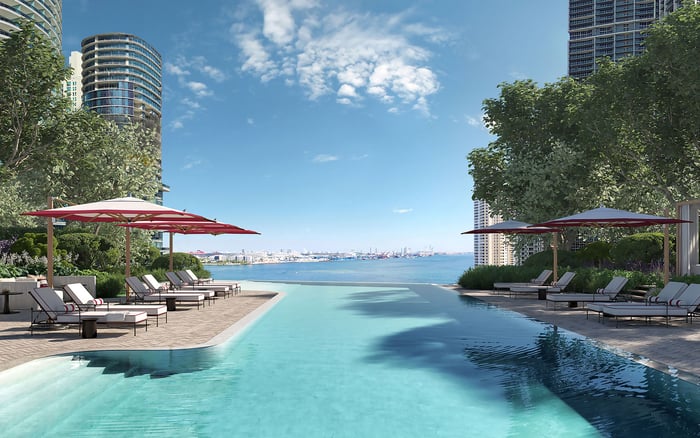
In Miami, architecture and services are converging in a distinctly new way. The skyline has been reshaped by signature towers such as One Thousand Museum, work by Renzo Piano in Surfside and a wave of new designs that treat buildings as global lifestyle brands. Branded residences have become a defining theme, pairing design narratives from fashion, automotive and hospitality houses with full scale amenity decks. Owners expect multi level wellness centres, resident only restaurants, curated art programs and sophisticated kids spaces as standard rather than exceptions. Oceanfront and bayfront pools with private cabanas, on site marinas and hotel grade staff transform daily life into something much closer to a luxury resort stay.
Two Downtown projects in particular illustrate this new chapter of Miami sophistication. At Aston Martin Residences Downtown Miami, the tower takes its cue from automotive design, integrating a sky lobby, private pools on select terraces and a yacht marina into an overall aesthetic that feels sleek, sculpted and distinctly international. A short distance away, Waldorf Astoria Residences Downtown Miami reimagines the legendary hotel brand as a vertical village of glass cubes, stacking private residences above a flagship hotel with views that sweep from Brickell to Miami-beach. For clients who began their collecting journey in traditional buildings in New York or Los Angeles, these new generation Miami towers now deliver a level of amenity, finish and service that feels thoroughly competitive.
From an Investment perspective, the last several years have seen Miami rise from sunbelt outlier to top tier performer. Global indices highlight that prime prices in the city have recently delivered some of the strongest growth among major United States markets, and subsequent forecasts continue to place Miami near the top of global tables. New York and Los Angeles, by contrast, have oscillated between mild appreciation and selective correction, reflecting periods of oversupply at the very top, shifting tax sentiment and a natural pause after the intense surge of the pandemic years.
Ultra luxury transaction data reinforces the picture. Recent national reporting shows Manhattan still leading the country in sales at ten million dollars and above, with just over three hundred deals in 2024 and an average price north of twenty four million dollars. Greater Los Angeles follows with roughly one hundred ninety such sales averaging around seventeen and a half million dollars, underscoring the depth of demand for view rich estates despite the introduction of a mansion transfer tax. Miami Dade now sits firmly in the same conversation with more than one hundred fifty ultra luxury closings and an average price around eighteen million dollars, remarkable for a market that only a decade ago was still seen primarily as a second home destination.
Tax treatment is a crucial layer of value for globally mobile families and entrepreneurs. Florida s lack of state income tax, combined with comparatively straightforward estate planning structures and a pragmatic regulatory environment, can translate into seven or even eight figure savings over a decade when compared with a high earner resident in New York City or Los Angeles. California and New York continue to command a premium for their ecosystems of finance, media, technology and culture, and for some buyers that exposure is non negotiable. For others, particularly those able to manage businesses remotely or through teams, structuring primary residency in South Florida while maintaining strategic pieds a terre in Manhattan or Los Angeles is proving to be a compelling optimisation.
Looking ahead, the most prudent strategy is rarely a simple bet on one market. New York offers deep liquidity and a long track record as a safe harbour for capital, but buyers should scrutinise building level governance, carrying costs and amenity relevance to ensure long term appeal. Los Angeles rewards those who prioritise singular sites and timeless architecture over sheer square footage, since land and views will always be the ultimate hedge. Miami, for its part, still trades at a discount on a price per square foot basis relative to New York and select West Coast enclaves, yet sits at the centre of a powerful narrative of population growth, wealth migration and brand new infrastructure. For many of MILLION Luxury s clients, the most resilient portfolio consists of a primary home in South Florida, a cultural base in Manhattan and, where lifestyle warrants it, a private hillside refuge in Los Angeles.
For bespoke guidance on how these three markets align with your personal objectives, speak with our team at MILLION Luxury and let us help you calibrate the next chapter of your global residence portfolio.
Which city offers the best overall value for a first luxury home purchase?
For a single primary residence, Miami often delivers the most compelling balance of price per square foot, lifestyle and tax efficiency, particularly for buyers whose businesses are not tied to Manhattan or Los Angeles. New York or Los Angeles may still come first if daily proximity to finance, media or entertainment hubs is non negotiable.
Where does a ten million dollar budget buy the most space?
Miami typically offers the greatest physical volume at this level, with the potential for a large bayfront penthouse or a new build waterfront home with dockage and extensive outdoor space. Los Angeles will usually deliver more land and privacy than a Manhattan apartment, but in the very best enclaves the focus is on site quality rather than raw interior square footage.
Is Miami now too frothy after several years of strong price growth?
Miami has certainly re priced upward, but it still trades at a meaningful discount to New York and to the most exclusive pockets of Los Angeles on a price per square foot basis. Buyers who focus on irreplaceable waterfront locations, strong building governance and high construction quality are better positioned to ride out future cycles.
How should I think about taxes when choosing among these markets?
If you can legitimately establish primary residency in Florida, the absence of state income tax can materially enhance long term returns compared with New York or California residency. Many clients anchor their primary home and business structures in South Florida, then layer in strategic pieds a terre in Manhattan or Los Angeles for access to those ecosystems without incurring full time tax exposure.
What is the smartest way to build a portfolio across the three cities?
One effective approach is to treat Miami as the core residential and financial base, New York as the cultural and deal making hub and Los Angeles as the private resort component. Within each market, prioritise best in class locations and buildings over sheer size so that every property remains liquid, desirable and aligned with your overall lifestyle plan.
If branded residences are on your mind — as a home or as an allocation — we would be glad to share what we are seeing, privately.
Begin a quiet conversation