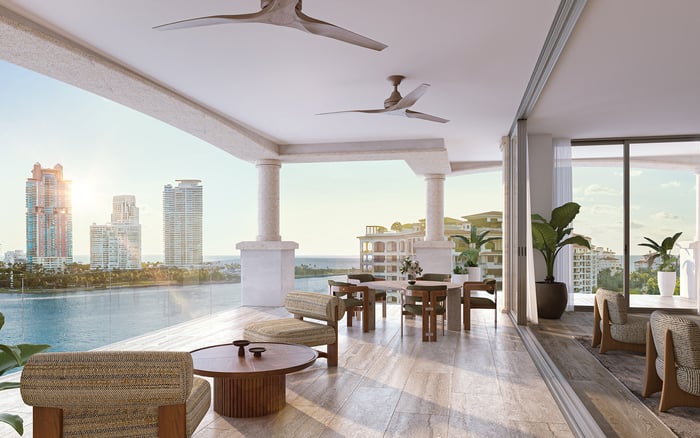
Miami’s second-home story has shifted from lifestyle upgrade to strategic positioning. In recent residential real estate analysis, Miami was ranked as the global epicenter for ultra-wealthy second homes, with roughly 13,200 ultra-high-net-worth individuals reported to own second homes here. At the same time, tax policy headlines, including a proposed California “Billionaire Tax Act” framework described as a one-time 5% excise tax on worldwide net worth above $1 billion, have sharpened the contrast between U.S. metros and offshore alternatives. For South Florida buyers, the real comparison is not “Miami or an island.” It is “Miami plus an island,” or “Miami as the operational base with optionality elsewhere.” The Caribbean remains compelling for privacy, seclusion, and residency pathways in certain jurisdictions. Yet Miami’s advantage is institutional: depth of healthcare, market liquidity and transparency, aviation and marine services, and a year-round social and cultural calendar. This is why the conversation has become less about pure escape and more about building a second-home portfolio that performs under scrutiny, whether that scrutiny is financial, familial, or geopolitical.
For years, the Caribbean held the intuitive edge for ultra-wealthy second-home buyers: privacy, water clarity that feels almost unreal, and the clean emotional separation of “leaving.” Miami, by comparison, was often positioned as a glamorous gateway, a place you passed through on the way to somewhere quieter.
That hierarchy is shifting. In a 2025 residential real estate analysis, Miami was ranked the global epicenter for ultra-wealthy second homes, with an estimated 13,200 ultra-high-net-worth individuals reported to own second homes in the city. At that scale, a market stops behaving like a trend and starts behaving like an institution. Infrastructure, not novelty, becomes the driver.
Policy has also reintroduced urgency. Florida’s lack of state income tax is not a seasonal perk; it is a structural feature that directly shapes the cost and simplicity of maintaining a U.S. base. At the same time, national coverage has highlighted a proposed California “Billionaire Tax Act” ballot initiative framework, described as a one-time 5% excise tax on worldwide net worth above $1 billion. Reporting around relocation dynamics tied to the proposal has repeatedly pointed to Miami as a beneficiary of billionaire interest.
For buyers, the practical conclusion is straightforward: second-home decisions are being stress-tested. Not only for enjoyment, but for continuity, access, and resilience. The question is no longer just where you unwind. It is where your family can operate comfortably when life gets complicated.
Miami’s shorthand is lifestyle, but its competitive moat is the number of high-functioning systems that overlap in one place. Yes, the city sells a version of winter that never arrives, often summarized as roughly 248 sunny days per year. For many UHNW families, however, weather is a baseline expectation, not the deciding factor.
What becomes decisive is the ability to land and operate without improvisation.
At the top of the market, transparency and liquidity carry real weight. Miami’s trophy ecosystem produces public pricing signals and widely covered closings. Star Island sales histories are public, and trophy transactions routinely make headlines, including a $120 million sale reported among South Florida’s most expensive 2025 deals. The Real Deal has also reported record-setting neighborhood transactions such as a roughly $85 million waterfront estate sale in Bay Point.
Those deals matter beyond their headline value. They illustrate that Miami can clear generational-scale price points with visibility and momentum. While that visibility is not for everyone, it supports valuation confidence, financing optionality, and credible exit paths when circumstances change.
This is also where Miami’s modern second-home product stands out. Increasingly, buyers are not only purchasing square footage; they are purchasing operating capability: staffing, security culture, predictable building management, and service standards that scale up to the expectations of global owners.
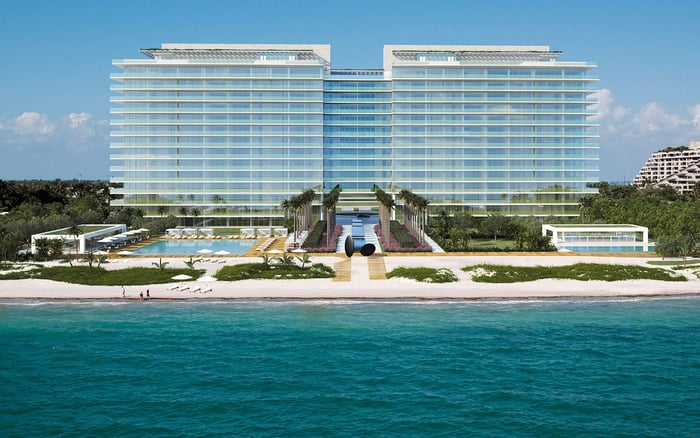
For buyers who want a Miami Beach address with hospitality DNA and a more curated arrival experience, Shore Club Private Collections Miami Beach reflects that institutional feel in built form, where service culture is part of the purchase, not an afterthought.
Miami’s ultra-luxury story is less about city limits and more about micro-markets with their own rules, rhythms, and buyer psychology. In a Miami vs. Caribbean comparison, these enclaves matter for one simple reason: they can deliver island-style separation while preserving American logistics.
In practice, that means controlled access, limited inventory, and a lifestyle that can feel deliberately removed, without asking you to trade away proximity to healthcare, aviation, or full-spectrum property services.
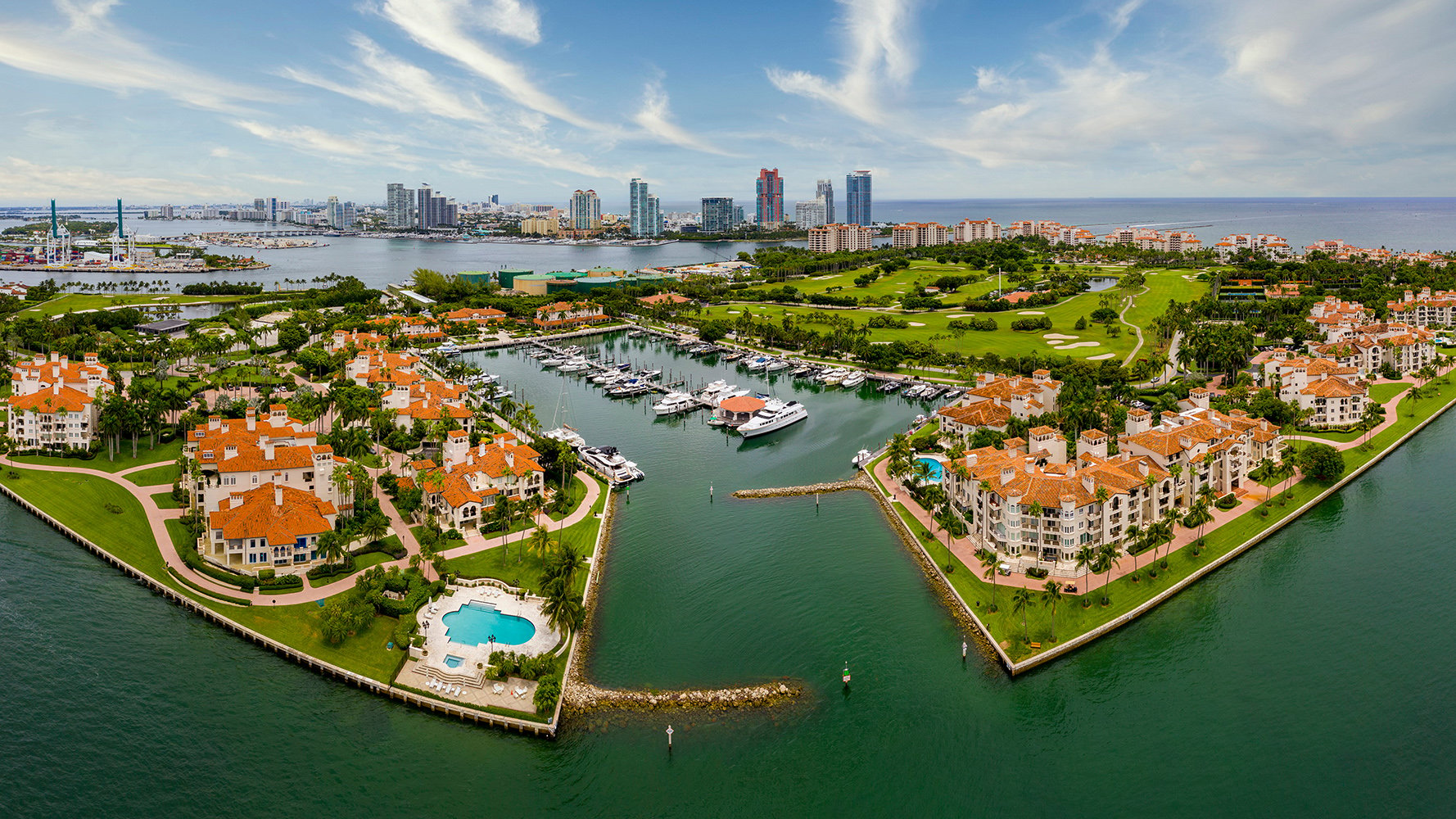
Fisher Island, ZIP code 33109, is repeatedly cited as an ultra-elite enclave and was reported as the most expensive U.S. ZIP code by median sale price in 2025 coverage. Even buyers who never intend to live there often treat Fisher Island as the local benchmark for “private island” living, with Miami’s skyline still within reach.
For second-home buyers, the appeal is not theoretical. Fisher Island’s controlled access and thin inventory tend to create a market that trades differently than the mainland. It can function as a strategic quiet zone: close enough to participate in Miami’s calendar, far enough to disappear when privacy becomes the priority.
Indian Creek Island, frequently described as “Billionaire Bunker,” has become shorthand for maximum security and minimal inventory. The draw is not only water frontage. It is the psychological certainty of a place designed around control, from policing to the limited number of homes.
For buyers weighing the Caribbean’s privacy against Miami’s connectivity, Indian Creek functions as a clear rebuttal: exceptional seclusion is possible without crossing a border, changing legal systems, or stepping outside U.S. infrastructure.
The billionaire migration story is no longer abstract. Google co-founder Larry Page was reported to have purchased two Coconut Grove waterfront properties totaling about $173.4 million. One purchase does not define a neighborhood, but the signal is hard to miss: Coconut Grove has re-entered the global conversation for serious, long-term capital.
The Grove often offers a different second-home cadence than Miami Beach. It can prioritize greenery, privacy, and a more residential feel, while still keeping you close to the core of South Florida’s cultural and business orbit.
Buyers who want newer condominium product in Coconut Grove’s orbit frequently monitor projects like Mr. C Tigertail Coconut Grove as part of that broader repositioning.
Miami Beach remains the most recognizable brand in South Florida real estate, but its role in the second-home portfolio has matured. The right oceanfront residence increasingly behaves like a staffed, turnkey operating base: suitable for extended stays, efficient for quick arrivals, and easy to host from without rebuilding your life each time you land.
At the high end, three motivations often converge:
First, the desire for oceanfront immediacy, the kind you feel the moment the elevator doors open.
Second, the preference for an address that reads globally, where guests and partners understand the value without a long explanation.
Third, the expectation that the property can support high-security, high-service living through established systems, not improvised workarounds.
This is why branded and hospitality-adjacent residences continue to command attention. For many UHNW buyers, the second home is not a vacation house in the traditional sense. It is a controlled environment that can remain guest-ready, staffed, and secure, with professional management that does not depend on the owner’s presence.
In that context, Setai Residences Miami Beach appeals to buyers who treat their second home like a private suite inside a larger hospitality ecosystem. For those who want the weight of a legacy brand paired with a more residential sensibility, The Ritz-Carlton Residences® Miami Beach sits naturally in the conversation.
And for buyers who prioritize a more boutique, design-driven shoreline experience with a direct relationship to the Atlantic, 57 Ocean Miami Beach reflects the continued appetite for lower-density oceanfront living.
Miami’s relationship with water is not only visual. It is operational. The marine economy is mature enough here that yacht ownership can be treated as routine rather than exceptional, supported by a network of services that makes maintenance, staffing, and logistics meaningfully easier.
The Miami International Boat Show is positioned as a major economic engine and a global marine showcase, and Miami-Dade County communications have cited large economic impacts tied to the event. The significance is not just the show itself. It is what the show signals: scale. Vendors, crew networks, brokerage activity, refit services, and a calendar that pulls decision-makers into the same ecosystem.
Layer in the reported push toward purpose-built mega-yacht infrastructure. Reporting has tied Ken Griffin to a proposal for a private superyacht marina concept in Miami Beach, underscoring the level of ambition around accommodating larger vessels.
For second-home buyers, these are not curiosities. They are indicators that Miami is building around UHNW needs in public view. When a city builds visibly for a category of owner, adoption tends to accelerate and friction tends to compress, from service availability to specialized talent.
A sophisticated buyer does not dismiss the Caribbean. Its appeal is real, and for certain families, it is the point. The Caribbean offers a particular kind of romance: seclusion, water, and a mental reset that can feel immediate.
There is also a strategic dimension. Several Caribbean jurisdictions compete for global capital through citizenship-by-investment programs, often pairing tax-friendly regimes with investment thresholds that can provide an alternative passport or residency pathway. For some buyers, that flexibility is as valuable as the view.
The trade-off is that the Caribbean is not one market. It is a constellation of smaller national markets with different legal systems, varying levels of transaction transparency, and uneven depth of services. Even market sizing data reinforces that dispersion, with Caribbean residential real estate transaction value projected around $12.09 billion in 2025.
Healthcare is often the decisive issue for families. Comparative expat guides frequently note that Caribbean healthcare quality varies widely by island and often cannot match the breadth and specialist depth of the U.S. system, particularly for complex care.
None of this makes the Caribbean “less.” It clarifies what the region is best used for. Many UHNW buyers increasingly treat the Caribbean as the pure retreat, and Miami as the primary second-home base that can absorb real life: school schedules, specialists, business meetings, and the unpredictability that comes with global families.
The Miami vs. Caribbean conversation can get stuck on taxes, but climate risk and insurance deserve equal attention. Sophisticated buyers increasingly treat these issues as part of the acquisition itself, not as post-closing details.
Research on Florida highlights the state’s massive concentration of coastal insured value, a factor behind broader insurance-market stress. That does not translate into a simple conclusion such as “avoid the coast.” It translates into a more disciplined purchase calculus: underwriting, resilience, and operational planning must be integrated, whether the home is on Miami Beach, Fisher Island, Indian Creek, or a Caribbean shoreline.
On both sides of the comparison, experienced owners tend to evaluate the same fundamentals:
The most successful second-home owners plan for absence as seriously as they plan for arrival. That means anticipating how a property is secured, maintained, and restored after a storm event, and ensuring decision-making authority is clear when the owner is not on the ground.
The strongest decisions in this category are made with a portfolio mindset, not a brochure mindset. The question is not which destination sounds more appealing in January. The question is which combination of assets supports the way you actually live.
For many UHNW families, the real choice is not “Miami or an island.” It is “Miami plus an island,” or “Miami as the operational base with optionality elsewhere.” Miami delivers institutional depth: healthcare access, market liquidity, transparency, aviation and marine services, and a year-round social and cultural calendar. The Caribbean delivers retreat, privacy, and in some jurisdictions, residency pathways.
Use the following framework to make the decision concrete.
If the home must host staff, maintain security protocols, and remain guest-ready on short notice, Miami often performs as the more plug-and-play option. Buildings and communities with established management cultures and consistent service expectations can reduce operational risk.
In contrast, a more remote retreat can be ideal for true disconnection, but it may require more hands-on oversight to maintain the same readiness level, particularly after weather events or during slower service seasons.
Privacy can be purchased in Miami through micro-markets like Fisher Island and Indian Creek, while still preserving proximity to U.S. healthcare and the Miami aviation network. Isolation is easier to buy in the Caribbean, but it can introduce friction when something breaks, medically or mechanically.
The distinction matters because privacy is a lifestyle preference. Isolation can become an operational constraint.
Miami’s trophy market has demonstrated an ability to transact at extreme price points, from widely covered Star Island benchmarks to major neighborhood records like Bay Point. A market that trades publicly and frequently tends to offer more pricing signals, more comparable sales, and a broader pool of potential buyers when it is time to exit.
For second-home buyers, liquidity is not only about resale. It is also about valuation clarity and the ability to finance or restructure holdings when circumstances evolve.
If you land for three-day bursts around events, a well-run condominium residence can outperform a standalone estate on convenience and predictability. It can also simplify security, staffing, and maintenance, which is often the hidden cost of a second home.
If you settle for months and want maximum separation, a gated community or island enclave may align better with your daily rhythm.
If boating is central, do not treat marina access as a “nice-to-have.” It should be a primary filter, whether you are buying on Miami Beach or evaluating a Caribbean dock where services and parts may not be as readily available.
In Miami, the marine ecosystem is part of the city’s operating infrastructure. In many island markets, boating can be extraordinary, but the service stack may be thinner, which can change the ownership experience.
Is Miami really the world’s leading market for ultra-wealthy second homes? Miami was ranked the global epicenter for ultra-wealthy second homes in a 2025 residential real estate analysis, with roughly 13,200 UHNWIs reported to own second homes here.
Why is Florida’s tax profile so central to relocation decisions? Florida has no state income tax, which creates a structural difference versus high-tax states and makes the cost of maintaining a U.S. base more predictable.
How do Miami’s “private island” areas compare with the Caribbean? Enclaves such as Fisher Island and Indian Creek can deliver strong privacy and controlled access, while keeping you near U.S. healthcare and Miami’s service ecosystem.
What is the most overlooked factor when comparing Miami and the Caribbean? Healthcare depth and specialist access. Caribbean healthcare quality varies by island and may not match the breadth of the U.S. system for complex care.
To evaluate the right second-home strategy for your lifestyle and portfolio, connect with MILLION Luxury.
If branded residences are on your mind — as a home or as an allocation — we would be glad to share what we are seeing, privately.
Begin a quiet conversation