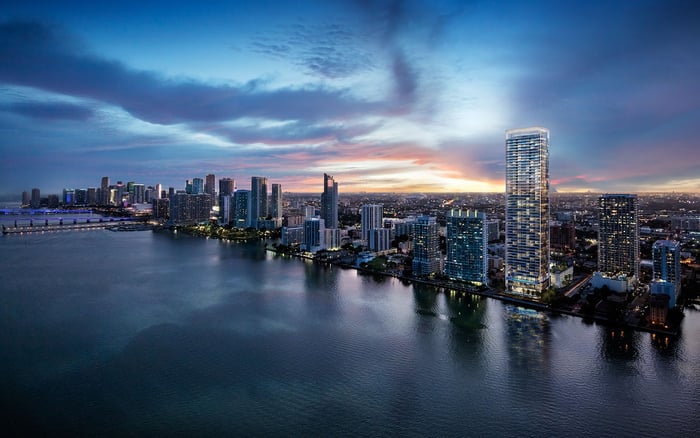
A buyer-oriented look at why school-morning exit performance may matter as much as design, amenities, and address prestige for families evaluating Midtown Miami residences in 2026.

For the luxury buyer considering Miami Design Residences Midtown Miami, the most revealing appointment may not be the sales gallery presentation, the sunset balcony visit, or the amenities tour. In 2026, the sharper test is a school-morning exit: how calmly a household moves from residence to lobby, from lobby to car, and from car to the first decisive turn toward the day.
This is not a minor operational detail. For families balancing private-school calendars, professional commitments, household staff, sports schedules, and social obligations, the first hour of the day can determine whether a residence feels elegant or merely impressive. A beautifully designed home that creates tension every weekday morning loses part of its value in lived experience.
Midtown Miami sits in a part of the city where buyers often weigh lifestyle energy against daily execution. The area appeals to those who want proximity to restaurants, design culture, Wynwood, Edgewater, Downtown, and Brickell without automatically defaulting to a traditional single-family neighborhood. That makes the school-morning question essential. The right buyer is not asking only whether the residence is central. The question is whether centrality converts into control.
Luxury real estate is often marketed through architecture, finish packages, views, and amenities. Those elements matter. Yet for a family with children, the building’s unseen choreography may matter just as much. Elevators, garage circulation, valet coordination, ride-share behavior, lobby staffing, and curb access all become part of the residence.
The buyer test should begin inside the unit. How many minutes does it take for a parent, child, backpack, sports bag, and possibly a stroller or pet to reach the ground level during the morning rush? Is the elevator experience calm, or does it become a daily negotiation with neighbors, service teams, deliveries, and other households leaving at the same time?
From there, the test moves to the parking level or pickup area. In a high-service building, the valet or garage sequence should feel composed even when demand rises. A family buyer should ask how the building handles stacked departures, guest vehicles, household staff arrivals, and package activity during the same window. These are not glamorous questions, but when answered well, they become unmistakably luxurious.
Midtown’s appeal is its ability to place the buyer between several Miami rhythms. Wynwood brings creative energy and dining. Edgewater offers a waterfront-adjacent residential pattern. Downtown provides access to the central business district and cultural venues. Brickell remains the financial and high-rise reference point for many international buyers.
For a school-morning household, that centrality is valuable only if the exit route is legible. A buyer should test more than one path, because the best route on paper may not be the best route with children in the car. Some households will prioritize the fastest departure. Others will prefer the smoothest, least stressful sequence, even if it is not the shortest.
The key is to evaluate the residence as part of a weekday map. Where does the car naturally point when leaving the building? How many conflict points appear before the household reaches a primary corridor? Are there predictable choke points around retail, loading areas, intersections, or construction activity? The buyer who answers those questions before purchase is buying with discipline, not anxiety.
A serious buyer should visit during the weekday window that mirrors the household’s actual routine. A quiet afternoon showing cannot reveal the same information. The test should feel practical and almost mundane: arrive early, walk the path from unit to exit if access allows, observe the lobby, watch vehicle movement, and note how the building team manages competing demands.
The most important observation is not whether there is any delay. In Miami, every urban neighborhood has moments of pressure. The real question is whether the delay feels managed. A composed building has staff who understand flow, residents who understand the rules, and physical spaces that do not turn every morning into improvisation.
Buyers should also compare the Midtown experience with the routines they would face in other target areas. Edgewater may offer a different relationship to waterfront living and north-south movement. Wynwood may trade residential calm for cultural immediacy. Downtown may feel more connected to business and civic destinations. Brickell may offer unmatched vertical luxury, but with its own morning intensity. The most sophisticated buyer does not choose the most fashionable location. The sophisticated buyer chooses the daily rhythm that fits the household.
For new-construction buyers, the school-morning test should be part of due diligence before emotional momentum takes over. Renderings can make a driveway look ceremonial. The weekday exit determines whether it performs.
Ask how many residential arrival and departure points exist. Ask whether the garage entry is shared with service access. Ask how deliveries, move-ins, ride-share pickups, and guest arrivals are separated from resident departures. Ask what happens when multiple families request vehicles at similar times. Ask whether bicycle, stroller, and pet movement intersects with the main lobby path.
The answers do not need to be dramatic. In fact, the best answers usually sound calm and specific. A building that has thought through morning pressure can describe the resident experience without resorting to vague promises. For family buyers, that clarity is a luxury feature.
A residence that lives well on a weekday can become easier to defend over time. Buyers with children are often highly sensitive to daily friction, and they tend to remember buildings that make life feel orderly. Even buyers without school-aged children may value the same operational intelligence because it suggests competent planning.
This is where the school-morning exit becomes more than a family issue. It becomes a proxy for the building’s overall discipline. If a residence handles the most compressed part of the day gracefully, it is more likely to feel refined across less demanding moments as well. The lobby will feel more intentional. The garage will feel less chaotic. The staff-resident relationship will feel more mature.
For Miami Design Residences Midtown Miami, the buyer test in 2026 should therefore be simple: do not evaluate the home only when the city is flattering. Evaluate it when the city is moving.
Why does the school-morning exit matter for luxury buyers? It reveals how the residence functions under real pressure, when elevators, parking, staff, children, and traffic all converge.
Should families test the route before making an offer? Yes. A weekday morning visit can reveal daily conditions that an afternoon tour will not show.
Is proximity to school enough? No. The route from unit to street, and then from street to the first major corridor, can matter as much as distance.
What should buyers observe in the lobby? Watch whether departures feel orderly, whether staff are proactive, and whether residents appear to move without confusion.
Is valet performance important? For many luxury households, yes. Valet or garage timing can define whether the morning feels calm or strained.
How should buyers compare Midtown with Brickell? Compare the full weekday routine, not just prestige or skyline presence, because each area has a different daily rhythm.
How should buyers compare Midtown with Edgewater? Look at both residential calm and route flexibility, especially if the household has a fixed school arrival time.
How should buyers compare Midtown with Wynwood? Consider whether cultural proximity outweighs any added complexity from restaurant, retail, or event-driven traffic patterns.
Does this matter for buyers without children? Yes. A building that handles morning pressure well often signals stronger operations for all residents.
What is the simplest buyer takeaway for 2026? Tour the residence when life is least polished, because that is when true livability becomes visible.
For a tailored shortlist and next-step guidance, connect with MILLION.
If branded residences are on your mind — as a home or as an allocation — we would be glad to share what we are seeing, privately.
Begin a quiet conversation