A practical luxury-buyer guide to evaluating Midtown Miami residences through the lens of hosting, guest arrivals, acoustics, terraces, parking, service flow and long-term fit.
A luxury residence for a frequent host should be evaluated differently from one designed primarily as a retreat. In Midtown Miami, the appeal is often immediate: energy, design adjacency, a lively urban rhythm and the possibility of a home that feels connected to the city without surrendering privacy. The harder question is whether the residence performs when guests arrive, linger and leave.
That performance is practical, not theoretical. It lives in elevator timing, acoustic separation, the ease of a rideshare drop-off, the friction of valet, the usefulness of a terrace after sunset and the way a kitchen supports conversation rather than separating the host from the room. Buyers should not tour only in polished midday conditions. They should pressure-test the building and the neighborhood during the same windows in which they actually entertain.
A serious Midtown search can begin with a residence such as Miami Design Residences Midtown Miami, but it should not end with the brochure experience. The question is not simply whether the building feels luxurious. It is whether it allows a host to receive six guests for cocktails, twelve for dinner or visiting family for a long weekend without operational fatigue.
The most revealing test is the arrival sequence. Visit at the hour your guests would arrive on a Thursday evening, a Friday night and a weekend brunch window. Watch how vehicles approach, whether the entrance feels intuitive, how protected guests feel from weather and how quickly a visitor can move from curb to lobby to residence.
For a buyer who entertains often, lobby glamour matters less than choreography. Is there a natural pause point for a guest who arrives early? Can multiple parties arrive at once without confusion? Does the front desk process feel discreet or performative? Can staff handle deliveries, florals, catering and guest access without turning the lobby into a staging area?
Parking deserves the same realism. If most guests will not drive, test rideshare pickup and departure. If they will drive, ask about guest parking protocol and observe whether the experience feels dignified. A residence can be visually exceptional and still fail the host if every dinner begins with apology texts about where to stop, wait or enter.
During the showing, resist the instinct to stand at the view line first. Instead, walk the residence as though guests are already there. Where do coats, bags and gifts go? Can someone enter without seeing directly into private spaces? Does the powder room location support entertaining, or does it send guests through a more intimate corridor?
The kitchen should be judged by social geometry. Some hosts want a show kitchen at the center of the evening. Others prefer concealed preparation and a quieter service rhythm. Neither is universally better. The correct answer depends on whether your entertaining style is chef-led, family-style, cocktail-forward or formal. In every case, the kitchen, dining area and principal living room should feel connected without becoming congested.
Acoustics are equally important. Clap softly, speak from different corners and stand near glass, bedrooms and corridors. Ask yourself whether music, conversation and service movement can coexist. Luxury is not only what guests see. It is what they do not hear: elevator noise, corridor traffic, mechanical hum, street intensity or the cleanup after midnight.
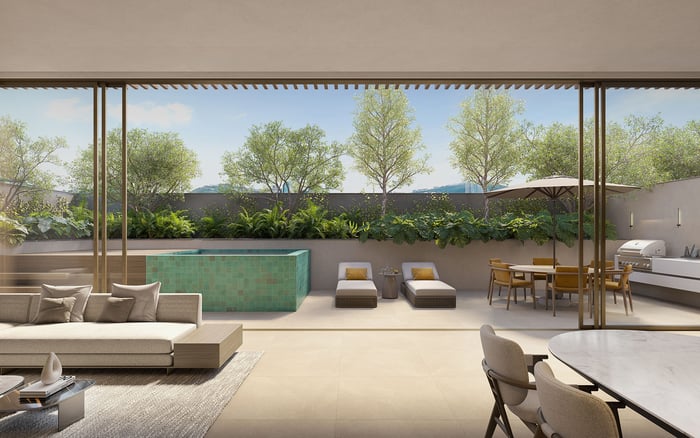
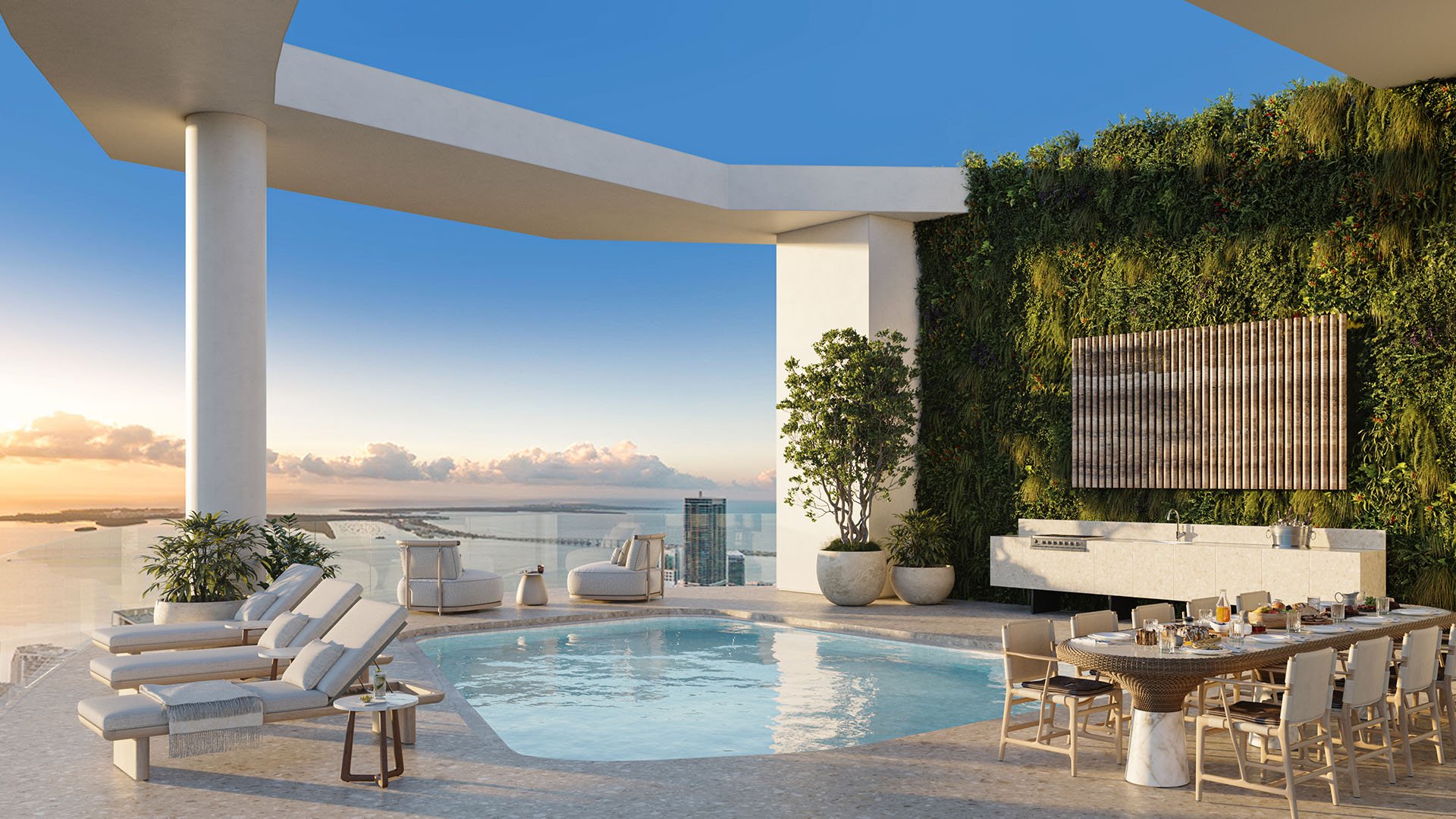
In Miami, outdoor space is often presented as a trophy. For entertainers, it must be tested as a room. Step outside at the hour you expect to use it. Consider wind, privacy, sound travel, lighting, furniture placement and whether the indoor and outdoor zones connect gracefully. A terrace that photographs well may still be too narrow, too exposed or too disconnected from the main hosting area.
Ask where a bar cart would sit, where guests would gather naturally and whether the door swing interrupts circulation. If outdoor dining is part of your lifestyle, measure the path between kitchen and table with the same seriousness you would bring to a formal dining room. If the terrace is primarily for after-dinner conversation, assess sightlines and seating rather than square footage alone.
Buyers comparing Midtown with Edgewater may want to tour Aria Reserve Miami or Villa Miami to calibrate how different waterfront and urban settings change the hosting mood. The goal is not to declare one neighborhood superior. It is to understand what kind of energy your guests will feel before they even reach the front door.
Frequent entertaining depends on rules as much as architecture. Before committing, review policies for guests, deliveries, caterers, amenity reservations, music, pets, elevator use and late-night access. A building may be perfectly suited for private living and still feel restrictive for a host who entertains several times a month.
Ask direct questions. Can a caterer use a service elevator? Is advance notice required for larger guest counts? Are there limits on amenity bookings? How are vendors screened? What is the procedure for deliveries on weekends? These details are not minor. They determine whether hosting feels effortless or administrative.
New-construction buyers should be especially attentive to how rules are expected to function once the building is fully occupied. Early presentations can be serene because usage is still hypothetical. The better lens is to imagine the building at full social volume, with residents booking amenities, guests arriving and staff managing simultaneous demands.
Midtown Miami should be tested not in isolation, but against the map of your life. Where do your guests come from? Where do you dine before or after hosting? How often do you continue the evening elsewhere? A residence that is ideal for one social circle may be inconvenient for another.
Wynwood, Downtown and Brickell each create a different hosting pattern. A Downtown option such as Waldorf Astoria Residences Downtown Miami may appeal to buyers who want a more vertical, skyline-oriented setting. A Brickell comparison such as 2200 Brickell may help clarify whether you prefer a more established financial-district cadence or Midtown’s more design-driven rhythm.
The important move is to rehearse the evening. Drive or ride from the places your guests actually frequent. Time the routes at realistic hours. Walk the final approach. Leave the building at the time your guests would leave. If the experience feels smooth three times in a row, that is meaningful. If it feels inconsistent, the residence must be exceptional enough to compensate.
There is a difference between a home that entertains beautifully and one that merely signals entertainment potential. Large rooms, dramatic views and glamorous amenity decks can create instant appeal, but frequent hosts need repeatable comfort. The best residence is one you can use often without feeling that every gathering requires a production team.
Think about resale through that same lens. Future buyers may also value flexible living areas, privacy for overnight guests, strong storage, intuitive access and a building culture that supports social use without chaos. These qualities are quieter than finishes, but they tend to matter deeply to sophisticated buyers.
Pressure-testing Midtown before purchase is ultimately an act of self-knowledge. If your ideal evening is intimate, design-forward and city-connected, Midtown may align beautifully. If your entertaining depends on extreme privacy, estate-like arrivals or a more resort-driven atmosphere, the test may lead you elsewhere. Either result is a success if it prevents a beautiful residence from becoming the wrong stage.
How many times should I visit Midtown before buying? Visit during the specific windows when you expect to host, including an evening, a weekend and a departure time.
What is the first entertaining detail buyers usually overlook? Guest arrival logistics are often underestimated. The curb, lobby, elevator and access protocol shape the first impression.
Should I prioritize a large terrace? Prioritize usable outdoor space over size alone. Wind, privacy, furniture layout and indoor connection matter more than a number.
How should I evaluate noise? Visit at active hours, stand in bedrooms and living areas, and listen for corridor, street, mechanical and neighboring-unit sound.
Are amenities important for frequent hosts? Yes, but only if reservation rules, guest policies and staffing make them genuinely usable for your entertaining style.
Should I compare Midtown with other neighborhoods? Yes. Edgewater, Downtown, Brickell and Wynwood comparisons can clarify whether Midtown matches your social rhythm.
What should I ask about caterers and vendors? Ask about service elevators, delivery windows, insurance requirements, loading access and advance notice for outside vendors.
Does new construction always work better for entertaining? Not automatically. The layout, rules, staffing model and building culture matter as much as the age of the property.
How do I know if a floor plan is host-friendly? Look for intuitive circulation, a well-placed powder room, privacy for bedrooms and a kitchen that suits your hosting style.
What is the clearest sign a residence is wrong for entertaining? If arrival, access or noise feels stressful during a realistic test visit, the issue may repeat every time you host.
When you're ready to tour or underwrite the options, connect with MILLION.
If branded residences are on your mind — as a home or as an allocation — we would be glad to share what we are seeing, privately.
Begin a quiet conversation