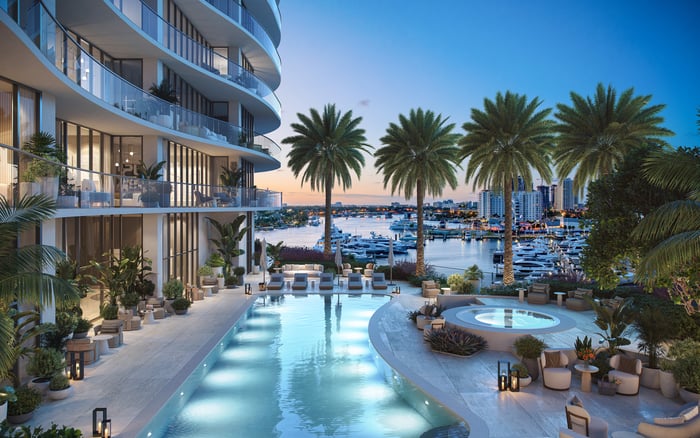
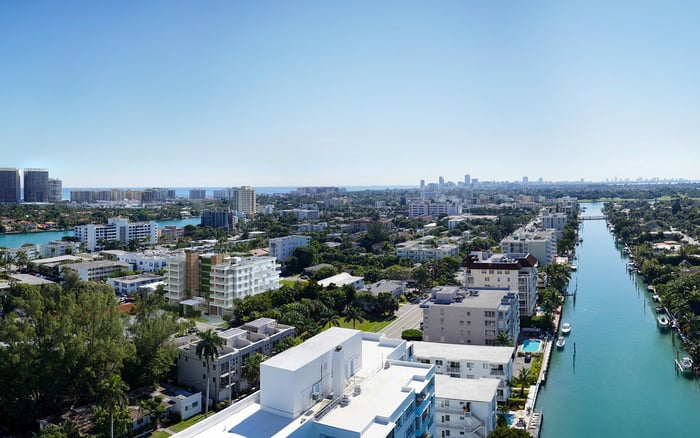
South Florida’s estate-scale wedding weekend has evolved into a private, multi-day live-in format: welcome cocktails, ceremony, after-party, and next-day brunch, all protected by tight access control and concierge-level logistics. For luxury real estate buyers, these gatherings reveal what truly matters in an event-capable residence: acreage or setback for privacy, indoor-outdoor flow, on-site lodging, staging zones for vendors, and security infrastructure that feels invisible to guests. This guide outlines the estate features that make a wedding weekend seamless, the operating realities behind the scenes, and how Miami Beach’s new generation of branded residences is reshaping where elevated celebrations begin and end.
The modern ultra-luxury wedding in South Florida is increasingly a residency, not a single night. The expectation is a 3-to-4-day arc: arrivals, welcome cocktails, the ceremony and reception, an after-party, then a morning-after brunch with enough time for genuine connection. In this format, a property is no longer just a backdrop. It operates as a small, temporary resort - and it has to perform flawlessly.
That shift matters for buyers. Whether you plan to host family milestones or simply want a home that can handle large-format entertaining, the criteria are the same: the site must preserve privacy, the architecture must move guests intuitively, and the operational plan must be embedded into the property rather than improvised.
An event-capable luxury estate is defined less by one headline feature and more by how multiple systems work together.
First is land and separation. Some Florida estates are marketed as fully fenced, 15-acre environments with multiple residences, a spring-fed lake, and multiple event spaces designed for multi-day, onsite celebrations. That physical scale delivers what smaller lots rarely can: distance from neighbors, clearer perimeter control, and the ability to keep production well away from guest areas.
Second is multi-structure programming. The strongest wedding-weekend properties treat each building or zone as a distinct chapter: a welcome pavilion, a main lawn or waterfront edge for the ceremony, a reception hall or covered terrace, and a late-night space that can run without disrupting sleeping guests.
Third is overnight capacity. A true weekend is far easier when a meaningful portion of the guest list - or at least immediate family - can stay onsite. Some estates build this into multiple cottages and suites, while others rely on an eight-bedroom main house plus nearby luxury inventory for overflow.
For MILLION Luxury clients, the aesthetic is assumed. What separates an effortless weekend from a stressful one is what you don’t see.
If arrivals stack, the entire weekend tightens. Event-ready homes need a clear, guest-facing arrival that reads like a resort porte-cochère, plus a separate service entry for vendors. Parking isn’t glamorous, but it’s decisive. When a property can’t accommodate cars or shuttles without spilling into neighboring streets, the event becomes a negotiation from the first car door.
Large celebrations require staging zones: catering prep, rentals, lighting, florals, and staff breaks. The most functional estates provide hidden hardscape areas or secondary driveways where trucks can unload without crossing guest paths.
Event-rental ecosystems continue to expand, and production has become more sophisticated. Estates that anticipate tenting, power distribution, and equipment storage reduce friction - and often protect the landscape from last-minute compromises.
South Florida entertaining is outdoor-first, but a wedding weekend needs a Plan B that still reads as intentional. Covered terraces, large interior rooms with tall ceilings, and multiple indoor-outdoor transitions matter more than a single grand space. The goal is continuity: guests should feel the party moved, not that it was salvaged.
If the home sits close to other residences, sound becomes the silent limiter. Larger parcels, water edges, and mature landscaping can help, but the most reliable solution is distance - paired with thoughtful placement of late-night spaces.
High-net-worth hosts are increasingly balancing physical and cyber risk. The baseline now includes controlled access points, credentialed staff, and privacy management that extends to devices and networks. The ideal is invisibility: guests experience warmth and hospitality while the perimeter stays firm.
The market now openly recognizes the tier of “ultra-luxury wedding” at $500,000+ excluding rings and honeymoon. At that level, the estate carries a heavier burden. The property needs not only beauty, but throughput: bathrooms, electrical capacity, kitchen adjacency, and staff circulation.
Venue economics can vary widely - which is another way of saying the pricing model you see is rarely the full operational picture. For buyers considering hosting as part of their lifestyle, or exploring event use where permissible, the sharper question isn’t “How much does it cost?” It’s “What does the property let me do without friction?”
South Florida offers a spectrum of estates that illustrate the wedding-weekend model.
In Coconut Grove, Villa Woodbine is a 1931 Mediterranean-Renaissance estate associated with architect Walter de Garmo and is commonly marketed with wedding pricing that starts around the mid-thousands and rises with seasonality. The appeal is historic character and garden-forward ambience; the operational win is clarity of layout - outdoor ceremony potential paired with interiors that read as classical and composed.
For a more expansive private-lifestyle approach, Villa Toscana Miami is marketed as a Tuscan-inspired estate on 4.5 acres, accommodating up to 200 guests and offering an eight-bedroom mansion for overnight stays. Venue-fee ranges are presented as date- and season-dependent, and its catering is described through tiered per-guest menus with premium upgrades. The takeaway for buyers isn’t the menu. It’s the blueprint: acreage, a defined capacity concept, and the ability to keep key people onsite.
On the waterfront side, Thalatta Estate in Palmetto Bay is widely known as a Mediterranean Revival-style venue on Biscayne Bay, with pricing that varies by day of week. That structure reflects a broader truth: weekend formats concentrate demand, and properties that can flex with multi-day programming tend to command the most attention.
Further north and inland, properties between major metros have leaned into the full “compound” model. Some advertise lodging for dozens of guests across multiple cottages and suites, with venue pricing that varies by season and day, plus tiered bar packages. This is the closest analog to a private resort: a controlled environment where the weekend doesn’t depend on outside movement.
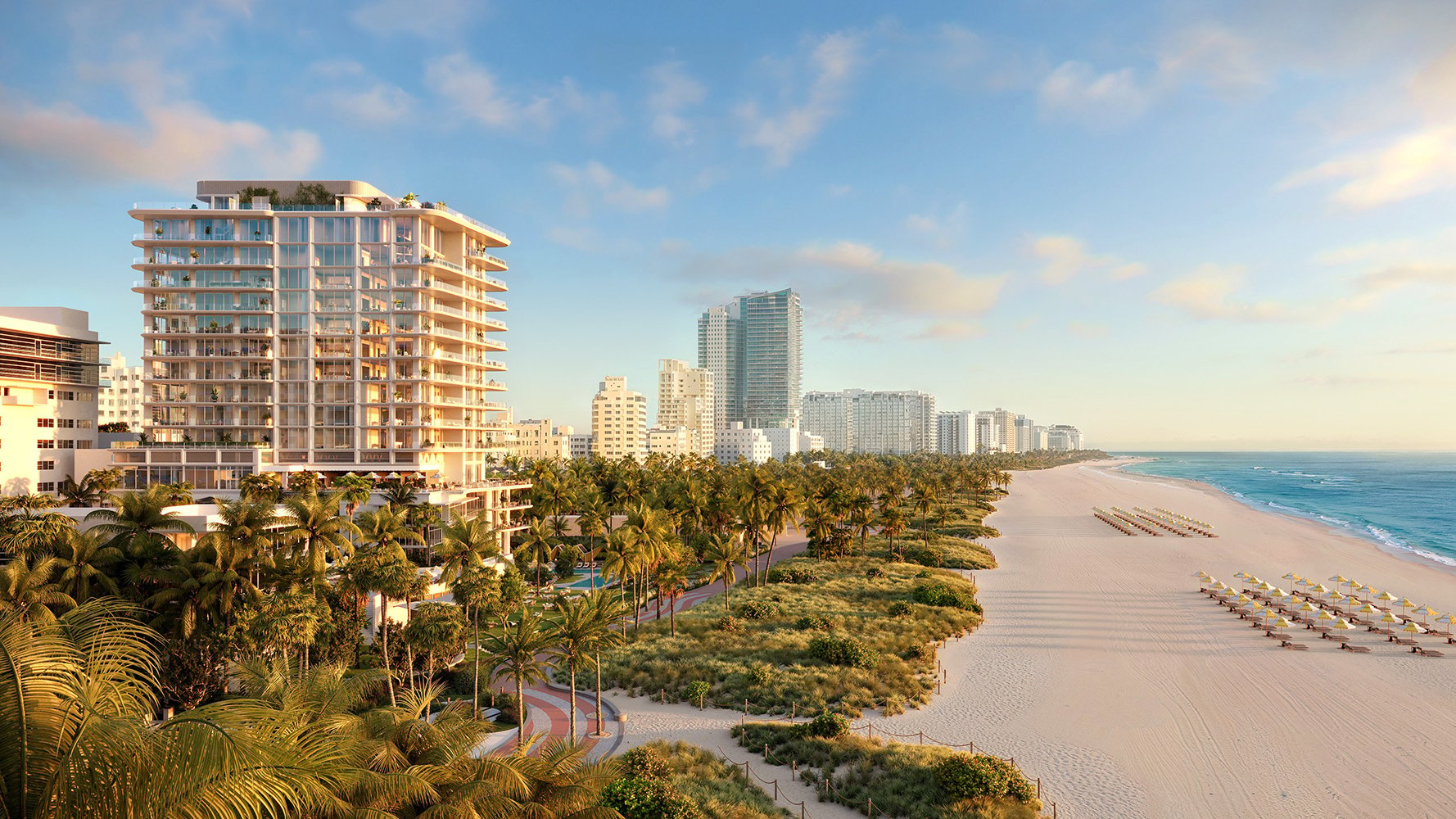
Not every host wants a sprawling compound, and not every guest wants to sleep onsite. That’s where Miami Beach has quietly become a sophisticated bridge between privacy and convenience.
A well-located luxury residence can serve as the core suite for the couple and immediate family, anchoring fittings, private dinners, and the decompression window after the celebration. In that role, branded condominiums aren’t “venues” as much as they are the command center.
For buyers focused on Miami Beach, Faena House Miami Beach offers the kind of privacy-forward positioning and service ecosystem that can support a multi-day itinerary without turning your personal space into a production site.
For a more contemporary, design-led base with a strong sense of arrival, Five Park Miami Beach fits the moment: close enough to the energy of the Beach to entertain, yet oriented toward a calmer residential cadence when the weekend ends.
For clients who prefer hospitality DNA with a quieter, more controlled rhythm, Setai Residences Miami Beach can function as the pre-wedding retreat and post-wedding refuge, especially for families who prioritize service and discretion.
And for those who want a fresh, private-collection approach, Shore Club Private Collections Miami Beach underscores a growing preference: residences that feel personal, but operate with professional-grade support when the calendar fills.
Miami has no shortage of mansions advertised for hourly or short-stay use, and “rent the house, host the weekend” can sound straightforward. In practice, event capability is uneven. House rules, permits, neighborhood restrictions, staffing access, and logistics can all dictate what’s actually possible.
For buyers, this matters in two directions. If you’re purchasing with entertaining in mind, validate the property’s operational flexibility early. If you’re simply trying to avoid disruption, remember that not every large house is automatically a viable event site - and enforcement and compliance can vary by micro-market.
A wedding weekend is a stress test, but the upgrades that make it work also elevate daily living.
The best properties aren’t the loudest. They’re the ones that can carry a thousand moving parts - and still feel like home on Monday morning.
What is a wedding weekend in luxury terms? A multi-day celebration that typically includes a welcome event, wedding day, and next-day brunch, often spanning 3 to 4 days.
How much space does an estate need to host a wedding weekend well? Enough land and separation to manage arrivals, staging, and sound without impacting neighbors or guest privacy.
Is on-site lodging essential for the wedding-weekend format? It is not mandatory, but it materially improves the experience by reducing transportation and keeping key guests close.
What is the biggest operational mistake hosts make at private estates? Underestimating back-of-house needs like vendor staging, service circulation, and parking logistics.
How should buyers think about indoor-outdoor flow for events? Look for multiple transitions and covered options so weather changes do not collapse the plan.
Are waterfront estates automatically better venues? They can be extraordinary, but they also require careful planning for wind, access, and sound management.
What budget range qualifies as an ultra-luxury wedding? A commonly used definition is $500,000+ excluding rings and honeymoon.
Do branded condos in Miami Beach replace estate venues? Not usually; they work best as a private home base for preparation, family hosting, and post-event recovery.
What security upgrades matter most for high-profile gatherings? Controlled access, credentialed staff, and strong privacy practices for both physical spaces and networks.
Can any large home be used for a wedding weekend? Not necessarily; rules, permits, neighborhood constraints, and site logistics determine what is truly feasible.
For a confidential assessment and a building-by-building shortlist, connect with MILLION Luxury.
If branded residences are on your mind — as a home or as an allocation — we would be glad to share what we are seeing, privately.
Begin a quiet conversation