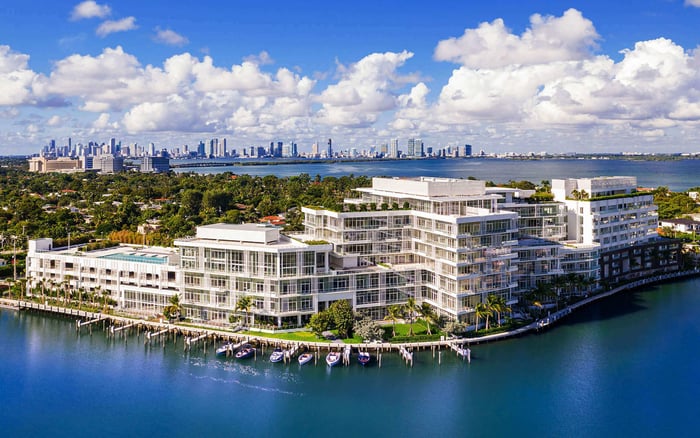
A buyer-focused guide to the ownership issues that matter at The Surf Club Four Seasons Surfside before contract review, from governance and branded services to access, costs and coastal condominium risk.
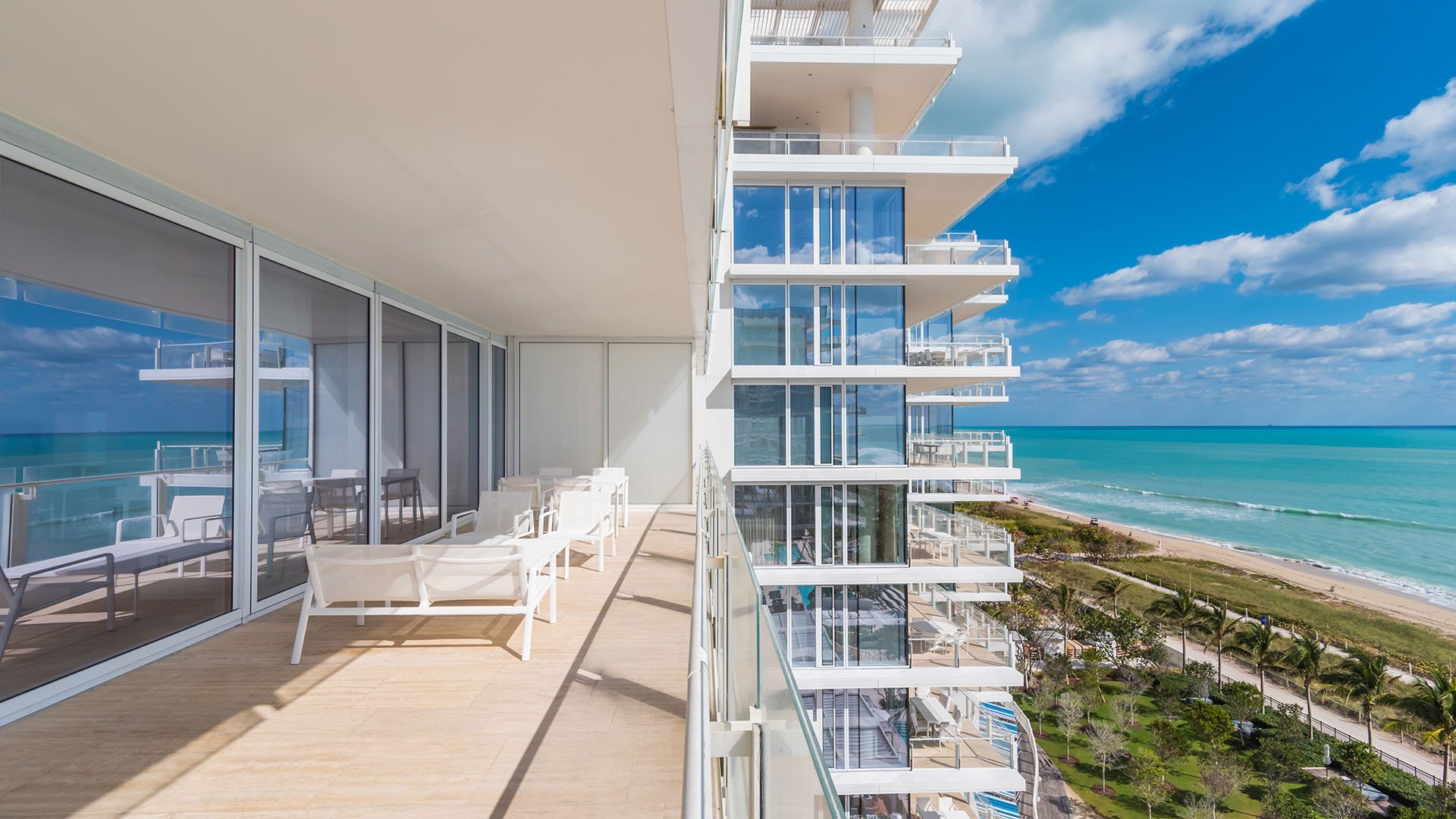
The Surf Club Four Seasons Surfside is not best understood as a conventional condominium with a celebrated address. It is a layered ownership environment where The Surf Club legacy, Four Seasons hospitality, oceanfront real estate and condominium-style ownership converge in one of Miami-Dade’s most discreet coastal municipalities. That combination is precisely what makes the property compelling, and precisely why pre-contract diligence matters.
The property sits in Surfside, between Miami Beach and Bal Harbour, in a corridor where privacy, beach access and long-term scarcity shape buyer psychology. The original Surf Club began as an exclusive oceanfront social club in the 1930s, and that historic identity remains central to the property’s appeal. The modern redevelopment preserved that sense of place while adding a contemporary residential and hospitality program anchored by Four Seasons.
For buyers, the first question should not be limited to price, view or interior finish. It should be: what exactly does ownership include, exclude, control and obligate over time? That question belongs at the center of any serious contract review.
Before counsel begins negotiating contract language, a buyer should understand how the property is organized across condominium, hotel, club and common-area components. The Surf Club’s value proposition depends on the interaction of those pieces. The legal and financial obligations may not sit neatly within a single association line item.
A proper ownership map should identify who controls the residential associations, who governs hospitality operations, who controls club-related spaces and who bears responsibility for shared infrastructure. The issue is not whether the experience feels seamless. The issue is whether the documents clearly allocate rights, costs and decision-making authority among owners, hotel interests, club-related interests and branded-service structures.
This is where many ultra-luxury buyers can be lulled by architecture and service. The more refined the arrival experience, the easier it becomes to overlook the underlying governance. At a property shaped by heritage and hospitality, document-level review is not administrative housekeeping. It is the foundation of ownership clarity.
Four Seasons is central to the contemporary Surf Club experience. For many buyers, that brand relationship helps explain the appeal: service culture, operational consistency and a standard of hospitality that feels more private resort than typical condominium. But in branded residences, the brand is not merely aesthetic. It can affect operations, service expectations, recurring charges and the way amenities are delivered.
A buyer should ask which services are included, which are optional, which are subject to separate charges and how standards may change over time. The documents should clarify whether service obligations are tied to residential ownership, hotel operations, association rules or separate branded-service agreements. If the service platform changes in cost, scope or control, owners should understand how those changes are approved and funded.
This same discipline applies when reviewing other South Florida branded or hospitality-linked projects, from Four Seasons Hotel & Private Residences Fort Lauderdale to Four Seasons Residences Coconut Grove. The brand may elevate the lifestyle, but the ownership documents define the economics.
The Surf Club’s historic and lifestyle narrative is club-oriented. That makes access rules especially important. Buyers should review how residents, hotel guests, club participants, visitors, family members, staff and service providers use the property. Privacy at this level is not just a mood. It is a governed condition.
Key questions include who may use particular amenities, whether access is transferable with ownership, how guests are handled, how private events are regulated and whether any facilities are shared with hotel or club-related users. If a buyer is purchasing for discretion, the rules around access may matter as much as the floor plan.
The most elegant buildings in Surfside share this emphasis on controlled arrival, coastal calm and a cultivated residential rhythm. Buyers evaluating Arte Surfside, Fendi Château Residences Surfside or The Delmore Surfside should bring the same eye to rules, restrictions and long-term control, even where the ownership structure differs.
At the high end of the market, the headline acquisition price rarely tells the full story. At a hybrid oceanfront property, recurring ownership costs deserve a granular review. Buyers should examine association assessments, branded-service charges, insurance exposure, reserve obligations and shared-facility expenses.
The important issue is not whether costs are high or low in isolation. It is whether they are predictable, clearly allocated and aligned with the buyer’s expectations for service and control. Shared infrastructure can create obligations that extend beyond the residential tower itself. Branded services can introduce additional costs tied to the service model. Club facilities can raise questions about use, maintenance and financial responsibility.
A sophisticated buyer should request a clear explanation of what is paid to the association, what is paid through any branded-service structure, what is reserved for future work and what costs may be passed through by separate components. This is where careful review can distinguish disciplined luxury operations from open-ended exposure.
Oceanfront ownership in Florida carries its own long-term considerations. Because the property is condominium-based and coastal, buyers should consider structural-safety compliance, insurance volatility, reserve obligations and the possibility of future capital projects. None of these considerations diminishes the appeal of the setting. They simply belong in the ownership model.
Insurance is particularly important in any oceanfront building. Buyers should understand what the association covers, what the unit owner must insure separately, how deductibles are allocated and whether special assessments could arise from future capital needs. Reserves should be reviewed not as a generic budget line, but as a signal of long-term planning.
This is also why a buyer should avoid reducing The Surf Club to a simple condo-hotel label or a conventional condominium comparison. The ownership experience is shaped by residence, hospitality, club identity and common-area complexity. Each layer has to be reviewed on its own terms.
Before contract review, a buyer should have answers to several practical questions. What property components are residential, hotel, club-related or shared? Who controls each component? What rights does a unit owner actually receive? What rights are excluded? Which services are mandatory, optional or separately charged? How are shared expenses allocated? What rules govern access, guests, leasing, pets, events and service providers? What insurance, reserve and capital project exposure could affect future carrying costs?
This is the core of buyer’s guide work at the ultra-premium level: translating beauty into ownership clarity. At The Surf Club, the romance of the place is real. So is the need for precision. The best buyers will admire the setting, respect the history and then read the documents with unusual care.
Is The Surf Club Four Seasons Surfside a conventional condominium? No. Buyers should treat it as more complex because it blends condominium-style ownership with branded hospitality, club identity and shared property components.
Why does the Four Seasons relationship matter to ownership? The brand relationship can influence operations, service expectations, costs and the way certain services are delivered to owners.
What should buyers review before contract negotiation? Buyers should first understand how the property is organized among residential, hotel, club and common-area components.
Why are club access rules important? The Surf Club’s appeal is tied to privacy and a club-style lifestyle, so guest access, amenity use and service rules can directly affect daily living.
What recurring costs deserve the closest attention? Association assessments, branded-service charges, insurance exposure, reserves and shared-facility expenses should all be reviewed carefully.
Does oceanfront ownership add risk? Yes. Coastal condominium ownership can involve insurance volatility, structural-safety compliance, reserve planning and future capital projects.
Should architecture and service level drive the decision? They matter, but they should not replace document-level review of governance, restrictions, control rights and long-term obligations.
What is the most important buyer question? The key question is what ownership includes, excludes, controls and obligates over time.
Are Surfside comparables useful? They can help frame lifestyle and location expectations, but each building’s legal structure and cost allocation must be reviewed separately.
When should counsel become involved? Counsel should be involved after the buyer understands the ownership map, so contract review can focus on the right governance and cost issues.
For a discreet conversation and a curated building-by-building shortlist, connect with MILLION.
If branded residences are on your mind — as a home or as an allocation — we would be glad to share what we are seeing, privately.
Begin a quiet conversation