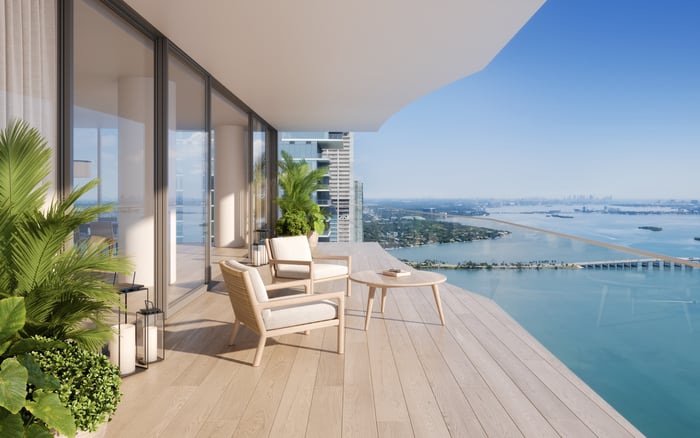
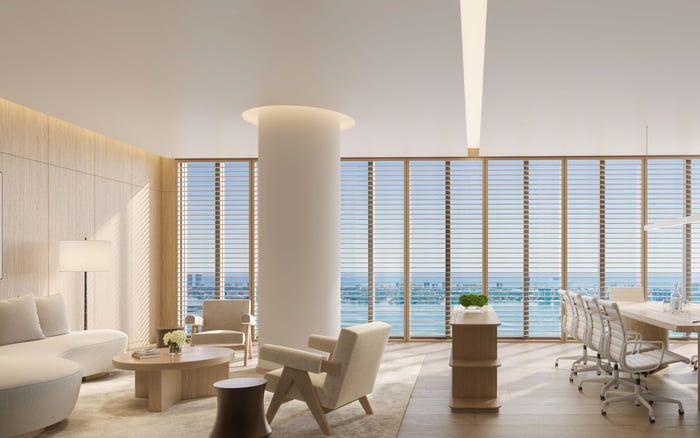
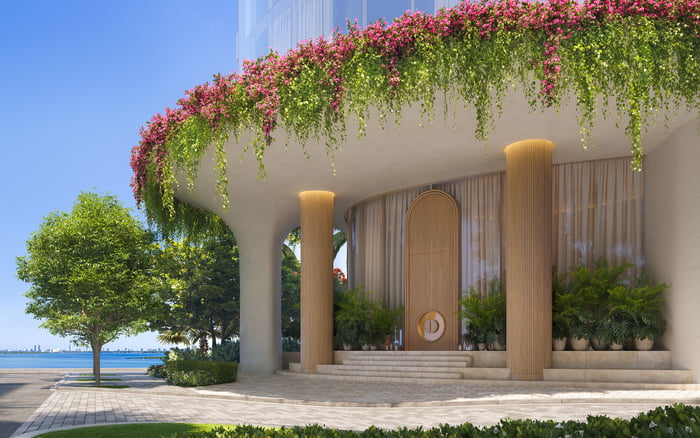
A buyer-focused look at EDITION Edgewater through privacy, arrival sequence, and resident circulation, with emphasis on how operational luxury shapes daily life in Miami’s Edgewater market.
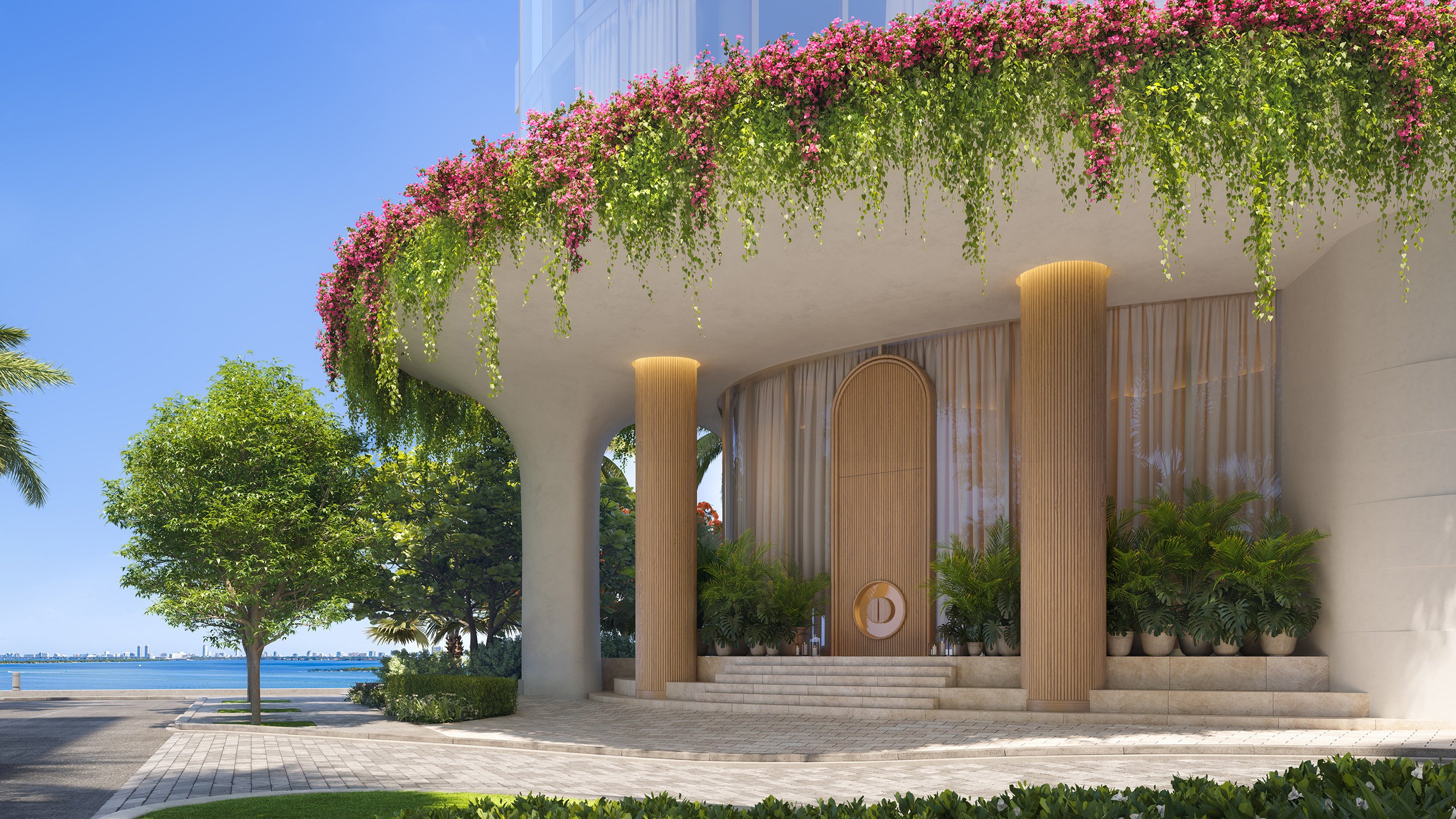
In Miami’s Edgewater market, luxury is no longer measured only by skyline presence, branded interiors, or the scale of an amenity deck. For sophisticated buyers, the more revealing question is how a building performs once life begins inside it. Privacy, arrival sequence, and resident flow are not secondary details at EDITION Edgewater. They are central to the residential proposition.
That distinction matters in an urban waterfront setting, where daily movement intersects with traffic, visitors, deliveries, service staff, amenity use, and the constant rhythm of the city. The best buildings do more than appear composed from the outside. They help residents feel composed as they move from the street to the elevator, from shared spaces to private interiors, and from public-facing moments to a more protected domestic life.
For buyers considering EDITION Edgewater, the useful lens is a curb-to-couch journey. The phrase matters because it shifts attention from isolated features to lived experience. How does a resident arrive? How quickly does the city fall away? How visible is daily life to others? How intuitive is the path from exterior approach to private residence? In that sequence, operational luxury becomes as meaningful as visual luxury.
The resident journey begins before the lobby. In Edgewater, the approach to a tower can carry the tension of the neighborhood around it: Biscayne Bay proximity, dense high-rise living, busy streets, and the social visibility that comes with prime Miami addresses. Arrival planning has to absorb that context and create a controlled transition.
At its best, the arrival sequence feels choreographed without feeling theatrical. A resident should understand where to go, how to move, and when the experience becomes private. This is not merely about grandeur. It is about reducing uncertainty. Clear movement from curb to entry is a form of comfort, particularly for owners who value discretion as much as architecture.
That is why the comparison set in Edgewater is increasingly evaluated through function as well as form. Projects such as Aria Reserve Miami and Villa Miami sit within the same broader conversation about high-rise waterfront living near Biscayne Bay, where arrival and circulation are integral to the value of the residence. EDITION Edgewater belongs in this buyer conversation because it invites scrutiny of the resident journey, not just the exterior image.
Privacy in a condominium is often misunderstood as a static attribute, as if it were created only by square footage, high floors, or architectural separation. In practice, privacy is produced by a sequence of decisions: how residents are routed, how shared spaces are organized, how service interactions are managed, and how congestion is minimized during ordinary daily use.
That distinction is important for EDITION Edgewater buyers. The privacy question is not simply whether a residence feels secluded once the door closes. It is whether the building reduces exposure along the way. The most desirable experience shields residents from unnecessary friction, repeated public encounters, and unclear circulation. A calm route can be as valuable as a dramatic view.
This is the difference between visible luxury and operational luxury. Visible luxury photographs well. Operational luxury reveals itself over months of use. It is found in the ease of returning home, the predictability of moving through the property, and the sense that the building supports discretion without asking the resident to manage it personally.
Edgewater’s appeal is tied to its urban energy and bayfront adjacency. That combination creates a specific challenge for residential design. Buyers want proximity, water-view expectations, and the vertical lifestyle of Miami, but they also want retreat. The building must reconcile exposure and privacy, movement and calm, access and separation.
In lower-density settings, privacy can be created through land, gates, setbacks, or distance. In Edgewater, it has to be designed into the resident experience. This makes circulation more than a technical topic. It becomes a measure of how well the building understands the neighborhood around it.
The same principle applies across the area’s evolving luxury field. The Cove Residences Edgewater reflects the broader focus on waterfront high-rise living, while EDITION Edgewater sharpens the conversation around how residents move within that environment. For new-construction and pre-construction buyers, the question is not only what is promised on a sales floor. It is whether the daily choreography will still feel refined after the novelty fades.
The lobby is not just a room. It is the psychological threshold between the city and the residence. In a well-considered building, this threshold should slow the pace without creating delay. It should provide orientation without spectacle. Most importantly, it should make residents feel that the public realm has ended and the private residential realm has begun.
Elevator movement is part of the same story. Without relying on unsupported technical claims, buyers can still evaluate the feeling of vertical circulation. Does the path appear intuitive? Are residents and guests likely to move predictably? Are amenity destinations reached without creating unnecessary cross-traffic? These are practical questions, but in the ultra-premium market, practical questions often separate the merely impressive from the genuinely livable.
Amenity access also tests a building’s operational discipline. A large amenity program can be appealing, but if residents experience congestion, ambiguity, or excessive visibility while moving through the property, the sense of privacy weakens. The ideal is not isolation. It is controlled sociability, with the ability to participate in the life of the building without surrendering discretion.
A buyer evaluating EDITION Edgewater should ask to understand the resident journey in sequence. Begin with the exterior approach, then follow the arrival, lobby transition, elevator movement, amenity access, and path to the private residence. This is more revealing than asking only about finishes or amenity names.
The goal is to see whether the experience has a clear logic. A strong building minimizes decision fatigue. It tells residents where to go without overexplaining itself. It anticipates moments of overlap and reduces the probability that daily life feels congested. It recognizes that discretion is not a decorative feature. It is an outcome created by design, routing, service, and operations working together.
This ultra-modern approach to buyer evaluation is becoming more common across South Florida. In Brickell, towers such as The Residences at 1428 Brickell also attract buyers who consider the relationship between architecture and daily function. In Edgewater, that scrutiny is amplified by the neighborhood’s urban density and bayfront desirability.
The strongest case for EDITION Edgewater is not simply that it participates in Miami’s branded, high-design residential moment. It is that the project can be read through a more mature definition of luxury. Privacy is not only what happens behind the residence door. Arrival is not only a first impression. Resident flow is not only a technical concern.
Together, these elements determine how life feels every day. They affect whether a home feels effortless, whether the building protects time, and whether the transition from Miami’s energy to private residence feels smooth. For the buyer who already understands views, finishes, and location, this is where the deeper value conversation begins.
Why is privacy so important at EDITION Edgewater? Privacy is central because urban waterfront living requires protection from congestion, exposure, and daily-life friction.
What does curb-to-couch mean for buyers? It means evaluating the full resident path from street arrival to the private residence, not just individual amenities.
How should buyers assess the arrival sequence? Buyers should look for a calm, legible transition from curb to entry, with minimal confusion and unnecessary exposure.
Is resident flow the same as elevator performance? No. Elevator movement is one component, but resident flow also includes lobby transition, amenity access, and internal routing.
Why does Edgewater make circulation more valuable? Edgewater combines density, bayfront appeal, and urban movement, so a building’s internal calm becomes especially meaningful.
What is operational luxury? Operational luxury is the ease, discretion, and predictability a resident experiences in daily use, beyond visible design features.
Should amenity size be the main focus? Not alone. Buyers should consider whether amenity access feels private, intuitive, and free from excessive congestion.
How does privacy differ from exclusivity? Exclusivity is often about access, while privacy is about how effectively the building shields everyday life.
What should buyers ask during a presentation? Ask to walk through the resident journey from exterior approach to residence, including lobby, vertical movement, and amenities.
Is EDITION Edgewater best understood as a lifestyle purchase? Yes, but the lifestyle should be judged by daily function as much as brand presence, design, and location.
If you'd like a private walkthrough and a curated shortlist, connect with MILLION.
If branded residences are on your mind — as a home or as an allocation — we would be glad to share what we are seeing, privately.
Begin a quiet conversation