A buyer-focused guide to evaluating primary-bath privacy at EDITION Edgewater before committing to a pre-construction contract, from sightlines and acoustics to plan clarifications and contract language.
At EDITION Edgewater, the primary bath is not merely a finish package or a lifestyle image. For a serious buyer, it is a spatial condition that should be tested before a pre-construction contract is signed. In a glassy high-rise environment, privacy is shaped by the tower, the unit line, the core, surrounding buildings, the glazing strategy, and the internal bathroom configuration.
That is why a primary-bath review should begin well before a buyer is choosing stone tones or hardware. The question is not only whether the room feels serene in a rendering. The sharper question is whether the bath can be used comfortably, quietly, and discreetly once the residence exists within the real geometry of Edgewater.
This is especially important in new-construction, where many buyers make decisions from marketing floor plans, key plans, elevations, sections, and specification documents. Those materials can reveal a great deal when read carefully. They can also leave critical issues unresolved unless the buyer asks precise questions before contract.
A floor plan may show a generous primary suite, a sculptural tub, a long vanity, or a glass-walled shower. Privacy, however, depends on how that plan sits within the larger building. Buyers should examine the unit line, the location of the elevator and service core, the position of adjacent residences, and the way the tower massing relates to nearby properties.
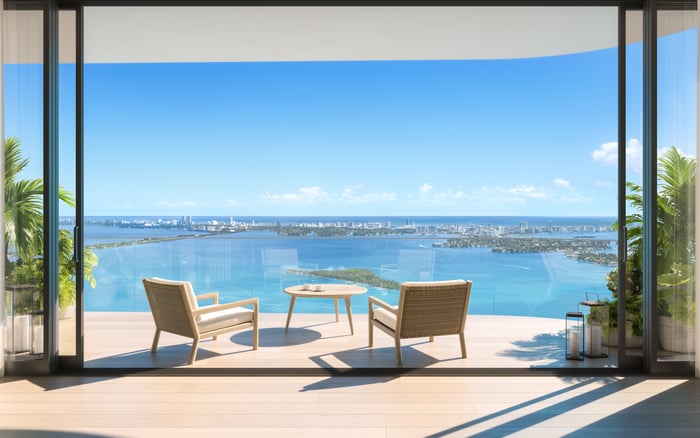
In Edgewater, a water view can be both a luxury and a privacy variable. A bath that faces the bay or skyline may feel exceptional on paper, but the tub, shower, or vanity may also align with another tower, a neighboring balcony, an amenity deck, or a future development site. The more glass and openness a bath offers, the more carefully the sightline should be tested.
The same logic applies to high floors. Elevation can improve privacy, but it does not automatically eliminate exposure. Upper-level bathrooms may still face other towers, angled balconies, or distant yet direct lines of sight. Privacy is not measured by height alone. It is measured by orientation, distance, angle, glazing, and future context.
A disciplined buyer should ask what the primary bath sees-and what can see into it. That means studying the key plan and elevation together, then comparing the residence exposure against surrounding towers, public-facing edges, amenity zones, and neighboring balconies.
The review should include both obvious and less obvious sources of visibility. Adjacent buildings matter, but so do building corridors, service areas, elevator approaches, pool decks, outdoor lounges, and angled views from other units within the same tower. A beautiful corner condition may still require scrutiny if bathroom glass, a freestanding tub, or a vanity mirror creates unintended exposure.
Future conditions deserve equal attention. Privacy today may not be the same privacy tomorrow if nearby parcels are developed. A current view corridor can narrow over time. Buyers do not need to predict every future building, but they should avoid assuming that an open exposure will remain permanently open unless that condition is supported by durable site realities.
Primary-bath privacy is also an internal planning issue. A luxury residence may entertain elegantly yet still create awkward exposure if the primary bath door opens toward a bedroom seating area, dressing zone, hallway, living room, or guest circulation path.
One practical test is simple: can the bathroom be used comfortably with the door open? Not as a habit, but as a diagnostic. If the open door reveals the shower, tub, vanity, or toilet area from the bed, living space, dining area, or a corridor used by guests or staff, the layout deserves closer review.
Buyers should also study mirror placement. A mirror can extend a sightline, turning what appears private on the plan into a reflected view from another room. Glass shower enclosures, backlit vanity walls, and reflective stone can add elegance, but they can also intensify visibility if not planned with discretion.
Visual privacy is only half the issue. Acoustic privacy can affect daily comfort just as much. Buyers should consider whether voices, water noise, ventilation sounds, and plumbing sounds may carry from the primary bath into the bedroom, dressing area, or social zones.
This is particularly relevant when the bath is placed close to entertaining areas or when a suite relies on open transitions between sleeping, dressing, and bathing spaces. A calm-looking plan may still allow sound to travel. The relationships among wet walls, ventilation routes, door type, wall assemblies, and adjacent rooms all matter.
The aim is not to demand silence. It is to understand whether the primary bath performs with the level of discretion expected in a refined Edgewater residence. In a luxury context, comfort is often defined by what guests do not see and what household members do not hear.
Because bathroom layouts are difficult to alter after closing, the buyer should treat unresolved privacy concerns as pre-contract matters. Plumbing stacks, vent shafts, wet-wall locations, slab conditions, and building systems can limit future redesign. Moving a tub, shower, toilet, or vanity after delivery may be costly, restricted, or impractical.
Before contract, buyers should request clarity on the exact plan version, unit line, exposure, glazing condition, bathroom configuration, and any available elevations or sections that explain the bath’s relationship to the tower and neighboring conditions. If privacy depends on a screen, shade, film, finish selection, door swing, or partition, that should be addressed before assumptions become expensive.
The most sophisticated buyers translate concerns into written clarifications. That may include plan notes, finish confirmations, privacy-related options, or contract language where appropriate. A verbal reassurance is less useful than a specific answer tied to the residence being purchased.
A strong review moves from macro to micro. First, understand the building context: tower massing, nearby towers, amenity placement, and likely future development around the exposure. Next, understand the residence: unit line, orientation, balcony relationships, core proximity, and corridor access. Finally, study the primary bath itself: door placement, glass, tub location, shower orientation, mirrors, vanity sightlines, toilet compartment, acoustic adjacency, and wet-wall constraints.
For EDITION Edgewater, that layered approach is especially valuable because the project sits in a market where water, skyline, glass, and vertical proximity all shape the lived experience. Edgewater rewards buyers who look beyond the rendering and ask how the space will actually perform at 7 a.m., after dinner guests leave, and years after neighboring parcels evolve.
The best outcome is not necessarily the most enclosed bath. It is the bath whose openness is intentional, whose exposure is understood, and whose privacy can be managed without compromising the architecture. In that sense, primary-bath privacy is not anti-design. It is part of good design.
Why evaluate primary-bath privacy before contract? Once a pre-construction contract is signed, layout changes may be limited by plumbing, venting, and wet-wall locations.
Is a bay-facing primary bath always more private? Not always. A bay or skyline exposure can still face another tower, balcony, amenity deck, or future development site.
What documents should buyers review? Buyers should review marketing floor plans, key plans, elevations, sections, and developer specification documents where available.
What exterior sightlines matter most? Check nearby towers, neighboring units, balconies, public-facing exposures, service areas, corridors, elevators, and amenity decks.
Can high floors solve privacy concerns? High floors may help, but privacy still depends on angles, neighboring buildings, glazing, and future development conditions.
What internal sightline should be tested first? Test whether the bath can be used with the door open without exposure to living, dining, guest, or circulation areas.
Does acoustic privacy matter in a primary bath? Yes. Voices, water noise, ventilation, and plumbing sounds can affect the comfort of the primary suite and nearby social spaces.
Can bathroom layouts be changed after closing? Sometimes, but plumbing stacks, vent shafts, wet walls, and building rules often make major changes difficult.
What should buyers ask the sales team to clarify? Ask for the exact plan version, exposure, glazing condition, bathroom configuration, and any privacy-related options or limitations.
How can buyers make privacy concerns actionable? Convert concerns into written clarifications, plan notes, finish confirmations, privacy-related options, or contract language where appropriate.
For a confidential assessment and a building-by-building shortlist, connect with MILLION.
If branded residences are on your mind — as a home or as an allocation — we would be glad to share what we are seeing, privately.
Begin a quiet conversation