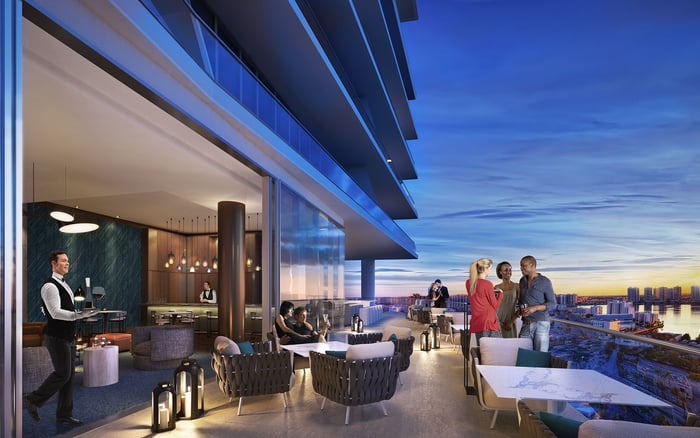
A discreet buyer’s guide to reading past amenity language and testing whether private, resort-style spaces can hold their composure during South Florida’s winter high season.
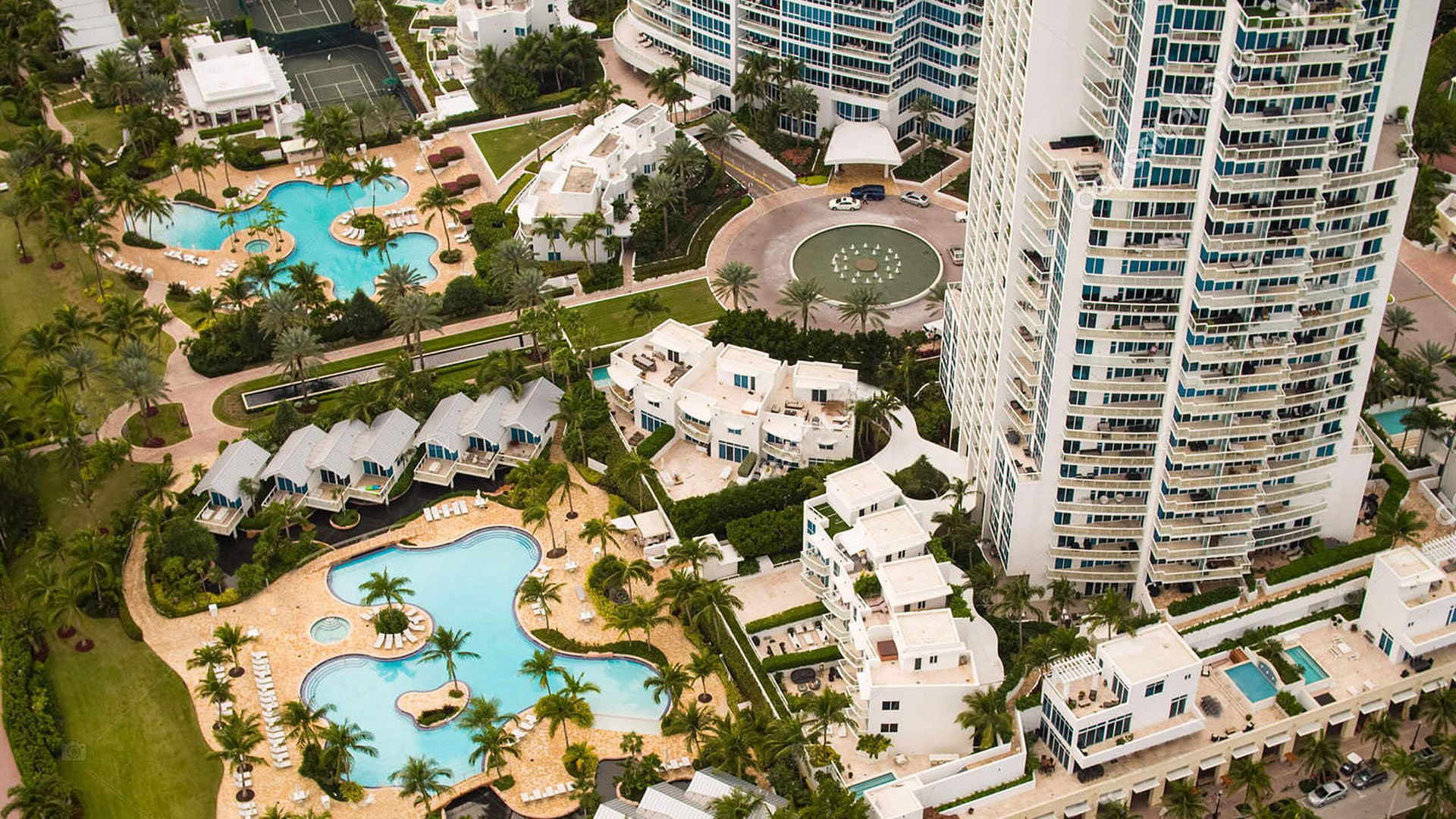
In South Florida luxury real estate, amenities are often presented as atmosphere: a quiet pool deck, a composed lobby, a beach service team that appears before one asks, a spa corridor with the hush of a private club. The images persuade because they show the property at its most cinematic. The buyer’s task is to determine whether that serenity survives high season.
Marketing theater is not always deception. More often, it is selective framing. A terrace photographed on a still weekday morning may be beautiful and accurate, yet not especially revealing. The real question is what happens when seasonal residents arrive, families visit, guests request cabanas, elevators fill, valet comes under pressure, and the concierge desk becomes the building’s operating center.
For a primary home, this matters daily. For a second home, it may matter even more, because the owner’s time in residence often overlaps with the most crowded weeks of the year. The amenity promise should not be judged by whether it exists. It should be judged by whether it performs.
Words such as “exclusive,” “private,” “resort-style,” “residents-only,” and “uncrowded” should prompt questions, not comfort. In a luxury context, privacy is operational. It depends on access rules, guest limits, staffing, design, scheduling, and enforcement. A building may have remarkable spaces and still feel crowded if the ratio of users to amenities is poorly managed.
Before becoming attached to a sales gallery narrative, ask what each term means in practice. Does “private beach service” mean a controlled stretch, a managed setup, or staff assistance near a public shoreline? Does “resort-style pool” mean generous lounging space, or a smaller deck animated by excellent photography? Does “wellness level” refer to true daily functionality, or to a collection of rooms that require reservations at the same peak times?
Buyers comparing Miami Beach residences such as The Perigon Miami Beach should think less about adjectives and more about use patterns. Who can enter, when they can enter, how many guests may accompany them, and how conflicts are resolved are the questions that determine whether the lifestyle feels private in February, not merely in a brochure.
Pool decks are the clearest place to identify theater. The word pool may sound simple, but in high-season luxury living it includes chair inventory, shade, towel service, food and beverage logistics, family patterns, lap swimming expectations, cabana policies, and guest privileges. A beautiful waterline is only one part of the experience.
During review, ask whether chairs are first-come, assigned, reservable, or attended. Ask how long a chair can remain unused before staff may release it. Ask whether guests are capped by unit, household, day, or event. If the property allows private gatherings on the deck, ask how that affects ordinary residents. The most refined buildings tend to make these rules feel invisible, but the rules still exist.
A quiet off-season tour may conceal friction points. Visit when residents are likely to be present. Observe whether staff are anticipatory or reactive. Notice whether conversations carry across the deck, whether children’s areas are separated from adult areas, and whether shade is available without negotiation. Luxury is not the absence of people. It is the absence of scramble.
Beach access is one of the most emotionally powerful phrases in the coastal market, and one of the easiest to overread. The buyer should separate proximity, access, service, and control. A residence may be close to the sand, may provide service on the sand, may have a managed path to the beach, or may offer a more limited convenience. These are not interchangeable experiences.
For oceanfront and near-ocean properties, request the exact rules that govern beach setups, guest usage, storage, staffing hours, and seasonal adjustments. Ask what happens on holiday weekends and during winter weeks when the building is heavily occupied. If a claim relies on a neighboring facility, hotel component, club, or outside operator, understand the agreement rather than the adjective.
In Bal Harbour, buyers evaluating Rivage Bal Harbour or comparable coastal addresses should treat the beach program as a service system. The difference between elegant and congested can be a matter of timing, staffing, and enforceable boundaries.
Amenity crowding often begins with guests. A building can be appropriately scaled for owners, then strained by generous guest privileges. This does not make the policy wrong, but it must match the buyer’s expectations. Some owners welcome a social environment. Others are purchasing sanctuary.
Ask for the written rules on family guests, accompanied guests, unaccompanied guests, renters, short-term visitors, holiday restrictions, and event usage. Clarify whether guest counts vary by amenity. A fitness center may have one policy, a pool deck another, and a residents’ lounge a third. The most important detail is not only what is allowed, but who enforces it and how consistently.
In Brickell, where high-rise living often layers work, entertainment, dining, and waterfront expectations into a vertical lifestyle, buyers considering St. Regis® Residences Brickell should look closely at how the building distinguishes residents, guests, staff, service providers, and any affiliated uses. Separation is part of quiet luxury.
South Florida’s best amenity programs are not merely designed. They are choreographed. The experience depends on service corridors, storage, staff training, elevator logic, arrival sequencing, maintenance access, and the ability to reset spaces quickly after peak use. None of this is as photogenic as a sunset terrace, but it is often what preserves the atmosphere.
Ask who manages each amenity and whether standards are embedded in condominium documents, association rules, service agreements, or internal operating procedures. Ask whether staffing levels change seasonally. Ask how maintenance is scheduled to avoid resident disruption. Ask whether the property has quiet hours, adult hours, children’s policies, pet rules, and protocols for private events.
At a Sunny Isles address such as The Ritz-Carlton Residences® Sunny Isles, the brand language may be compelling, but a sophisticated buyer still verifies the mechanics. Service culture is valuable when it is supported by governance, staffing, and clear resident rights.
The brochure tells you the aspiration. The condominium documents, association rules, developer disclosures, budgets, and management materials tell you the operating reality. Read them together. If the marketing language implies privacy but the documents allow broad guest access, the documents matter. If the renderings suggest abundant amenity use but the rules require advance reservations, the rules matter.
Pay particular attention to shared-use arrangements, hotel components, club relationships, commercial spaces, marina access, restaurant access, and event rights. These structures can be excellent when clearly governed. They can also create ambiguity if the buyer assumes residential priority without seeing it in writing.
A strong question is simple: “Where is that right stated?” If a sales representative describes preferential access, dedicated service, priority reservations, or resident exclusivity, ask where the promise appears in the documents. Refined buyers are not adversarial. They are precise.
A curated tour usually begins in the most flattering sequence. To understand crowding, change the sequence. Arrive at a busy time. Sit in the lobby longer than expected. Watch the valet rhythm. Listen near the elevators. Walk amenity corridors without rushing. Ask to see secondary spaces, not only the signature rooms. Notice whether staff know residents by name, or whether the atmosphere feels transient.
If possible, speak with current residents in a manner that is respectful and discreet. Ask what feels different in high season. Ask which spaces become difficult to use. Ask whether rules are enforced evenly. The most useful answers are often specific but not dramatic: chairs are scarce after a certain hour, the gym is best before breakfast, guest weekends feel different, or the spa is easier to book midweek.
This is not about finding a flawless building. Every desirable address has peak moments. The goal is to know whether those moments are managed with grace.
The first red flag is vagueness. If every answer returns to mood language and no one can explain policy, capacity, or enforcement, the buyer should slow down. The second is overdependence on renderings. Renderings can communicate design intent, but they cannot prove operational comfort.
The third is a mismatch between price and governance. Ultra-premium pricing should be accompanied by ultra-clear rules. The fourth is amenity sprawl without service clarity. More rooms do not necessarily mean a better lifestyle if each room competes for the same staff, reservation platform, or resident demand.
The fifth is reluctance to discuss high season directly. In South Florida, high season is not an exception. It is part of the ownership experience. A building that performs beautifully in peak weeks has earned its promise.
What is marketing theater in amenity language? It is presentation that emphasizes atmosphere while leaving practical questions about access, crowding, and service unanswered.
Is a crowded amenity deck always a problem? Not necessarily. The issue is whether the building manages demand in a way that still feels orderly, fair, and residential.
Which documents should buyers review? Review condominium documents, association rules, disclosures, budgets, management policies, and any shared-use agreements.
How can I test pool crowding before buying? Visit during likely peak periods, ask about chair rules, and learn how guests, cabanas, towels, and food service are managed.
Why do guest policies matter so much? Guests can materially change the feel of amenities, especially during holidays, school breaks, and winter high season.
Are branded residences automatically better at managing crowding? A brand may signal service ambition, but the buyer still needs to verify rules, staffing, governance, and resident priority.
What should I ask about beach service? Ask who controls setup, where service is provided, when staff are present, and how guests are handled during peak weeks.
Can reservation systems solve crowding? They can help, but only if rules are clear, enforcement is consistent, and residents accept the tradeoff between access and order.
Should second-home buyers be more cautious? Yes. Their visits often coincide with the busiest weeks, so the high-season experience may define the value of ownership.
What is the best way to shortlist comparable options for touring? Start with location fit, delivery status, and daily lifestyle priorities, then compare stacks and elevations to validate views and privacy.
For a confidential assessment and a building-by-building shortlist, connect with MILLION.
If branded residences are on your mind — as a home or as an allocation — we would be glad to share what we are seeing, privately.
Begin a quiet conversation