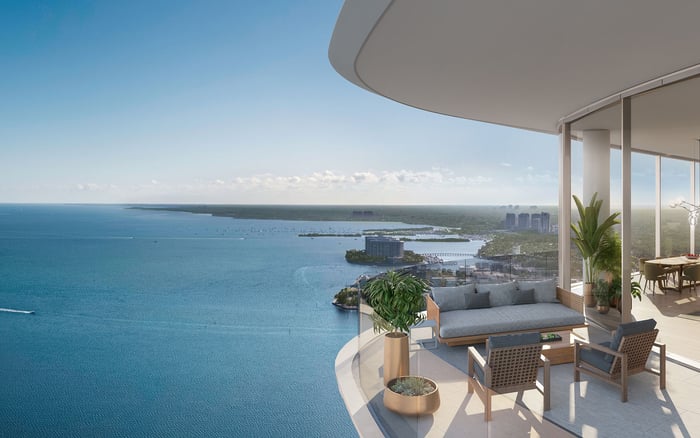
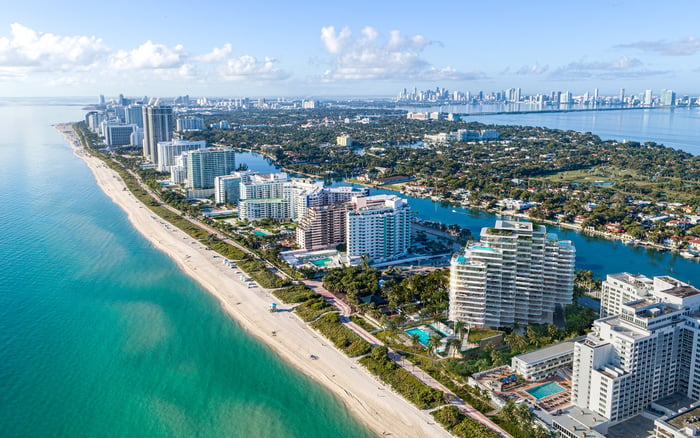
A refined buyer’s guide to evaluating luxury residential pool decks across South Florida, focusing on privacy, wind, shade, and the social character that shapes daily life.
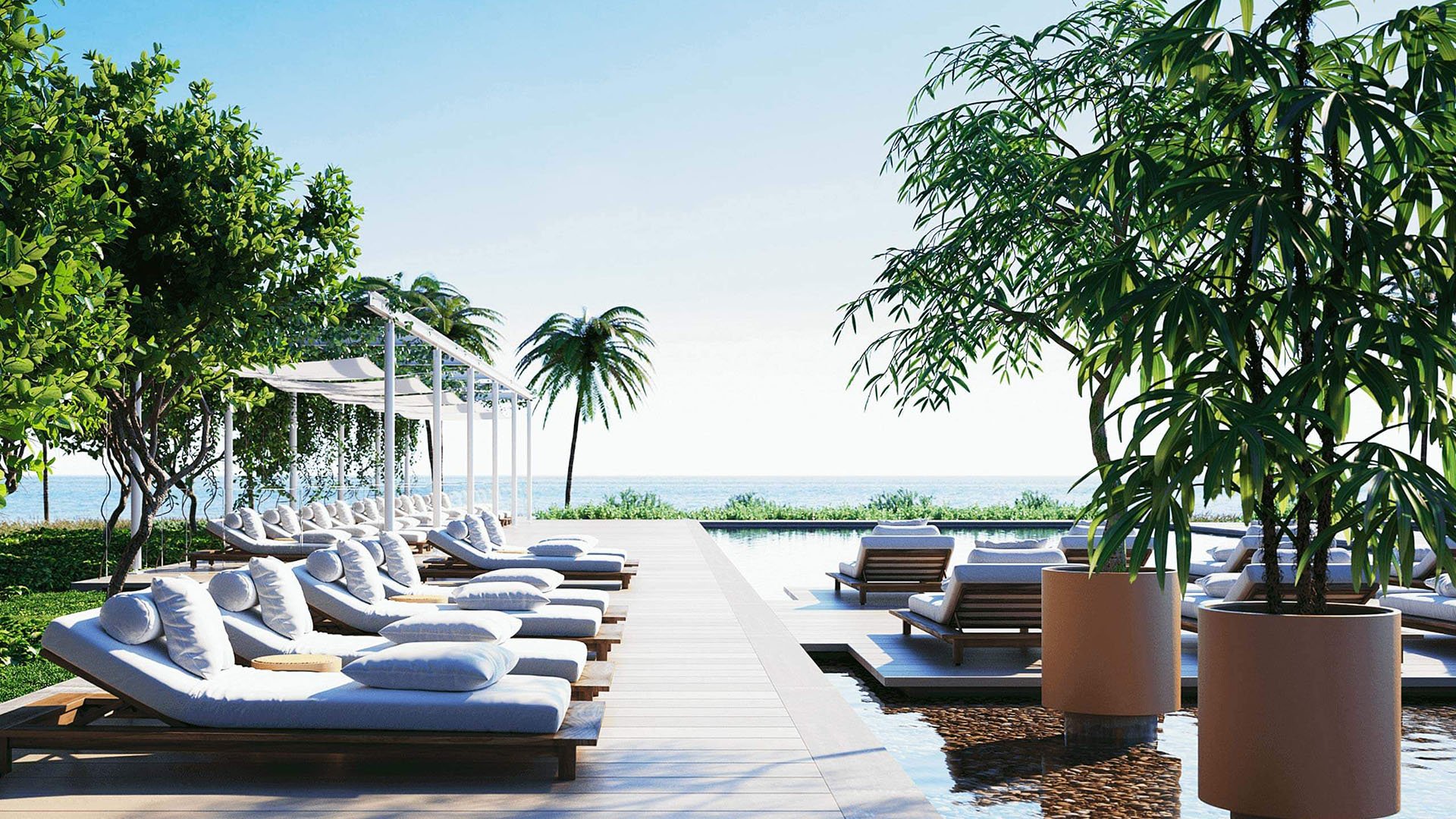
In South Florida luxury real estate, the pool deck is often treated as a visual amenity: turquoise water, sculptural loungers, palms, perhaps a horizon line beyond the glass rail. For a serious buyer, that is only the opening image. The more useful question is how the deck behaves when the building is full, the afternoon sun shifts, the breeze moves through the site, and residents settle into their routines.
A strong pool deck is part architecture, part hospitality, part microclimate. It can make a residence feel more private, more resort-like, more social, or more restorative. The right comparison is not simply which deck is larger or more photogenic. It is which deck aligns with the way you live: morning laps, quiet reading, weekend guests, sunset cocktails, family time, or a discreet retreat from the city below.
When touring residences such as 57 Ocean Miami Beach, the most valuable exercise is to slow down. Stand in multiple locations, not only at the pool edge. Sit where you would actually sit. Look back toward the tower. Listen. Notice whether the deck feels protected, exposed, ceremonial, or communal. That sensory reading often reveals more than a brochure can.
Privacy on a pool deck is rarely about total isolation. In a condominium or branded residence, it is more often about controlled visibility. The question is not whether anyone can see the deck. The question is who can see it, from where, and how constantly.
Begin with sightlines from surrounding towers, neighboring balconies, restaurant terraces, sidewalks, bridges, and marina edges. A deck may feel private at ground level yet exposed from adjacent residences. Conversely, a rooftop or elevated deck may enjoy distance but still feel visually open if planting zones, shade structures, or cabanas do not create layers.
Access is just as important. Does the path to the pool pass through a busy lobby sequence, a wellness area, or a quieter resident-only corridor? Are loungers placed directly along circulation routes, or are there protected pockets away from movement? A private deck is often defined by thresholds: a gate, a garden transition, a change in paving, a shaded passage, or the subtle separation between active and calm zones.
Cabanas, palms, screens, and low walls can all improve privacy, but only when they are positioned with intent. A row of cabanas facing the wrong direction may create little comfort. A narrow planting bed can do more if it breaks the line of sight from a neighboring structure. For buyers, the clearest test is simple: sit in the most desirable chair and ask, “Who is looking at me, and how often?”
Wind is one of the most underestimated variables in South Florida pool design. A breeze can be delightful in August, but persistent wind can make a pool deck feel restless, noisy, or difficult to use. On oceanfront, bayfront, riverfront, and high-elevation decks, the issue is not whether wind exists. It is whether the deck has been composed to make wind livable.
Look for clues. Are umbrellas substantial or frequently closed? Are cushions secured? Do towels stay in place? Are dining tables positioned in calmer zones, or placed where gusts move through corners? Do palms and planting soften exposure, or are they purely decorative? Wind comfort often reveals itself in small operational details.
At urban waterfront residences such as Aria Reserve Miami, buyers should pay particular attention to how open air, tower orientation, and deck zoning interact. A pool facing a dramatic view may be visually seductive, but the most usable chair might be set back, partially screened, or tucked beside a planted edge.
The best time to test wind is not only during a scheduled tour on a perfect day. If possible, return at different hours. Morning, late afternoon, and post-storm conditions can all feel different. Ask where residents tend to sit when it is breezy. The answer may tell you which parts of the deck are truly loved.
Shade is not a static amenity. It is a moving asset, shaped by the sun path, tower shadow, pergolas, umbrellas, palms, neighboring buildings, and glare from water or pale paving. A pool deck that feels graceful at 10 a.m. may become intense by 2 p.m. A shaded lounge that looks secondary in photographs may be the most valuable seat on the property.
The first question is personal: when will you use the deck? A full-time resident who swims at 7 a.m. has different needs from a second-home owner who hosts late lunches. A family with children may value shaded shallow areas, while a wellness-focused buyer may prioritize a calm morning lane and a cool recovery lounge.
Study the relationship between pool, terrace, and vertical shade. Deep overhangs, trellises, covered outdoor rooms, and mature planting can extend use without making the environment feel enclosed. Movable umbrellas offer flexibility, but they are not a substitute for architectural shade if wind limits their use.
In Miami Beach settings such as The Perigon Miami Beach, the balance between sun, view, and shelter is especially important. Buyers often focus on the waterline, but the real luxury may be a shaded seat with a partial view, a breeze that does not overwhelm, and enough distance from the most photographed part of the deck.
Every pool deck has a social temperature. Some are hushed and residential. Some feel club-like, with visible arrivals and a sense of occasion. Others are family-friendly, resort-driven, or arranged for entertaining. None is inherently better. The key is alignment.
In Brickell, a buyer considering a vertical urban lifestyle at Una Residences Brickell may evaluate the pool deck differently than a buyer seeking a quieter beach or garden setting. The city itself can contribute energy: skyline views, evening light, nearby dining, and a more dressed rhythm of use. That can be a benefit if you want sociability close at hand. It can be a drawback if your ideal pool day is silent and hidden.
Observe seating geometry. Chaise lounges in long rows encourage visibility. Smaller clusters support conversation. Daybeds suggest lingering. Dining tables bring a more social cadence. A lap pool separated from the main lounge can protect wellness routines from weekend activity. A children’s area near the center of the deck creates a different soundscape than one set discreetly to the side.
Ask about guest policies, towel service, food and beverage expectations, and reservation customs without treating them as minor details. These rules shape the culture of the deck. A beautifully designed environment can feel very different depending on whether it operates like a private garden, a resort terrace, or a social club.
A disciplined tour should compare four categories: privacy, wind, shade, and social energy. Give each a simple rating from one to five, but write down the reason behind the score. “Private” is too vague. “Protected from neighboring balconies on the north side, exposed near the main spa” is useful.
For privacy, note sightlines, access paths, cabana placement, planting depth, and whether seating feels too close to circulation. For wind, observe corners, umbrella use, furniture weight, planting movement, and where staff naturally place towels or cushions. For shade, record the hour of your visit and identify which seats will be comfortable later in the day. For social energy, listen to the soundtrack: voices, music, children, service movement, city noise, and water features.
Also compare the deck to your private outdoor space. A generous balcony may reduce your need for a quiet pool retreat. A smaller residence may make the communal deck more important to daily life. Oceanfront buyers may prioritize serenity and salt-air openness, while downtown buyers may embrace a more animated, skyline-oriented experience.
The most sophisticated buyers do not ask, “Is the pool deck impressive?” They ask, “Will I actually use it, and at what times?” That question turns an amenity tour into a lifestyle decision.
South Florida’s pool decks are not interchangeable. Beachfront decks, bayfront decks, riverfront terraces, garden decks, and urban rooftops each carry their own atmosphere. The deck should be read in relation to its neighborhood, not in isolation.
A Pompano Beach residence such as The Ritz-Carlton Residences® Pompano Beach invites a different comparison from a Brickell tower or a Miami Beach address. One buyer may prize a quieter coastal rhythm. Another may want the energy of a denser urban setting. A third may want the middle ground: water, service, privacy, and enough social life to feel animated without becoming performative.
This is where the pool deck becomes a proxy for the building’s personality. Architecture, operations, resident mix, and neighborhood all meet at the water’s edge. Choose the deck that feels natural to your daily rituals, not simply the one that photographs best.
What is the first thing to check on a luxury pool deck? Start with privacy and sightlines. Sit in the best chairs and look outward, inward, and upward.
How can I judge wind during a short tour? Watch umbrellas, towels, palms, and corners. Ask which seating areas residents prefer on breezy days.
Is a rooftop pool always better for views? Not necessarily. A rooftop may offer drama, but comfort depends on wind, shade, access, and layout.
What makes a pool deck feel private? Layered planting, thoughtful cabana placement, controlled access, and protected seating zones all help.
How important is shade in South Florida? Very important. Evaluate shade at the hour you expect to use the deck most often.
Should I prioritize a lap pool or a social pool? Choose based on routine. Fitness-focused buyers may value separation from lounge and guest areas.
Can a lively pool deck hurt daily enjoyment? It can if you prefer quiet. Social energy should match your lifestyle, not just impress guests.
Do guest policies matter when comparing decks? Yes. Guest rules, reservations, and service customs strongly influence the pool deck’s character.
How does a private balcony affect the pool decision? A strong private outdoor space may reduce reliance on the pool deck for quiet relaxation.
What is the best overall pool deck? The best deck is the one you will use often, comfortably, and without compromising your preferred rhythm.
If you'd like a private walkthrough and a curated shortlist, connect with MILLION.
If branded residences are on your mind — as a home or as an allocation — we would be glad to share what we are seeing, privately.
Begin a quiet conversation