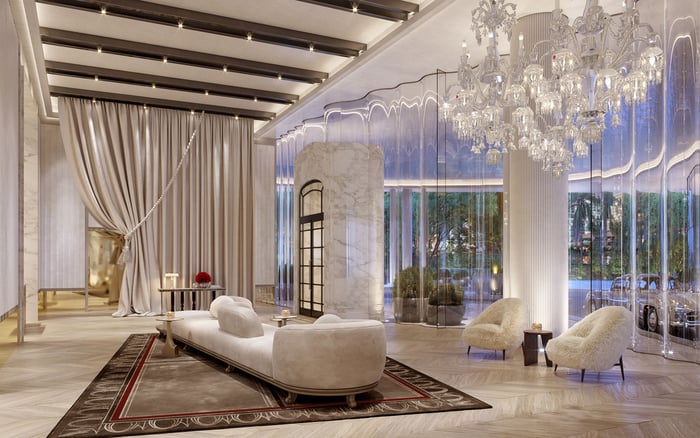
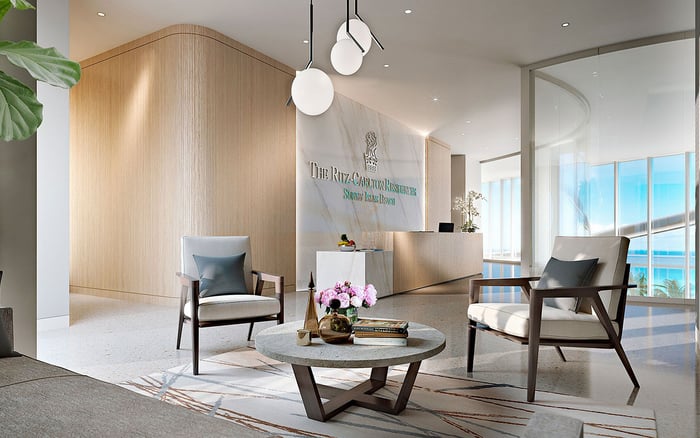
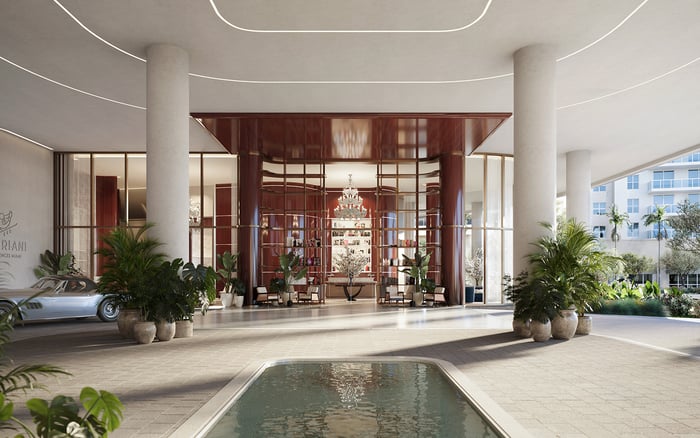
A buyer-focused guide to reading lobby volume as a practical signal of privacy, arrival rhythm, daily comfort, and design discipline across South Florida settings.
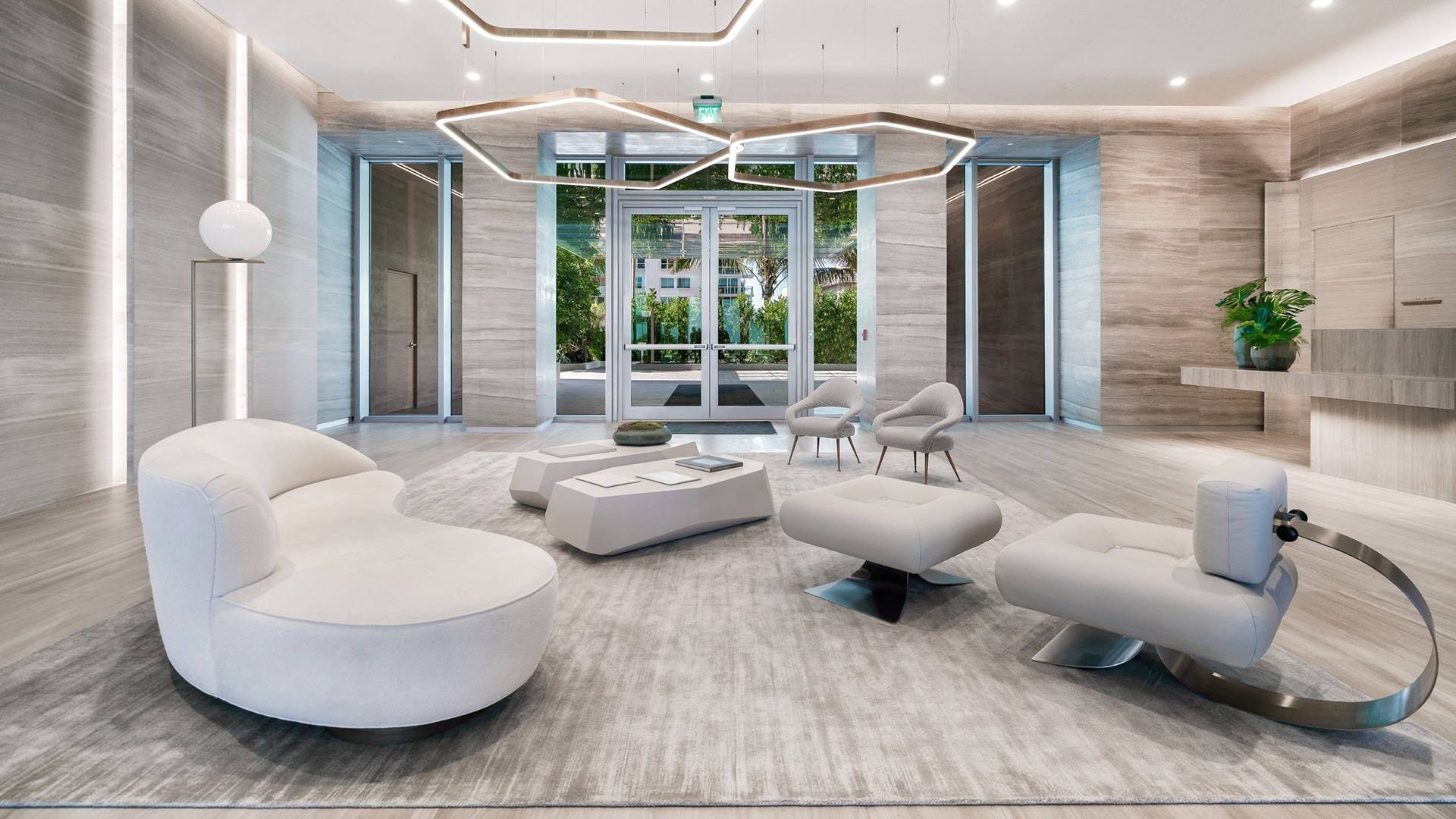
In South Florida luxury real estate, the lobby is often treated as a first impression. For a serious buyer, it deserves a more careful reading. Lobby volume, the perceived height, breadth, light, and circulation of the arrival space, can reveal how a building intends to manage privacy, pace, service, and daily ritual.
A dramatic room is not automatically a better room. A low, tailored entry can feel more private than a soaring hall when its proportions are deliberate. A double-height space can feel gracious, or it can feel exposed. The point is not to choose the tallest lobby, but to understand whether the volume supports the way you want to live.
This is especially important when comparing oceanfront, bayfront, and city residences. Each setting creates a different arrival challenge. Oceanfront buildings must transition residents from brightness, wind, sand, and resortlike movement into calm. Bayfront buildings often balance views, intimacy, and a softer residential pace. City towers must absorb street energy, valet motion, and vertical density without making home feel like a hotel.
Ceiling height is only one part of the story. When you tour, slow down before you reach the reception desk. Ask what happens from curb to door, from door to seating, and from seating to elevator. A successful lobby gives each moment enough room to unfold without friction.
If the ceiling is high but the path is narrow, the lobby may photograph better than it lives. If the room is wide but the seating sits in the path of residents and guests, it may feel more public than private. If the elevators are immediately visible, efficiency may come at the expense of discretion. Volume should be judged by how it choreographs arrival, not by how it appears in a single image.
In new-construction presentations, renderings can emphasize height and gloss. During a private appointment, ask to study the plan, the entry sequence, and the relationship between valet, reception, mail or package areas, amenity access, and elevator banks. The best volume feels composed even on a busy day.
An oceanfront lobby has a distinct responsibility. It must convert the sensory intensity of the coast into a controlled residential atmosphere. The most successful examples do not fight the setting. They filter it. Materials, light, doors, seating depth, and circulation should make the transition from exterior brightness to interior calm feel natural.
When comparing ocean-facing residences, stand near the main entry and imagine returning after beach time, dinner, or a guest arrival. Is there enough space for overlapping movements without congestion? Does the reception area feel present but not performative? Are sightlines elegant, or does everyone entering the building become part of the room’s theater?
A buyer looking at Miami Beach options may encounter very different expressions of arrival, from slender, serene lobbies to more gallerylike rooms. A project such as The Perigon Miami Beach belongs in that broader conversation because it prompts the right question: does the entry feel like a private threshold, not merely a branded stage?
For oceanfront living, also consider how the lobby handles waiting. A gracious seating area is valuable only if it is not exposed to every resident, guest, delivery, and service movement. True luxury often reveals itself through separation, not spectacle.
Bayfront residences tend to invite a quieter reading of volume. The water is still present, but the mood is often less about resort arrival and more about composure. Here, oversized volume can work against the character of the setting if it makes the building feel less residential.
Look for proportion. A bayfront lobby may benefit from warmth, layered lighting, tactile surfaces, and seating that supports conversation without turning the space into a lounge. Waterview moments can be powerful, but they should not compromise privacy. A beautifully framed view is often more refined than an exposed glass box.
In Bay Harbor and neighboring island settings, the best lobby experiences often feel measured rather than monumental. When touring a project such as Onda Bay Harbor, the important comparison is not simply whether the lobby is large. It is whether its scale suits the building’s daily rhythm and gives residents a sense of calm possession.
Bayfront buyers should also observe sound. Marble, glass, and water views can be seductive, but a room that amplifies heels, luggage, voices, and elevator chimes may feel less peaceful over time. Ask whether the space encourages a lowered voice. In luxury buildings, that is often a meaningful test.
In Brickell and other dense urban districts, the lobby has a more protective role. It is the pause between public energy and private life. Volume matters because the city brings intensity to the door: cars, valet, visitors, deliveries, restaurants, offices, and nightlife. A successful city lobby absorbs that motion without carrying it upstairs.
The best city entries often create layers. There may be a strong exterior presence, then a quieter interior reception zone, then a more private elevator sequence. If everything is visible at once, the room may feel efficient but not intimate. If the ceiling is high but the circulation is unresolved, residents can feel as if they are crossing a public concourse every day.
For buyers comparing city towers, properties such as Baccarat Residences Brickell and The Residences at 1428 Brickell can be discussed through the lens of arrival discipline. The central question is how convincingly the building converts urban momentum into residential calm.
Do not confuse activity with vitality. A city lobby can feel alive without feeling exposed. The distinction is in zoning, staffing, sightlines, and acoustic control. A refined urban lobby allows guests to be welcomed, residents to pass discreetly, and service operations to remain visually quiet.
Boutique buildings and larger towers require different lobby strategies. A boutique lobby can feel exceptional with restrained volume if the details are precise. The smaller resident population may allow the room to be more intimate, more tactile, and less processional. In that context, too much height can feel unnecessary.
A tower usually needs more spatial capacity. It must account for overlapping arrivals, amenities, staff, guests, and peak-hour elevator use. Yet even in a tower, volume should be disciplined. A cavernous room can dilute the sense of home if it lacks warmth or hierarchy.
Ask whether the lobby scale matches the number of residences, the type of amenities, and the expected service model. You do not need exact figures to sense imbalance. If a room feels crowded when only a few people are present, it may not be scaled for daily life. If it feels empty even when active, it may be prioritizing drama over comfort.
Visit at more than one time of day if possible. Morning arrivals, late-afternoon valet activity, evening guests, and weekend movement all change the way lobby volume feels. Stand still and listen. Watch how staff greet residents. Notice whether guests know where to go without interrupting the room.
Test the path from car to elevator. Consider whether a terrace return, beach return, dinner arrival, or family visit would feel graceful. Look at where people wait. Look at where packages, pets, luggage, and service carts might move. Luxury is not the absence of function. It is function handled beautifully.
Finally, trust the body. The right lobby lowers your shoulders. It gives you orientation without signage, privacy without severity, and ceremony without noise. That is the volume worth buying.
Is a taller lobby always better in a luxury residence? No. Height matters only when it improves arrival, acoustics, circulation, and privacy.
What should oceanfront buyers look for first? Look for a calm transition from exterior brightness and activity into a controlled residential setting.
How is a bayfront lobby different from an oceanfront lobby? Bayfront spaces often benefit from softer proportion, quieter movement, and carefully framed water views.
What matters most in a Brickell lobby? The lobby should buffer city energy and create a clear shift from public street life to private home.
Can a boutique building have a small lobby and still feel luxurious? Yes. Intimacy, material quality, and circulation can matter more than sheer scale.
What is the biggest mistake buyers make when judging lobby volume? They judge the rendering or first photograph instead of the full path from arrival to elevator.
Should I visit the lobby at different times? Yes. Different hours reveal how the space handles residents, guests, valet activity, and quiet periods.
How do acoustics affect the lobby experience? Hard surfaces and open volume can amplify sound, so the room should still feel composed when active.
Does waterview access in the lobby matter? It can be valuable when framed with discretion, but privacy should not be sacrificed for a view.
How should I compare two similar luxury buildings? Choose the lobby that makes daily arrival feel easier, quieter, and more personally residential.
For a confidential assessment and a building-by-building shortlist, connect with MILLION.
If branded residences are on your mind — as a home or as an allocation — we would be glad to share what we are seeing, privately.
Begin a quiet conversation