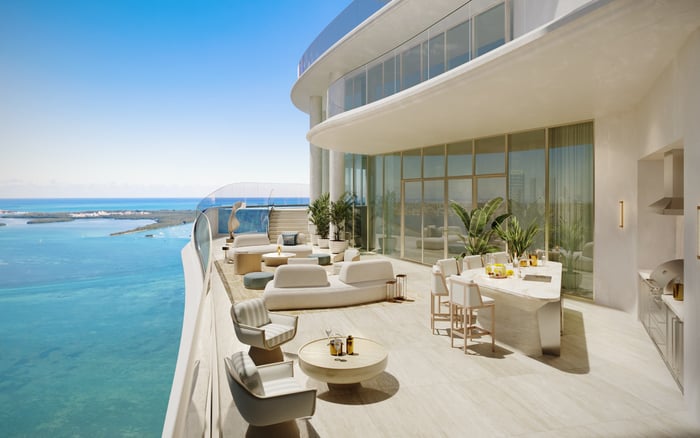
A discreet buyer’s guide to reviewing grill approvals, balcony rules, association documents, and practical outdoor-living expectations before purchasing in Sunny Isles Beach.

In Sunny Isles Beach, a terrace is often more than an architectural flourish. It is where morning light, ocean air, and private entertaining converge. For buyers comparing high-rise residences, the ability to cook outdoors may seem like a modest amenity, yet it can carry outsized importance for daily living, guest hosting, and the emotional value of a home.
The mistake is assuming that a generous balcony automatically permits a grill. In condominium living, outdoor cooking is typically governed by a layered approval environment: association documents, house rules, building management practices, insurance considerations, fire-safety expectations, and the physical design of the terrace itself. A buyer does not need to become a code specialist, but the right questions should be asked before becoming attached to a particular view line or floor plan.
This is especially relevant in a market where properties range from established resale towers to design-forward new-construction offerings. At Bentley Residences Sunny Isles, St. Regis® Residences Sunny Isles, and other headline addresses, outdoor space is part of the lifestyle conversation. The prudent buyer treats grill rights with the same seriousness as parking, storage, pet policy, and rental restrictions.
The first comparison point is documentary. Before relying on a verbal assurance, request the current condominium documents, rules and regulations, architectural guidelines, and any written policy addressing balconies, terraces, appliances, fire features, and exterior modifications. If the residence is a resale, ask whether the seller has an existing grill, whether it was approved in writing, and whether that approval is transferable or personal to the current owner.
Do not settle for the phrase “grills are allowed” without context. A building may allow only certain equipment types. It may limit size, placement, storage, fuel source, use during high-wind conditions, or visibility from neighboring residences. It may also distinguish between a freestanding grill, a built-in outdoor kitchen, a warming appliance, and decorative equipment. Each distinction can materially change the owner experience.
A high-value purchase calls for written precision. The question is not merely whether a grill exists in the building. The question is whether the specific grill concept you have in mind is permissible for the specific residence you intend to buy.
The second point is process. Some buildings may handle outdoor equipment through management review. Others may involve a board, an architectural committee, an engineer, or outside professionals, depending on the scope of work. A simple plug-in appliance may be treated differently from a built-in installation with cabinetry, utility connections, anchoring, or changes to terrace surfaces.
Ask who approves the request, what documents are required, how long review typically takes, and whether approval must be obtained before closing or after ownership transfers. If post-closing approval is required, the buyer should understand the risk that the desired installation may not be granted.
For buyers comparing Jade Signature Sunny Isles Beach with another Sunny Isles Beach option, the better question is not which terrace photographs best. It is which building can produce the clearest, most current answer about outdoor-cooking permissions. Clarity is a luxury amenity.
Grill approvals often turn on practical details. Fuel type is one of the most important. A building may treat electric, gas, charcoal, and portable equipment differently. Even if a certain category is permitted, there may be conditions on where the appliance can sit, how it may be stored, and when it may be used.
Location also matters. A large terrace may still have limited permissible zones once railings, overhead elements, doors, mechanical equipment, drainage, neighbor proximity, and furniture circulation are considered. Buyers should review the actual floor plan and terrace conditions, not just the square footage.
Storage is another subtle issue. If equipment must be stored indoors, kept in a specific area, or removed during certain weather conditions, the lifestyle appeal may change. A grill that is technically permitted but operationally cumbersome may not suit an owner who expects effortless entertaining.
In marketing language, balcony and terrace are sometimes used casually, but buyers should examine the physical and regulatory differences carefully. A compact balcony may be ideal for seating and views, yet unsuitable for the buyer’s cooking expectations. A deep terrace may offer more flexibility, but it can still be subject to association restrictions and building-safety review.
Oceanfront living adds another layer of judgment. Salt air, wind exposure, visibility, and maintenance expectations can affect how an association views outdoor equipment. At The Ritz-Carlton Residences® Sunny Isles, as with any refined coastal building, the best buying posture is to separate lifestyle desire from approval reality. A beautiful outdoor setting deserves practical confirmation.
This is also where buyers should compare the residence’s intended use. A full-time owner who cooks outdoors several nights a week will evaluate the rule set differently from a seasonal owner who wants occasional entertaining. The more central grilling is to your lifestyle, the earlier it belongs in the negotiation and due-diligence timeline.
A sophisticated buyer should ask direct questions in writing. Is any grill permitted on this balcony or terrace? Which fuel types are permitted? Is board or management approval required? Are built-ins treated differently from movable equipment? Are there restrictions on size, brand, placement, storage, or operating hours? Are there insurance requirements? Has this specific residence ever received approval for outdoor cooking equipment?
The final question is particularly useful in a resale purchase. If the current owner has a setup in place, request the written approval, not just photographs. If no written approval exists, the buyer should not assume the condition is sanctioned. An unapproved improvement can become the new owner’s problem.
For pre-completion purchases or early-stage opportunities, the conversation is different. In new construction, buyers should ask whether grill permissions are embedded in the governing documents, whether terraces are delivered with any cooking infrastructure, and whether future owner modifications will require association review. The answer may influence unit selection, furniture planning, and closing expectations.
Create a simple matrix before making a decision. Across the top, list the buildings or residences under consideration. Down the side, compare permitted equipment, fuel category, approval authority, documentation required, installation limits, storage rules, operating restrictions, maintenance obligations, insurance requirements, and whether any approval is specific to the unit.
This matrix removes emotion from the comparison. One building may have a dramatic outdoor space but restrictive use. Another may have a smaller terrace with clearer permissions. A third may allow a narrow category of equipment that is sufficient for one buyer but disappointing for another.
The goal is not to find the most permissive building. The goal is to find the residence whose rules align with the way you actually live. In Sunny Isles, where the outdoor room can be central to the appeal of oceanfront ownership, that alignment can make the difference between a good acquisition and a deeply satisfying one.
Grill approval can also become a negotiation point. If outdoor cooking is essential, a buyer may make satisfactory document review part of the due-diligence process. In some situations, it may be appropriate to request seller cooperation in obtaining management confirmation before closing. If the seller advertises a grill or outdoor kitchen as part of the residence, the buyer should confirm whether it is included, compliant, and approved.
For ultra-premium buyers, discretion matters. The most effective approach is measured, not adversarial. Ask for the rules, request the written history, and have counsel or an experienced advisor review the language. The objective is certainty, not drama.
Can I assume a grill is allowed if the balcony is large? No. Size alone does not determine approval; the governing documents and building rules control the answer.
Should I ask about grill approval before making an offer? Yes, if outdoor cooking is important to your lifestyle. Early clarity can prevent wasted time and misplaced expectations.
Is an existing grill proof that it is approved? Not necessarily. Request the written approval or building confirmation tied to that specific residence.
Are electric grills usually treated the same as gas grills? Not always. Buyers should ask how the building classifies each fuel or equipment type.
Can a seller’s grill approval transfer to me? It depends on the building’s rules and the wording of the approval. Confirm transferability in writing.
Do new developments make grill rules easier to understand? They can, but buyers should still review the final governing documents and any architectural guidelines.
Should my attorney review grill restrictions? Yes. Outdoor-use rules can affect enjoyment, improvements, and future resale positioning.
What if the listing photos show an outdoor kitchen? Treat photos as a prompt for verification, not as approval evidence. Ask for documentation.
Can grill restrictions affect resale value? They may affect buyer appeal for clients who prioritize outdoor entertaining, especially in coastal residences.
What is the safest way to compare buildings? Use a written checklist and compare permissions, process, fuel type, storage, and approval history side by side.
When you're ready to tour or underwrite the options, connect with MILLION.
If branded residences are on your mind — as a home or as an allocation — we would be glad to share what we are seeing, privately.
Begin a quiet conversation