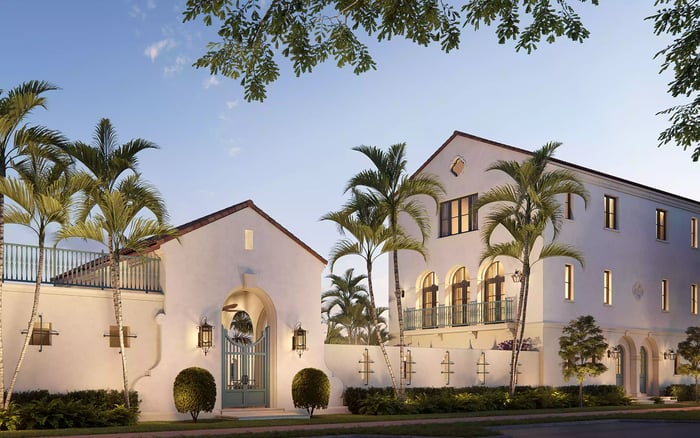
For waterfront buyers comparing Coconut Grove and Coral Gables, boat-lift rules can shift the conversation from architecture and address to usable water access, permitting discipline, association oversight and long-term ownership fit.

For a certain South Florida buyer, the waterfront decision begins with a deceptively simple question: can the property support the boat lifestyle envisioned? In the comparison between Coconut Grove and Coral Gables, that question can matter as much as architecture, square footage, or the name on the gate.
Boat-lift rules are rarely just about equipment. They prompt a deeper review of seawalls, dock configuration, setbacks, water depth, association controls, municipal approvals, and environmental review. They also reveal the buyer’s true priorities. Some owners want a tender for sunrise runs across the bay. Others want a center-console immediately behind the house. Some simply want confidence that a future owner will see the waterfront as usable, not ornamental.
That is why the choice between Coconut Grove and Coral Gables should not be framed only as a neighborhood preference. It is a lifestyle due-diligence exercise. The right property is the one where the rules, the water, and the owner’s habits are aligned before emotion takes over.
Coconut Grove often attracts buyers who respond to a layered coastal atmosphere: mature streets, a village cadence, and a softer transition between home, garden, and water. For these buyers, the boat-lift conversation is part of a broader desire for immediacy. They are not only buying a view. They are buying the possibility of moving easily between land and bay.
That does not make every waterfront opportunity equal. A buyer should ask whether the existing dock condition, water access, lift placement, and surrounding property controls support the intended vessel. It is also sensible to understand whether improvements would require approvals that could affect timing or cost. A beautiful setting can still be a poor boating match if the operational details are unclear.
For those who want the Grove lifestyle without making private dock ownership the organizing principle, condominium living may offer a different kind of ease. Projects such as Four Seasons Residences Coconut Grove and Park Grove Coconut Grove speak to buyers who value the neighborhood’s prestige and proximity to the water, while keeping the focus on residence design, services, and daily convenience rather than dock infrastructure.
Coral Gables enters the conversation differently. Buyers evaluating Coral Gables waterfront homes often think in terms of long ownership, privacy, architectural control, and a more formal sense of place. In that environment, boat-lift rules can become especially important because the home is often assessed as a complete estate proposition, not simply a waterfront parcel.
Here, the buyer’s questions should be exacting. Is a lift already present? If so, does its configuration match the intended use? If not, what would be required to pursue one? Are there association, deed, architectural, or municipal considerations that could affect the answer? None of these questions should wait until late contract stages. They belong at the beginning, particularly when the buyer has a specific boat in mind.
The same logic applies to non-waterfront luxury in the city. A residence near cultural, dining, or village amenities can satisfy a buyer who wants Coral Gables for its refinement but does not need a private lift. In that lane, Ponce Park Coral Gables and The Village at Coral Gables provide useful reference points for buyers separating neighborhood preference from boating utility.
A disciplined buyer will ask the same core questions in both markets. First, what type of boat is being accommodated today, and what type may be desired later? A lift that suits one owner’s weekend pattern may not suit another owner’s fishing, cruising, or tender requirements.
Second, what is the status of the existing waterfront infrastructure? The lift cannot be considered apart from the seawall, pilings, dock condition, electrical service, and site geometry. Waterfront is not a single amenity. It is a system.
Third, who has approval authority? The answer may involve more than one layer of review. Municipal departments, homeowners’ associations, architectural committees, or environmental considerations may all shape what is possible. The buyer does not need to become a permitting expert, but the advisory team should know which questions to ask and when.
Fourth, what is the timeline risk? A property that works on day one has a different value proposition than a property that requires approvals before the owner can use the water as intended. That distinction can influence offer terms, contingencies, and patience.
The boat-slip question is not cosmetic. For some buyers, a nearby slip, club access, or marina arrangement may fully satisfy the boating need. For others, those solutions miss the point. They want the boat behind the house, visible from the terrace, and available without coordination.
This distinction can dramatically change the search. A buyer who is flexible about off-site access may consider a wider range of homes and condominiums across both neighborhoods. A buyer who needs a private lift immediately narrows the field and should evaluate each property through a technical lens before giving weight to finishes, landscaping, or staging.
The word marina can sound simple, but in luxury real estate it describes a spectrum of convenience. Some arrangements are deeply practical, while others are better understood as lifestyle adjacency. The buyer should be clear about the difference between owning usable private infrastructure and merely being near the boating world.
Waterfront property commands attention because it is finite, emotional, and visually powerful. Yet in the highest tier, certainty can be more valuable than romance. If two homes appear similar, the one with clearer usable-water answers may be the stronger purchase for a boating family.
This is especially true when resale is considered. Future buyers may ask the same questions, often with the same urgency. If the property’s lift status, improvement pathway, or access limitations are uncertain, that uncertainty can become part of the negotiation. Conversely, a home with well-understood waterfront utility can feel more complete.
In an Estates & Single-Family context, the issue becomes even sharper. The buyer is not only purchasing interiors and land. The buyer is acquiring a private operating environment. That includes the quiet mechanics of how the home receives guests, stores equipment, handles weather, and connects to the water.
The best comparison starts with use, not address. If the buyer’s daily life depends on a specific vessel and immediate bay access, the search should begin with properties whose water conditions and approval posture can be evaluated early. If the buyer is more focused on architecture, schools, privacy, or a town-like rhythm, the boat-lift question may become secondary.
Coconut Grove may feel more natural to buyers who want their South Florida life to lean informal, lush, and close to the bay. Coral Gables may feel more compelling to buyers who want a composed residential environment with a strong sense of civic identity. Neither answer is universal. The right choice is the one where the water, rules, and personal routine agree.
For serious buyers, the most elegant move is also the most practical: ask the difficult boat-lift questions before falling in love with the house. The answers will clarify whether the property is merely beautiful or genuinely fit for the life being purchased.
Why do boat-lift rules matter when comparing Coconut Grove and Coral Gables? They can determine whether a waterfront property supports the buyer’s intended boating lifestyle or simply offers a view.
Should a buyer ask about boat lifts before making an offer? Yes. Lift status, improvement potential, and approval requirements should be reviewed early, especially when a specific vessel is involved.
Is an existing boat lift automatically an advantage? Not always. The lift must match the buyer’s boat, the site conditions, and any applicable approval or association requirements.
Can a buyer rely on nearby marina access instead of a private lift? Some buyers can, but others specifically want immediate private access behind the home. That preference should shape the search from the start.
What should be reviewed besides the lift itself? Buyers should consider seawalls, pilings, dock condition, electrical service, water access, associations, and permitting pathways.
Does a condominium make sense for a boating buyer? It can, if the buyer prioritizes neighborhood lifestyle, services, and convenience over private dock control.
How can boat-lift uncertainty affect negotiations? Uncertainty may influence price, contingencies, timing, and the buyer’s willingness to proceed without further review.
Is waterfront always better for resale? Waterfront can be highly desirable, but usable and well-understood water access is often more persuasive than water frontage alone.
Do Estates & Single-Family buyers need extra diligence? Yes. Private homes often require a broader review of infrastructure, approvals, and how the property functions day to day.
What is the most important first step? Define the intended boating use, then evaluate only those properties whose water conditions and rules can realistically support it.
When you're ready to tour or underwrite the options, connect with MILLION.
If branded residences are on your mind — as a home or as an allocation — we would be glad to share what we are seeing, privately.
Begin a quiet conversation