South Florida’s luxury condo market is treating work space as a core lifestyle amenity, from floor plans with true dens to buildings that create business-ready environments. Here is how to evaluate office-forward residences and why the best setups prioritize acoustics, light, connectivity, and flexibility.
In South Florida, the conversation around luxury condos has expanded beyond views, finishes, and service. Today’s buyer is also underwriting the workday: where calls happen, where focus happens, and where a laptop closes at 6:00 and the space returns to living. That shift is increasingly visible in how new buildings are conceived and presented, with work-from-home functionality treated as a building-level priority, not an in-unit afterthought. At the highest end, the goal is not a token “workspace.” It is a quiet, ergonomic, technology-ready environment that protects privacy and pace. For some households, it is also an asset: space that can be used, reserved, or monetized depending on the season.
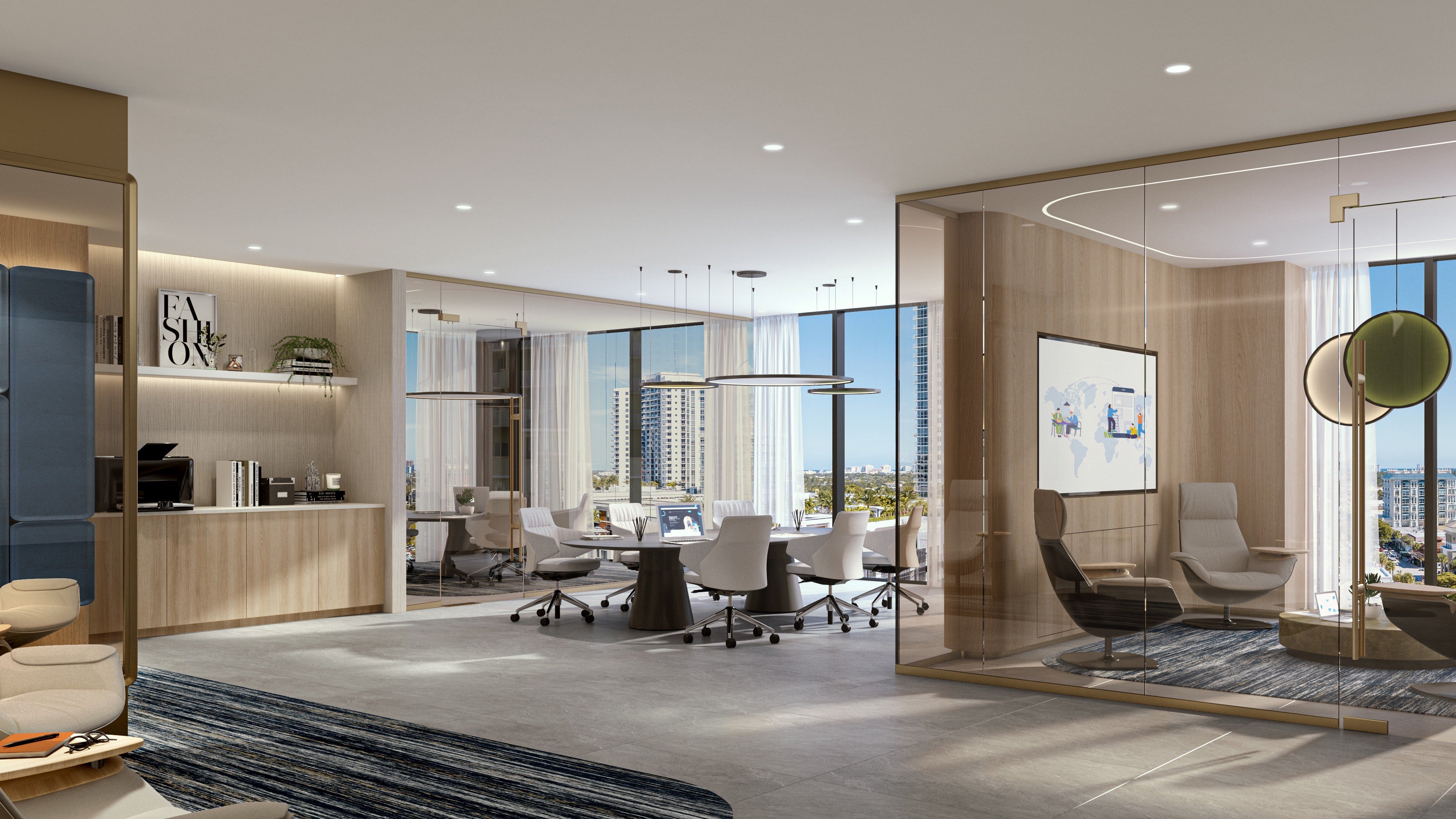
The phrase “office suite” is often used loosely, so it helps to separate the concept into three distinct tiers. First is the classic in-residence den or study: a dedicated room or flexible alcove intentionally drawn as an office-ready zone. This is increasingly embedded in new floor plan thinking. In Edgewater, Aria Reserve Miami is positioned as a case-study example of residences with a dedicated den or office area integrated into the floor plan concept, an indicator of how central workspace has become to the design narrative. Second is the building-level business environment: shared work lounges, reservable meeting rooms, and coworking-style spaces designed to handle a real calendar of calls. In Aventura, Modera Aventura reflects this direction with coworking-oriented amenities including private workstations, private conference rooms, and high-speed Wi‑Fi in common areas. In the luxury context, these features matter when you want to keep the residence quiet but still need a professional setting without leaving the building. Third is the most structurally new option: deeded private office suites that are owned and controlled like real property. In Wynwood, Twenty Sixth & 2nd Wynwood Residences introduced deeded private office suites that owners can use personally, rent separately, or list on Airbnb. The result is a work-living-income hybrid model that reframes what a “home office” can be.
Deeded office suites change the math in two ways. They introduce separability. A traditional den is inseparable from the residence, so it creates value primarily through lifestyle and resale appeal. A deeded suite, by contrast, can function as a private professional space when you are in town and can potentially be rented when you are not, creating optionality aligned with a second-home and investment mindset. They also strengthen boundaries. Many high-performing households do not struggle with motivation; they struggle with separation. A physically distinct office suite can preserve the home as a restorative environment while still supporting a full workday. For buyers who entertain frequently or travel in and out of Miami, that boundary can be as valuable as any view corridor. Because these suites sit at the intersection of lifestyle and utilization, buyers should ask practical questions before assuming the concept fits. How is access controlled? What are the rules around short-term use? How does the building manage noise and privacy in the corridor? The “deeded” structure may be the headline, but the daily experience is defined by operations.
Luxury amenities have always competed on pool decks, wellness, and service. Now, coworking and meeting capability is joining that roster. In Brickell, St. Regis® Residences Brickell presents amenities that include meeting and business-oriented facilities suited to resident work needs. That positioning matters because it reflects what luxury buyers already understand: productivity is not only about a desk and Wi‑Fi, it is about having the right environment for a pitch, a board call, or a quiet review session. Even when a building is not explicitly “business branded,” the direction is consistent across South Florida: shared work lounges, coworking areas, and reservable rooms are being treated as core features. In Fort Lauderdale, for example, coworking is now a recognizable amenity category in the broader multifamily landscape, indicating that expectations are becoming standardized across markets. A subtle advantage of a strong building-level workspace is guest management. If family is visiting, if staff is in the residence, or if the home is being staged or refreshed, the ability to relocate work to a dedicated amenity space keeps the day running smoothly.
The most common weak point in a home office is acoustic control. It is easy to furnish a beautiful room. It is harder to make it quiet enough for confidential calls and sustained concentration. Purpose-built acoustic solutions typically emphasize three pillars: isolation (blocking sound from entering or leaving), absorption (reducing reverberation inside the room), and layout (placing the work zone away from noise sources). In a condo, the challenge is two-sided: you may be managing building noise and urban noise at the same time. In multifamily environments, noise reduction often comes down to assemblies that limit sound transmission between units: wall and ceiling build quality, detailing at junctions, and practical separation between living zones. For city-facing elevations, soundproof window systems are often marketed to reduce outside noise intrusion. You do not need a recording studio, but if you spend hours on calls, window performance becomes a daily quality-of-life issue. In buyer terms, evaluate acoustics the way you would evaluate a finish level. Walk the residence at different times of day. Stand in the den with the door closed. Listen for corridor noise. If you intend to use a building’s coworking lounge, test it with the same rigor; a beautiful room without acoustic discipline can read as an amenity and fail functionally.
The luxury home office is increasingly assessed through a wellness lens. The best rooms do not just look right; they feel right at 9:00 a.m. and at 7:30 p.m. Circadian lighting design aims to support wellness and productivity by adjusting light intensity and color temperature throughout the day, aligning more closely with human biological rhythms. In practice, that can mean brighter, cooler light for morning focus and warmer, softer light later, especially if the office sits near a bedroom or other restorative area. This connects to the broader “wellness home” concept: healthy-living features like light, air, and comfort are increasingly integrated into residential design. The takeaway is straightforward: if a home office is used daily, it should be designed like a wellness zone, not treated as a storage room with a chair. In Coconut Grove, where the lifestyle leans residential and leafy, an office that doubles as a reading room or quiet retreat often complements the architecture more naturally than a hard-edged corporate look. A project such as The Well Coconut Grove naturally supports that blend of productivity and restoration.
High-speed internet access is widely treated as a search and marketing differentiator in Miami rentals, reflecting baseline expectations for remote work. For luxury buyers, the baseline is no longer simply “fast.” It is “reliable enough to disappear.” Fiber availability is often promoted as a practical path to fast, stable connectivity. But the in-building experience still matters: where equipment is placed, how Wi‑Fi coverage performs through thicker wall assemblies, and whether common areas maintain the same performance level as the residence. If you frequently host video calls, consider redundancy. Many owners keep a primary provider plus a backup solution, especially during active travel weeks or major deal cycles. It is a small operational choice that protects the larger value of your time.
Even in large residences, the best office setups are space-efficient. Remote-work-friendly design tends to prioritize ergonomics and layout choices: desk placement, monitor distance, and storage that keeps the visual field calm. A useful mental model is the “dedicated desk” versus a flexible hot-desk approach. A dedicated setup offers consistency and reliability, which is exactly why buyers gravitate toward true dens, office-ready floor plans, and deeded suites. You are not setting up and breaking down your workday each morning; the space holds the routine for you. In Miami Beach, where buyers often split time between the city and elsewhere, a den that can be closed off cleanly becomes a premium feature. A coastal-facing residence like 57 Ocean Miami Beach aligns with that sensibility: privacy, serenity, and a layout that supports leisure while still delivering a focused hour when needed.
When touring, separate what is “nice” from what is “useful.” Ask yourself: Does the space allow privacy for sensitive conversations, or will you be forced into common areas? Is there a true door and a true wall, or is the “office” essentially part of a living room? Is the building offering coworking and meeting rooms as a serious program, or as a decorative lounge? Are there noise mitigation features in the envelope and between units that support real call clarity? Do lighting options support long work sessions without fatigue? Does the connectivity feel robust in the exact spot your desk would sit? In Brickell, where density and energy are part of the appeal, business-forward design can be a deciding factor. A building such as 2200 Brickell can be assessed through this lens: does the residence and amenity mix match the way you actually live, including weekdays?
South Florida luxury has always been about the visible: water, skyline, light. The next layer is invisible: acoustic calm, lighting that respects the body, connectivity that never interrupts, and spaces that allow work to happen without taking over the home. Whether you prefer a dedicated den, a building with true business amenities, or a deeded office suite that creates a different kind of optionality, the market has moved in a clear direction. The best residences will feel effortless not only on Saturday, but on Tuesday at 10:00 a.m.
What is a deeded office suite in a condo setting? It is a privately owned office space that can be used by the owner and, in some cases, rented separately depending on building rules.
Are coworking lounges replacing in-unit home offices? Not entirely; the best buildings offer both, letting residents choose between privacy and a professional shared setting.
Why does sound matter so much for a luxury home office? Call clarity and confidentiality depend on isolation and reduced reverberation, not just attractive furnishings.
Do soundproof windows make a noticeable difference? They can reduce outside noise intrusion, which is especially valuable in dense urban areas and near major roads.
What should I look for in an office-ready floor plan? Prioritize a dedicated den with a door, sensible layout, and distance from high-traffic living zones.
How can lighting improve productivity at home? Circadian-aligned lighting can support alertness during the day and help the home feel calmer later in the evening.
Is high-speed internet enough for remote work in a condo? Speed helps, but reliability and strong in-unit and amenity Wi‑Fi coverage are what keep work frictionless.
Can office amenities add resale appeal? Yes; as remote and hybrid routines persist, purpose-built work spaces can differentiate a residence.
Is a separate office suite better than a den? It depends on your need for boundaries and optional income; a deeded suite can add flexibility that a den cannot.
How do I evaluate a building’s coworking space during a tour? Sit in the room, test noise levels, check privacy, and confirm whether meeting rooms and workstations are truly usable.
For tailored guidance, speak with MILLION Luxury.
If branded residences are on your mind — as a home or as an allocation — we would be glad to share what we are seeing, privately.
Begin a quiet conversation