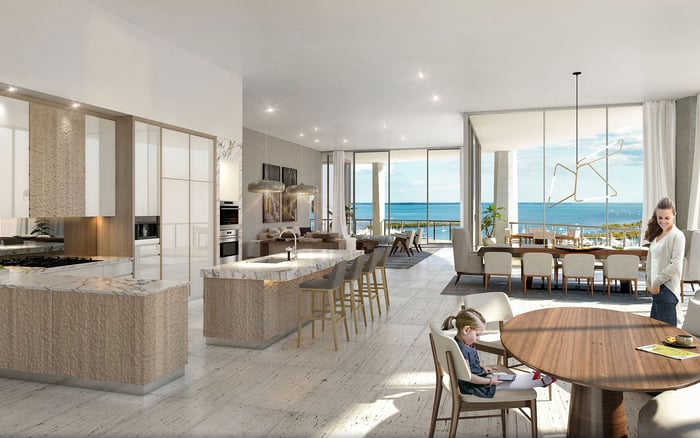
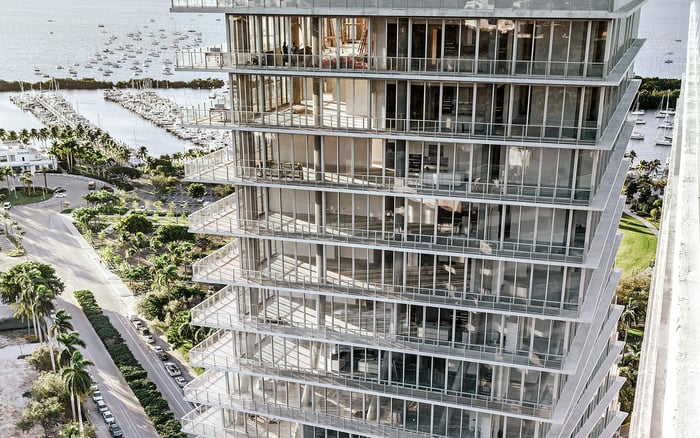
A buyer-oriented comparison of Coconut Grove’s two most design-forward condo campuses, focused on architecture, density, and what the published floor plans reveal about daily life.
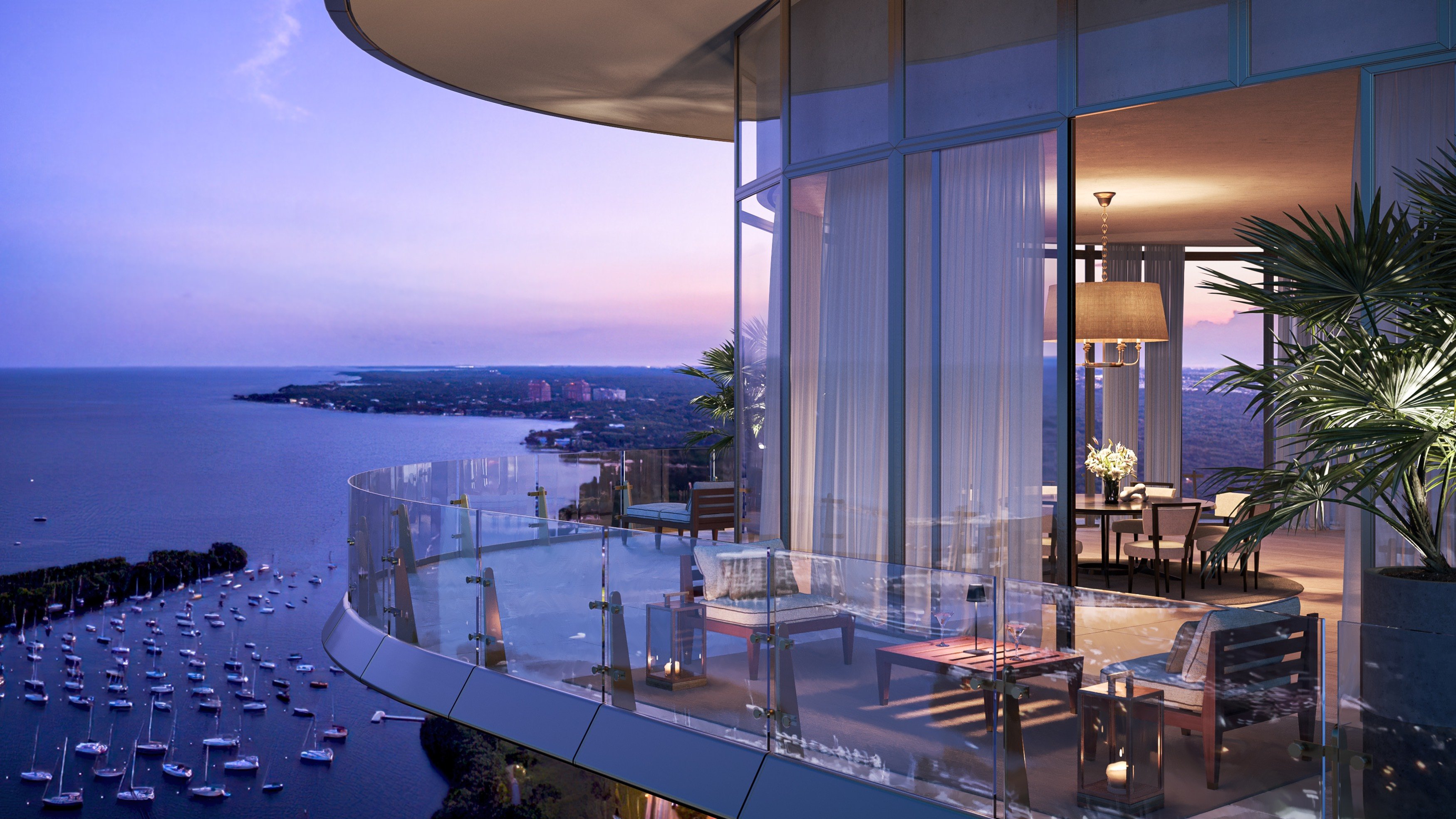
In Coconut Grove, the choice between Grove at Grand Bay and Park Grove is rarely about a universal “best.” It is about which definition of luxury aligns with how you intend to live day to day.
Grove at Grand Bay is a two-tower, approximately 20-story development at 2669 S Bayshore Dr. It is widely positioned as ultra-luxury and low-density, with a limited total residence count commonly cited around 99 units. Developed by Terra Group and designed by Bjarke Ingels Group (BIG), it has been profiled as LEED Gold certified. Its official floor-plan catalog is organized by tower (North and South) and then by individual residence stacks. That structure is more than administrative; in a boutique building, stack identity often defines the experience.
Park Grove, by contrast, reads like a campus. It is a three-tower condominium development on South Bayshore Drive, commonly referenced as 2811, 2821, and 2831 S Bayshore Dr. The architecture is by OMA (Rem Koolhaas and Shohei Shigematsu), and the overall unit count is commonly cited at 276 residences across the three towers. Public comparisons also cite a larger site footprint for Park Grove, roughly 5.2 acres versus roughly 3 acres for Grove at Grand Bay, reinforcing the sense of a broader, multi-building composition.
For Miami buyers who move decisively, the most useful comparison is not amenities, which can be subjective. It is the objective: massing, density, and what the published plans reveal about outdoor space, circulation, and long-term livability.
Grove at Grand Bay’s defining move is its two-tower composition. For many buyers, that translates to a more edited community feel: fewer neighbors, fewer repeating plans, and more emphasis on how each stack sits within the building. BIG’s authorship also reads as a single, cohesive design idea expressed in two forms.
Park Grove’s identity is different by design. The OMA approach, paired with three towers, naturally produces more variety and more segmentation inside the same address: One Park Grove, Two Park Grove, and the Park Grove Club Residences. That internal segmentation can be the deciding factor. Buyers who value the ability to trade up, downsize, or place family members within the same overall environment often gravitate toward a three-tower ecosystem.
To anchor your research in official materials, start with Grove at Grand Bay to see the tower-and-stack plan organization, then compare how a larger multi-tower community is presented at Park Grove Coconut Grove.
Luxury buyers often ask for “the best line.” The more precise question is what the developer chooses to publish, and what those choices imply about daily life.
At Grove at Grand Bay, the official floor-plan catalog is structured by North and South tower and then by individual stacks. That is typical of a low-density building where view corridors, terrace orientation, and vertical position can meaningfully shift a residence’s character even when bedroom counts appear similar. Across layouts, one theme is consistent: the terrace or balcony is treated as a primary room, not a leftover rectangle.
At Park Grove, the plan libraries are explicitly separated by product type.
One Park Grove is positioned as a larger-format offering, with a dedicated published floor-plan set. It includes, for example, Residence A as a four-bedroom plan with 3,592 square feet of interior area and 442 square feet of exterior area. Residence C is published as a two-bedroom plan with an optional third-bedroom configuration, at 2,232 square feet interior and 314 square feet exterior. At the top end, One Park Grove Penthouse A is published as five bedrooms with 6,476 square feet interior and 835 square feet exterior.
Two Park Grove is marketed with its own floor-plan library showing Type A, B, C, and D layouts and penthouse variants. Two Park Grove Type A is published as a four-bedroom plan that includes a staff room, totaling 3,233 square feet of interior area. Two Park Grove Type C is published as a two-bedroom plan totaling 2,232 square feet of interior area.
Then there are the Club Residences, often described as the more attainable, smaller-unit component of Park Grove. The plan mix spans one-bedroom, two-bedroom, and three-bedroom layouts. The published plan book shows smaller footprints starting roughly around the 700 square foot range, scaling up to larger three-bedroom plans roughly in the 1,600 to 1,700 square foot range depending on layout.
The takeaway is straightforward. Park Grove offers a deliberate staircase of scale and price positioning inside one community. Grove at Grand Bay emphasizes a tighter collection, where the differentiator is more often the stack and terrace relationship than a broad spread of unit sizes.
In South Florida, some of the most valuable square footage is the square footage that allows intentional outdoor living. Both properties lean into this, but they express it differently.
Grove at Grand Bay’s plan language consistently centers large terraces and balconies. When a plan book treats outdoor area as a recurring, organizing element, it tends to produce homes that feel larger than their interior numbers suggest, especially for owners who entertain or simply live with doors open when weather allows.
Park Grove’s marketing materials frequently separate interior and exterior square footage, which is exactly how a discerning buyer should evaluate it. The split clarifies what is air-conditioned and what is not, and it makes it easier to compare value across buildings. The published examples in One Park Grove and its penthouses underline that exterior area is not token; it is intended to function as a true extension of the home.
If your lifestyle requires a terrace that reads like a second living room, focus on residences where exterior square footage is treated as a primary metric. If you want a balcony that is beautifully scaled for morning coffee and sunset, but not the central program of the home, smaller outdoor allocations can still satisfy.
Privacy in a condo is not just about security. It is also about how many doors you pass on the way to your own.
Grove at Grand Bay’s low-density positioning and commonly cited limited unit count create a more intimate ownership environment. In practice, a smaller resident population can feel calmer, with fewer daily touchpoints and less rotational traffic.
Park Grove’s commonly cited 276 residences across three towers, paired with a wider unit mix that includes smaller one-bedroom formats in the Club Residences, typically supports a more dynamic social ecosystem. For some owners, that is a feature: more neighbors, more varied household types, and potentially more day-to-day activity within the community.
The subtle advantage is optionality. Park Grove’s three-tower structure lets buyers select a preferred intensity level by tower type. Grove at Grand Bay’s proposition is more singular: an ultra-luxury, boutique-minded approach with fewer variables.
Many sophisticated Miami buyers prioritize flow-through units because multiple exposures can improve daylight, cross-breezes, and the sense of volume throughout the day. Not every published plan is explicitly labeled this way, but you can read circulation patterns and terrace placement as clues.
At Park Grove, the published materials point to a range that supports different household phases: larger four-bedroom formats (including plans with staff rooms), adaptable plans like the two-bedroom Residence C with an optional third-bedroom configuration, and penthouses with substantial interior and exterior programs.
At Grove at Grand Bay, the tower-and-stack approach supports a different kind of flexibility. You select a stack that aligns with your preferred view corridor and terrace orientation, then let the outdoor-first design carry the lifestyle. For buyers who want to optimize daily experience rather than maximize room count, that can be the right form of luxury.
For those calibrating the broader Coconut Grove landscape, the neighborhood’s high-touch set also includes branded and boutique options such as Four Seasons Residences Coconut Grove and Mr. C Tigertail Coconut Grove. They can be useful benchmarks when weighing service expectations and overall residential tone.
Use these questions as your private filter before you tour.
First, do you want boutique certainty or campus variety? Grove at Grand Bay tends to deliver a more edited community experience. Park Grove offers more internal choice across One, Two, and Club Residences.
Second, what role should outdoor space play in your daily rhythm? Both prioritize exterior living. Park Grove’s published interior-versus-exterior disclosures make comparisons straightforward, while Grove at Grand Bay’s plan language treats terraces and balconies as a consistent signature across stacks.
Third, how do you define privacy? If a limited resident population matters, Grove at Grand Bay’s low-density positioning is compelling. If you prefer a layered community with multiple building identities and plan tiers, Park Grove can feel richer.
Finally, decide what you are actually buying: a floor plan, or a long-term cadence of living. In Coconut Grove, the best choice is often the one that feels effortless on an ordinary Tuesday, not only impressive on closing day.
What is Grove at Grand Bay’s basic building composition? It is a two-tower, approximately 20-story luxury condominium development.
Where is Grove at Grand Bay located? It is at 2669 S Bayshore Dr in Coconut Grove.
Who developed and designed Grove at Grand Bay? It is a Terra Group development designed by Bjarke Ingels Group (BIG).
Is Grove at Grand Bay LEED certified? It has been profiled as a LEED Gold certified residential project.
How are Grove at Grand Bay floor plans organized? The official catalog is organized by North and South tower and then by residence stacks.
What is Park Grove’s overall tower concept? It is a three-tower condominium development designed by OMA.
Roughly how many residences are cited for Park Grove? It is commonly cited at 276 residences across the three towers.
What is an example of a published larger Park Grove plan? One Park Grove Residence A is published as a four-bedroom plan with 3,592 interior square feet and 442 exterior square feet.
What is the Club Residences’ unit-mix idea? It spans one-bedroom to three-bedroom plans, with smaller footprints starting roughly around 700 square feet and larger plans roughly in the 1,600 to 1,700 square foot range depending on layout.
How should buyers compare square footage between these properties? When available, compare interior and exterior areas separately and prioritize terrace and balcony usability, not just totals.
For discreet guidance on Coconut Grove’s best-fit residences, connect with MILLION Luxury.
If branded residences are on your mind — as a home or as an allocation — we would be glad to share what we are seeing, privately.
Begin a quiet conversation