As trillions in inherited capital move into the hands of millennials and Gen X, the most coveted addresses are being treated less like purchases and more like intergenerational strategies. For South Florida buyers, the next decade will reward clarity: how cash reshapes negotiations, why supply stays tight, and what ownership structures can preserve optionality across generations.
Luxury real estate has always tracked wealth. What is changing now is the schedule, the scale, and the profile of the buyer driving it.
A widely cited outlook tied to the “Great Wealth Transfer” projects that roughly $6 trillion in inherited wealth is expected to change hands in 2025, with an estimated $124 trillion transferring between generations through 2048. For South Florida, the implication is straightforward: a meaningful share of that movement is expected to land in property, with roughly $25 trillion projected to flow into real estate over that same long arc.
This is not only more capital. It is different intent. Fidelity, citing Cerulli Associates, projects that millennials will inherit around $46 trillion and Gen X around $39 trillion during the transfer. These cohorts often prioritize mobility, privacy, and lifestyle efficiency. They are also comfortable treating a residence as both a place to live and a component of long-range family planning.
At the national level, Realtor.com pegs the “luxury” threshold around $1.2 million, and the top 1% “ultra-luxury” threshold around $5.49 million. At this end of the market, buyers typically optimize for control, not monthly cost. Control means location certainty, security, hospitality-grade operations, and the ability to host family in a way that feels permanent.
Globally, the most expensive markets trade like rare objects. Monaco has been described as the highest UHNW density market, with roughly one ultra-high-net-worth individual per 22 residents, and it has been cited as the priciest city for luxury property at around $38,800 per square meter. New York City is ranked as the leading city by total UHNW residential footprint. In London, a majority of UHNW individuals are reported to own a secondary home.
Those reference points help clarify what top-tier buyers are really buying: a primary base plus at least one Second-home that functions as a lifestyle hedge. South Florida increasingly occupies that “secondary home” position within global portfolios, with the added benefit of being culturally international and operationally straightforward for U.S. families.
A quiet driver of price resilience is not only new construction or interest rates. It is non-participation.
A significant share of existing owners simply does not intend to sell. Realtor.com reports that about 54% of baby boomer homeowners say they never plan to sell their primary residence during their lifetime. When long-time owners hold, inventory tightens and the best homes become difficult to replace.
For buyers, this changes the goal. In a constrained market, the win is not “finding a deal.” The win is securing a home you would still want if you could not buy the neighboring unit later. It is also why new, design-forward inventory can exert outsized influence on where luxury demand concentrates.
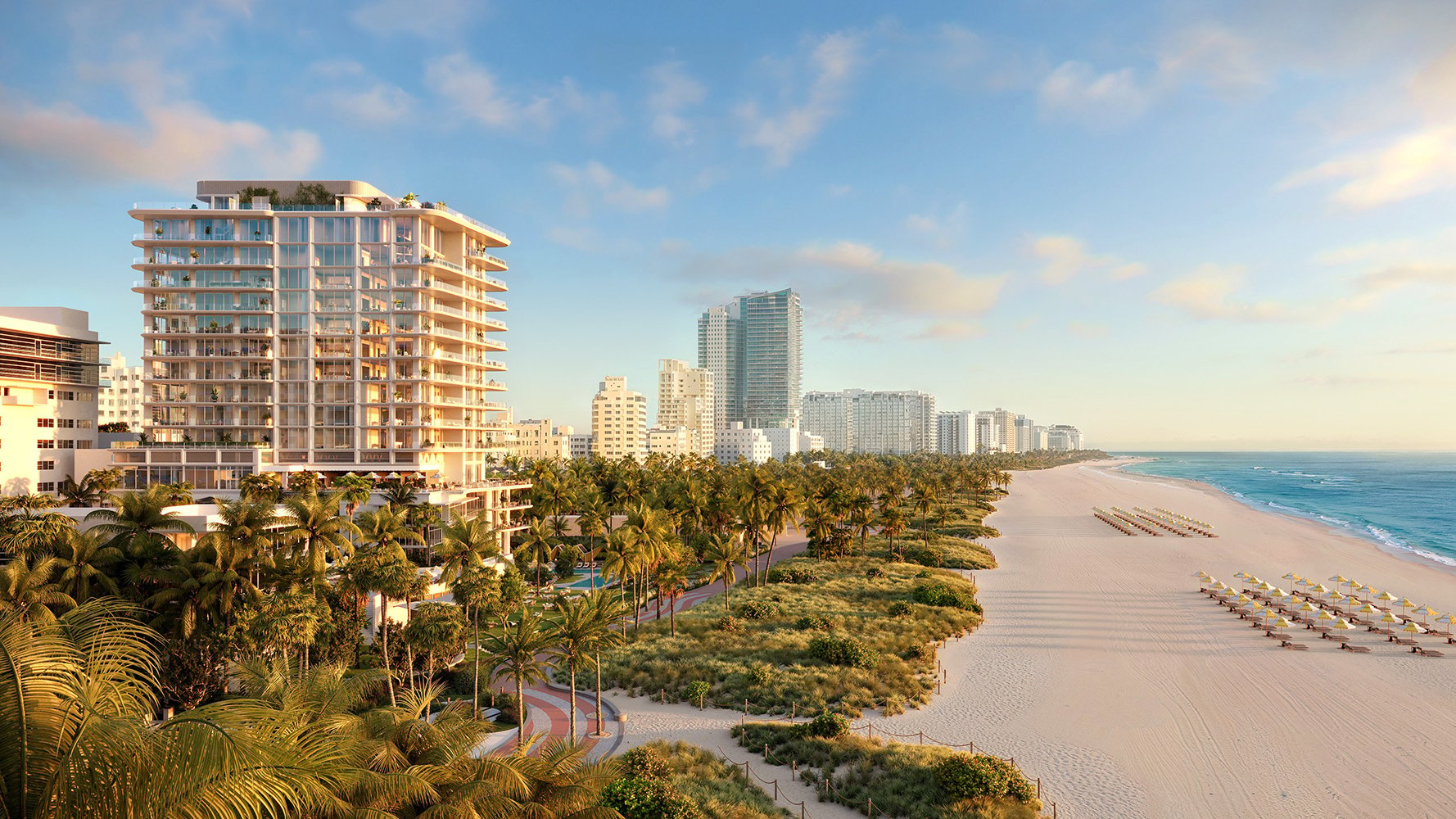
In Miami-beach, the appeal is often less about raw square footage and more about the full daily system around the residence: arrival experience, privacy, services, and the quality of the public realm outside the front door.
At the top of the market, cash is not a flex. It is a certainty tool.
Realtor.com reports that in the U.S., cash accounts for about 50% of purchases in the $2 million to $5 million tier and 65% or more in the $5 million to $10 million tier. That concentration helps explain why negotiations in ultra-luxury feel structurally different from the broader housing market.
When a buyer can close without financing contingencies, the seller’s risk profile changes. Certainty can be traded for price concessions, or used to secure access to a property that may not be broadly marketed. In practice, the strongest advantage is optionality: the ability to act quickly when a rare layout, a protected view corridor, or a specific service level appears.
This is one reason newer Miami Beach inventory is watched so closely. For buyers who want contemporary building systems and amenities, Five Park Miami Beach reads as a marker of the city’s next chapter: design-led, modern, and oriented toward residents who want a turnkey lifestyle with a distinctly urban edge.
Ultra-luxury buyers are often weighing two competing ideals: a “trophy” that signals status and a “legacy” that supports the family. The next decade favors legacy because inheritance planning and lifestyle planning are converging.
Homes designed with a hospitality mindset tend to perform best in this test. The ability to host adult children, friends, and business partners without sacrificing privacy becomes a defining feature of the modern ultra-luxury purchase.
That is where branded residential ecosystems can matter, not for the logo, but for the operating model. Setai Residences Miami Beach is often discussed as an address capable of delivering a more discreet, service-forward ownership experience, aligning with buyers who see their residence as a long-term family base rather than a short-term lifestyle experiment.
For families prioritizing stewardship and consistency, The Ritz-Carlton Residences® Miami Beach similarly speaks to predictability: a known standard of service and an ownership environment designed around ease and discretion.
At the more intimate end of the oceanfront spectrum, 57 Ocean Miami Beach reflects another priority gaining weight: boutique scale. For many buyers, fewer residences can mean fewer variables, which matters when the home is intended to remain in the family.
In a world where capital is concentrating, record transactions act as signals. Recent headlines have included a top-priced U.S. residential transaction reported by Realtor.com: a $225 million sale of a three-parcel beachfront compound in Naples, Florida. Elsewhere, widely covered examples include a $175 million London penthouse listing at One Hyde Park, a $150 million penthouse sale tied to a branded Dubai tower, and multiple $110 million sales reported in Los Angeles.
South Florida does not need to match those numbers for the conclusion to hold. Top-of-market demand is not disappearing; it is becoming more selective. Buyers are choosing homes that feel globally competitive: architectural presence, high-touch living, and scarcity that stays scarce even during a new construction cycle.
The Great Wealth Transfer is not only increasing demand. It is also pushing families to formalize how they will hold and transfer assets.
One widely discussed planning consideration is the U.S. federal estate and gift tax exemption, which has been noted by legal sources as scheduled to drop by roughly half after 2025 absent congressional action. That kind of shift can influence timing: families already inclined to make long-term moves may choose to accelerate decisions.
Another approach estate planning attorneys often discuss is the Qualified Personal Residence Trust (QPRT), a structure that can allow an owner to transfer a residence to heirs while retaining the right to live in it for a set term, potentially reducing the taxable value of the transfer.
For luxury buyers, the practical takeaway is simple: treat legal and tax structure as part of the acquisition, not an afterthought. The purchase contract is not the finish line. It is the start of a long holding period. The strongest advisory teams help model multiple futures, including a home used by the family, rented on a limited basis, or held for eventual transfer.
As inherited capital increases competition for the best properties, diligence becomes more precise. A few questions are worth elevating.
First, what are you buying beyond the unit. In ultra-luxury, building governance, privacy protocols, and operational competence can define the ownership experience.
Second, how liquid is the layout. A residence optimized for one lifestyle can be less adaptable for multigenerational use. Prioritize flexible sleeping arrangements, privacy separation, and storage.
Third, can the home function as a Second-home without friction. Consider security, service availability, and the practical reality of arriving after long travel.
Finally, how does the property align with your family timeline. If the intention is to hold for decades, integrate estate strategy early, particularly in light of potential post-2025 tax changes.
Is the Great Wealth Transfer expected to meaningfully impact real estate? Yes. Projections widely covered in the luxury market suggest a substantial portion of generational wealth is expected to flow into real estate over time.
What price level is considered “ultra-luxury” nationally? A commonly cited benchmark places the top 1% threshold around $5.49 million, though local market definitions can be higher.
Why do cash buyers matter so much in the $5M to $10M range? Because a large share of purchases are reported to be cash, which shifts negotiations toward certainty, speed, and reduced closing risk.
What is a QPRT in plain English? It is an estate planning strategy that can transfer a residence to heirs while allowing the owner to live in it for a set term, potentially improving tax efficiency.
Why does limited resale inventory matter in luxury neighborhoods? If long-time owners hold rather than sell, the best homes trade less often, and new inventory can command a premium due to scarcity.
Explore South Florida’s ultra-luxury opportunities with MILLION Luxury.
If branded residences are on your mind — as a home or as an allocation — we would be glad to share what we are seeing, privately.
Begin a quiet conversation