A collector-focused 2026 due-diligence guide comparing Glass House Boca Raton, La Baia North Bay Harbor Islands, and The Residences at Mandarin Oriental Boca Raton through art logistics, freight access, climate stability, storage, and building protocols.

For the 2026 ultra-luxury buyer, art is no longer an afterthought to place after closing. It is part of the acquisition strategy. A residence may offer the right light, the right water view, and the right social address, yet still require deeper review before it can safely accommodate large-scale canvases, sculpture, archives, wine, photography, or design objects that demand controlled conditions.
That is the useful lens for comparing Glass House Boca Raton, La Baia North Bay Harbor Islands, and The Residences at Mandarin Oriental Boca Raton. Each belongs to the luxury conversation, but the art-collector question is more technical than decorative. Can a large crate move from arrival point to private residence without a problematic turn? Are service elevators sized and protected for insured handlers? Is humidity controlled consistently enough for sensitive material? Are storage areas appropriate for valuables that should not sit in ordinary utility rooms?
This is where discretion becomes diligence. For a buyer whose family office, curator, or art adviser is involved, the most important tour may not be through the model residence. It may be through the loading approach, service corridors, elevator banks, storage areas, and management office.
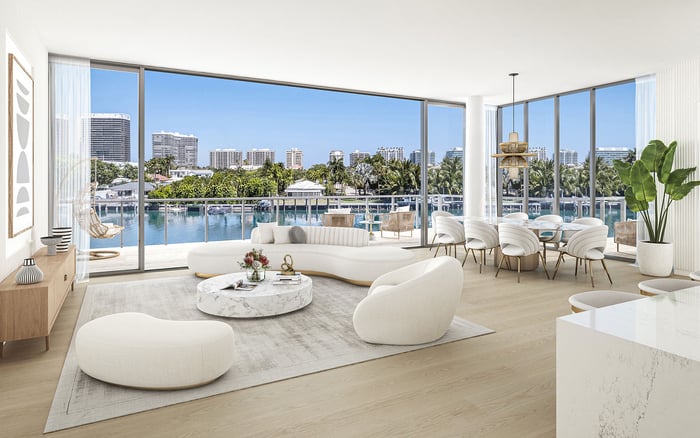
Glass House Boca Raton belongs in this comparison because it raises the classic Boca Raton luxury question: how do refined residential interiors perform when a serious collection arrives? For international buyers who may even file their search under Boca-ratón, the answer should come from verified specifications rather than assumptions.
The first issue is movement. A collector should directly confirm whether large-format crates can travel from street or loading areas to residences without tight turns, low clearances, elevator limitations, or corridor conflicts. This is especially relevant for oversized paintings, framed photography, dimensional works, and delicate objects that cannot be tilted, stacked, or rotated casually.
The second issue is installation readiness. Before assuming a residence can accommodate heavy or large-scale works, buyers should ask for clarity on wall construction, blocking, ceiling heights, lighting controls, and structural capacity. A beautiful wall is not necessarily an art wall. The difference may be backing, load tolerance, power access, glare control, and the ability to support future rehangs without compromising finish quality.
Rules matter as much as dimensions. Buyers with significant art or collectible holdings should request written guidance on insured art handlers, elevator padding, delivery windows, common-area protection, and oversized-item moves. The strongest answer is not verbal reassurance, but a predictable process that can be shared with an installer before a purchase contract becomes irreversible.
La Baia North Bay Harbor Islands adds a different layer to the diligence exercise. In Bay-harbor, island living creates a distinctive luxury atmosphere, yet waterfront conditions and access logistics deserve careful attention when valuable objects are involved.
Here, the buyer should confirm the practical route for art handlers from truck arrival to residence entry. That means asking about loading access, service elevator dimensions, back-of-house circulation, corridor widths, and any moments where handlers would need to navigate common areas. The best installation plan is measured in inches and turning radii, not adjectives.
Waterfront exposure also changes the conservation conversation. Purchasers should evaluate whether humidity, salt air, and storm-season logistics create special requirements for transport, scheduling, wrapping, acclimation, and in-unit climate stability. This does not mean a waterfront residence cannot be collection-ready. It means the property should be evaluated as an environment, not only as an address.
Association rules deserve equal attention. A purchaser should confirm requirements for third-party vendors, insurance certificates, protection of common areas, elevator reservations, and after-hours installation work. A high-value installation can involve multiple specialists, precise timing, and careful sequencing. If the building limits access windows or requires unusual approvals, those rules should be understood before art is shipped.
The Residences at Mandarin Oriental Boca Raton introduces the branded-residence dimension. The value proposition is not only physical space, but also service culture, security posture, and operational framework. For an art collector, that can be an advantage when protocols are clear and coordinated. It can also add another layer of approvals if vendor access, delivery timing, and private service circulation are tightly managed.
Diligence should therefore include both physical freight access and brand or service protocols. Buyers should ask how management coordinates deliveries, private service access, and security procedures for high-value collections. If a sculpture arrives on a specific truck, with insured handlers and limited installation tolerance, the building’s process should support the operation rather than improvise around it.
Storage is another crucial question. Buyers should ask whether any on-property storage is climate-controlled and suitable for art, wine, archives, or other sensitive collectibles. Ordinary storage may be acceptable for luggage or seasonal décor, but not necessarily for works on paper, photographs, textiles, documents, leather, rare books, or temperature-sensitive assets.
For collectors, the branded setting should be reviewed through two parallel questions. First, can the physical building receive, protect, and circulate significant objects? Second, can the operating culture coordinate those movements quietly, securely, and predictably?
New-construction luxury buyers often spend great energy on finishes, views, parking, and amenity programming. Those still matter, but for collection owners the more consequential items may sit in the technical packet and governing documents.
A family office comparing these three properties should build a checklist around crate dimensions, dock availability, elevator size, elevator capacity, corridor widths, HVAC redundancy, humidity tolerances, storage conditions, and emergency protocols. The same checklist should include vendor insurance requirements, elevator padding rules, common-area protection standards, after-hours work policies, and security procedures for discreet deliveries.
HVAC performance is central. Climate stability is not simply about comfort. It is about whether interior conditions can remain within reasonable tolerances for sensitive materials through seasonal humidity, intense heat, owner absences, and storm-related disruptions. Buyers should ask how systems are designed, what can be controlled in-unit, what is monitored by building operations, and what happens during service interruptions.
Security should be discussed without theatricality. High-value collections require confidentiality, predictable access control, and a clear understanding of who sees delivery information. A refined building culture should minimize exposure, coordinate arrivals discreetly, and keep sensitive vendor details limited to appropriate personnel.
Final condo documents, building engineer input, and developer confirmations are essential for 2026 buyers because granular specifications may not be visible in public-facing materials. The right question is not whether a property feels luxurious. It is whether its hidden systems and rules align with the way the owner actually lives with valuable objects.
This is not a beauty contest. Glass House Boca Raton, La Baia North Bay Harbor Islands, and The Residences at Mandarin Oriental Boca Raton should be compared through operational fit.
Glass House Boca Raton should be tested for the physical realities of installation: wall readiness, lighting control, service access, and the movement of large crates. La Baia North Bay Harbor Islands should be examined through waterfront-island logistics, humidity awareness, salt-air considerations, and association rules for specialist vendors. The Residences at Mandarin Oriental Boca Raton should be reviewed for the interplay between branded service standards, freight movement, security, and climate-appropriate storage.
The refined buyer will ask for written answers, not broad assurances. A residence that can welcome a dinner party is one thing. A residence that can receive, hang, store, insure, and protect a significant collection is another. In South Florida’s next luxury cycle, the second standard may become the more revealing one.
What is the first due-diligence question for an art collector? Confirm the full route from truck arrival to residence entry, including turns, clearances, elevator size, and common-area protection.
Why does freight access matter in a luxury condominium? Large crates, sculpture, and delicate works may not tolerate tight turns, tilting, or improvised handling through public spaces.
What should buyers ask at Glass House Boca Raton? Ask about crate movement, elevator rules, wall construction, blocking, ceiling heights, lighting controls, and oversized-item procedures.
What makes La Baia North Bay Harbor Islands different for collectors? Its waterfront-island context makes humidity, salt air, storm-season planning, and vendor access especially important to verify.
What should buyers review at The Residences at Mandarin Oriental Boca Raton? Review branded-residence protocols for deliveries, vendor access, private service circulation, security, and climate-controlled storage.
Is ordinary storage suitable for art or archives? Not necessarily. Sensitive objects may require climate control, stable humidity, security, and conditions beyond typical household storage.
Should association rules be reviewed before closing? Yes. Delivery windows, insurance certificates, elevator padding, after-hours work, and vendor approvals can affect installation timing.
Why is HVAC performance part of art diligence? Temperature and humidity stability can affect works on paper, photography, textiles, furniture, wine, books, and archival materials.
Can public marketing materials answer all technical questions? Often they cannot. Buyers should seek final documents, developer confirmations, and building engineer input before relying on assumptions.
Should a family office create a separate collection checklist? Yes. The checklist should cover crate dimensions, dock access, elevator capacity, corridor widths, HVAC resilience, storage, and emergencies.
For a discreet conversation and a curated building-by-building shortlist, connect with MILLION.
If branded residences are on your mind — as a home or as an allocation — we would be glad to share what we are seeing, privately.
Begin a quiet conversation