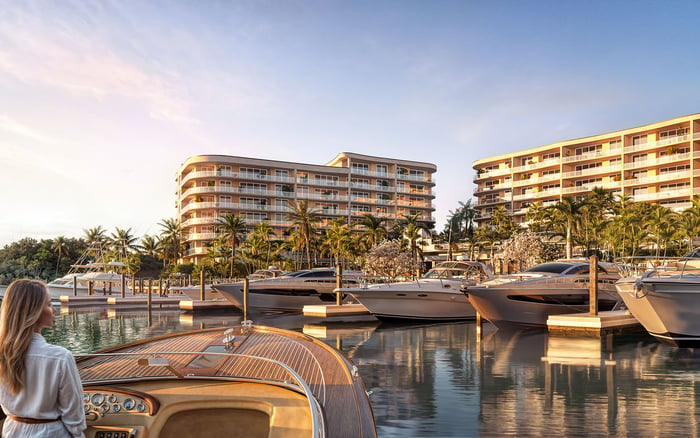
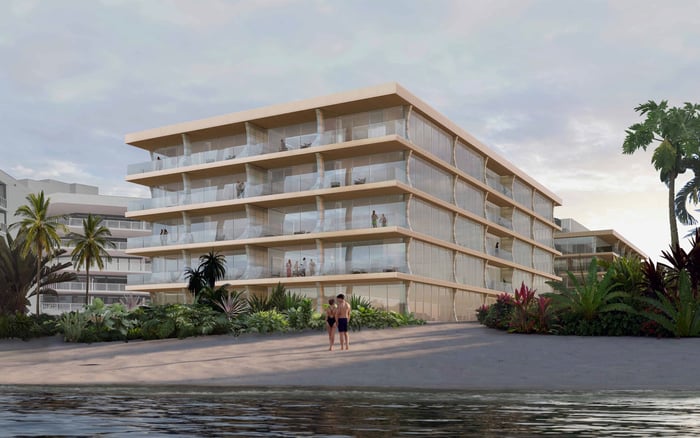
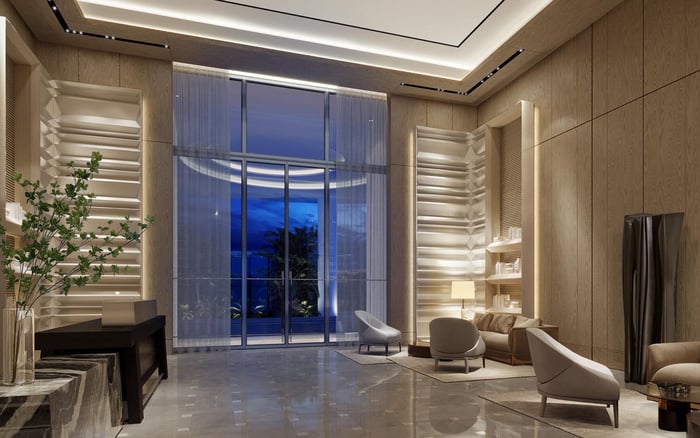
A discreet buyer framework comparing 888 Brickell by Dolce & Gabbana and The Ritz-Carlton Residences® Palm Beach Gardens through arrival choreography, security expectations, and guest discretion.

For the buyer comparing 888 Brickell by Dolce & Gabbana with The Ritz-Carlton Residences® Palm Beach Gardens, the most useful question is not which address feels more glamorous. The sharper question is operational: how life moves from curb to residence, from guest arrival to private departure, and from public attention to controlled discretion.
That is where luxury real estate becomes less about renderings and more about choreography. A residence can be visually compelling, brand-rich, and socially desirable, yet still feel inconvenient if the daily arrival sequence is exposed, compressed, or overly theatrical for the way a buyer actually lives. Another residence may be quieter in tone, yet better aligned with a family office schedule, a second-home rhythm, or a household that prizes low-friction privacy over scene.
This comparison is therefore best understood as a practical buyer study. 888 Brickell by Dolce & Gabbana sits within the language of Brickell, where verticality, urban energy, and immediate recognition are part of the appeal. The Ritz-Carlton Residences® Palm Beach Gardens speaks to a different residential instinct, one closer to resort composure, suburban spacing, and a Palm Beach mindset of privacy without performance. Within Palm Beach County, the broader branded-residence conversation can also include The Ritz-Carlton Residences® West Palm Beach, but the Palm Beach Gardens question remains distinct: how much calm, control, and guest discretion does the buyer want built into daily life? Neither posture is inherently superior. The answer depends on what the buyer needs to protect.
Arrival is the moment when lifestyle becomes visible. Buyers often focus on the residence itself, but the most revealing due diligence begins earlier: the approach, the pull-in, the valet or parking condition, the lobby threshold, the elevator transition, and the final movement to the private floor or residence entry.
At a Brickell address, the buyer should study how the building handles intensity. Urban arrival can be exhilarating, but it also raises questions about timing, circulation, and separation. Where do owners arrive during peak hours? How are guests received when multiple parties converge at once? Is there a clear distinction among resident movement, visitor flow, deliveries, staff access, and ride-share activity? For a buyer who values anonymity, the goal is not merely an elegant entrance. The goal is an entrance that does not demand social performance every time one comes home.
At Palm Beach Gardens, the arrival question often changes in tone. Instead of asking how a tower handles city velocity, the buyer may ask how a residential environment controls approach, sequence, and calm. Is the entry experience ceremonial, private, or both? Does the property feel protected without feeling institutional? Can family, drivers, service providers, and overnight guests move through the property without unnecessary exposure?
In new-construction purchases, floor plans and amenity descriptions are not enough. A serious buyer should request a precise explanation of arrival choreography, including after-hours procedures, guest confirmation, service movement, package handling, and emergency access. The smoother the choreography, the less the owner has to think about it.
Security in ultra-premium residential real estate is often discussed in broad language, but sophisticated buyers know the difference between visible security and intelligent security. The former can reassure. The latter can disappear into daily life while still creating confidence.
For 888 Brickell by Dolce & Gabbana, the practical question is how a high-profile urban residence balances brand visibility with private control. A recognizable address can be an asset, especially for buyers who want proximity to the financial, dining, and cultural energy of Brickell. Yet visibility also means the operational plan matters. The buyer should understand where public awareness ends and resident-only life begins.
The right questions are specific. How are visitors identified before they reach private residential areas? Are guests announced in a way that preserves discretion? Are staff routes separated from owner routes where appropriate? How are contractors, stylists, chefs, medical personnel, tutors, assistants, and drivers processed without creating unnecessary lobby theater? These are not minor details. They are the lived architecture of privacy.
For The Ritz-Carlton Residences® Palm Beach Gardens, the security conversation may be less about urban exposure and more about residential continuity. Buyers should examine how the property supports daily routines over time: seasonal occupancy, extended family stays, household staff, visiting friends, club schedules, and service appointments. The best posture feels calm to residents and legible to staff, while remaining unobtrusive to guests.
A luxury buyer should avoid equating heavier visible controls with better security. The more relevant measure is whether the building or community can consistently identify who belongs where, at what time, and under what permissions, without making the owner feel managed.
Guest discretion is a subtle but decisive category. Many buyers entertain, host family, receive advisors, or maintain households with complex schedules. In that context, privacy is not isolation. It is the ability to welcome people without turning every visit into a visible event.
At an urban branded residence, the guest experience carries social energy. That can be attractive for buyers who want an address with presence. Yet the buyer should test whether that presence becomes friction when discretion is required. Can a guest arrive quietly? Can a dinner guest, business advisor, or family member move from vehicle to residence without unnecessary observation? Are there protocols for multiple guests, last-minute arrivals, or high-profile visitors?
At a Palm Beach Gardens residence, guest discretion may be judged by a different standard: ease, calm, and control. The buyer might care less about dramatic arrival and more about whether guests feel expected, protected, and naturally absorbed into the property. For owners who divide time between residences, the question becomes even more practical. Can the property handle a second-home lifestyle gracefully when the owner is away, returning, or hosting for the season?
The most refined hospitality is often quiet. It does not require guests to decode the building. It does not place staff in awkward improvisation. It does not make visitors feel surveilled, but it also does not allow ambiguity. The protocols should be gracious, repeatable, and aligned with the owner’s household culture.
The 888 Brickell by Dolce & Gabbana buyer is likely to be comfortable with an address that carries urban identity and design-forward recognition. This buyer may value immediate access, vertical living, a strong aesthetic point of view, and the social electricity of Brickell. The central due diligence is whether the building’s private systems are strong enough to support a life that may sometimes require invisibility.
The Ritz-Carlton Residences® Palm Beach Gardens buyer may be drawn to a quieter residential cadence. This buyer may care about a composed approach, intuitive service culture, and a setting that supports family, wellness, golf, boating, seasonal living, or a less public version of luxury. The essential due diligence is whether the environment delivers enough privacy, control, and convenience without feeling remote from the owner’s desired daily circuit.
The choice is not simply Miami versus Palm Beach County, nor branded fashion versus branded hospitality. It is a question of temperament. Does the buyer want to be close to the center of urban movement, with privacy engineered around intensity? Or does the buyer want residential calm first, with service and access layered into a more measured environment?
Before selecting either property, a serious buyer should walk the path of daily life. Arrive at different times of day. Ask how guests are handled. Understand parking, valet, lobby, elevator, and service sequences. Clarify whether household staff can operate efficiently. Discuss how privacy is maintained during events, holidays, peak season, and nearby construction periods.
The buyer should also separate brand emotion from operational fit. Brand can signal taste, service, and aspiration, but it does not replace the need to understand how the residence functions when a flight lands late, a guest arrives early, a driver waits downstairs, or a family member needs private access. In the ultra-prime market, the most expensive inconvenience is often the one discovered after closing.
For a Palm Beach-oriented household, quiet continuity may outweigh urban drama. For a Brickell buyer, immediate access and architectural identity may justify a more active arrival environment, provided the building’s private systems are convincing. The best answer is the one that matches the owner’s actual calendar, not an imagined weekend.
Is 888 Brickell by Dolce & Gabbana better for buyers who want city energy? It may suit buyers who value Brickell access, vertical living, and a recognizable design identity, provided the privacy systems match their expectations.
Is The Ritz-Carlton Residences® Palm Beach Gardens more privacy oriented? It may appeal to buyers seeking a calmer residential rhythm, but the specific privacy experience should be tested through arrival and guest protocols.
What is the most important arrival question to ask? Ask how residents, guests, staff, deliveries, and ride-share vehicles move through the property without overlapping unnecessarily.
Does a branded residence automatically mean better service? Not automatically. Buyers should evaluate how service is organized, trained, and translated into daily residential life.
Why does guest discretion matter so much? It determines whether family, advisors, friends, and staff can visit without creating unwanted visibility or friction.
Should buyers prioritize visible security? Visible security can reassure, but intelligent access control and consistent protocols are usually more important.
Which property is better for a second-home buyer? The answer depends on travel patterns, household staffing, guest frequency, and whether the owner prefers city energy or calmer seasonal use.
What should buyers ask before contract review? They should ask for clear explanations of access, visitor approval, parking, service routes, package handling, and after-hours procedures.
Can an urban residence still feel discreet? Yes, if the building separates public energy from private residential movement with disciplined operational design.
Can a quieter residence still feel too exposed? Yes, if arrival, guest, or service routines are not carefully controlled and consistently executed.
When you're ready to tour or underwrite the options, connect with MILLION.
If branded residences are on your mind — as a home or as an allocation — we would be glad to share what we are seeing, privately.
Begin a quiet conversation