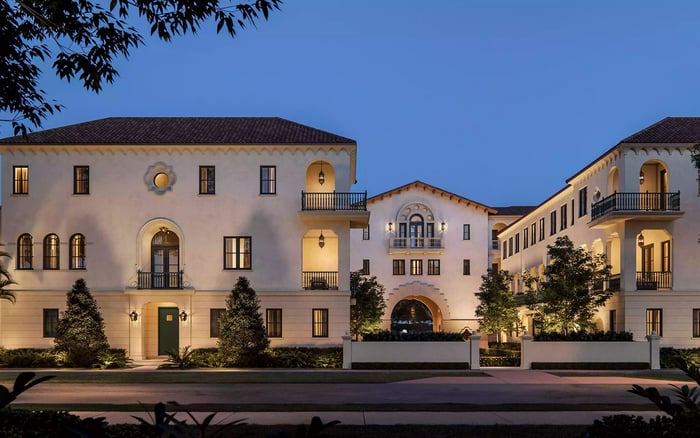
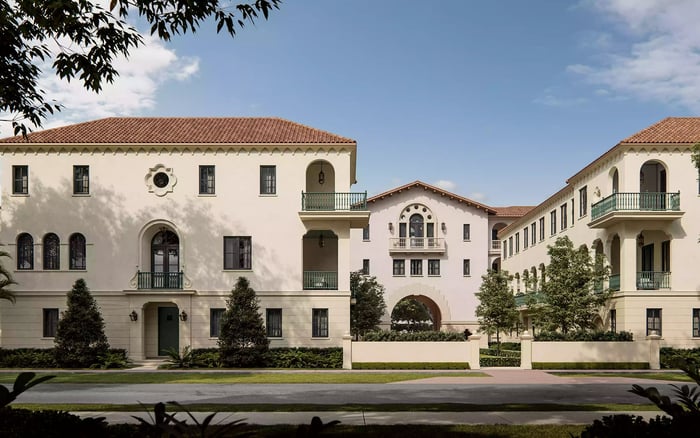
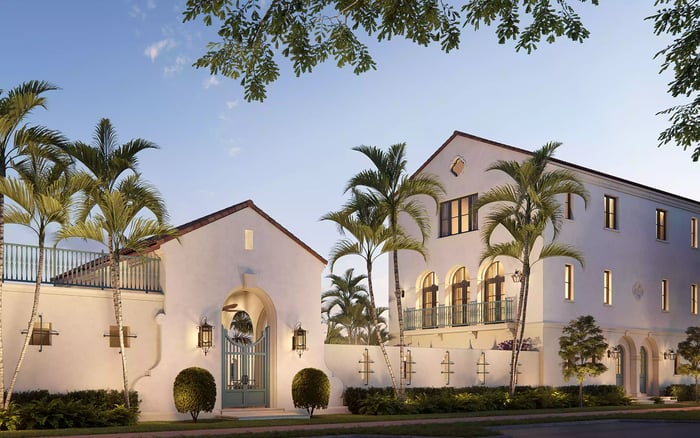
For globally mobile buyers accustomed to privacy, the right South Florida home treats security as choreography rather than spectacle. The strongest choices combine calm arrivals, layered access, thoughtful landscaping, service protocol, and architecture that protects without announcing itself.
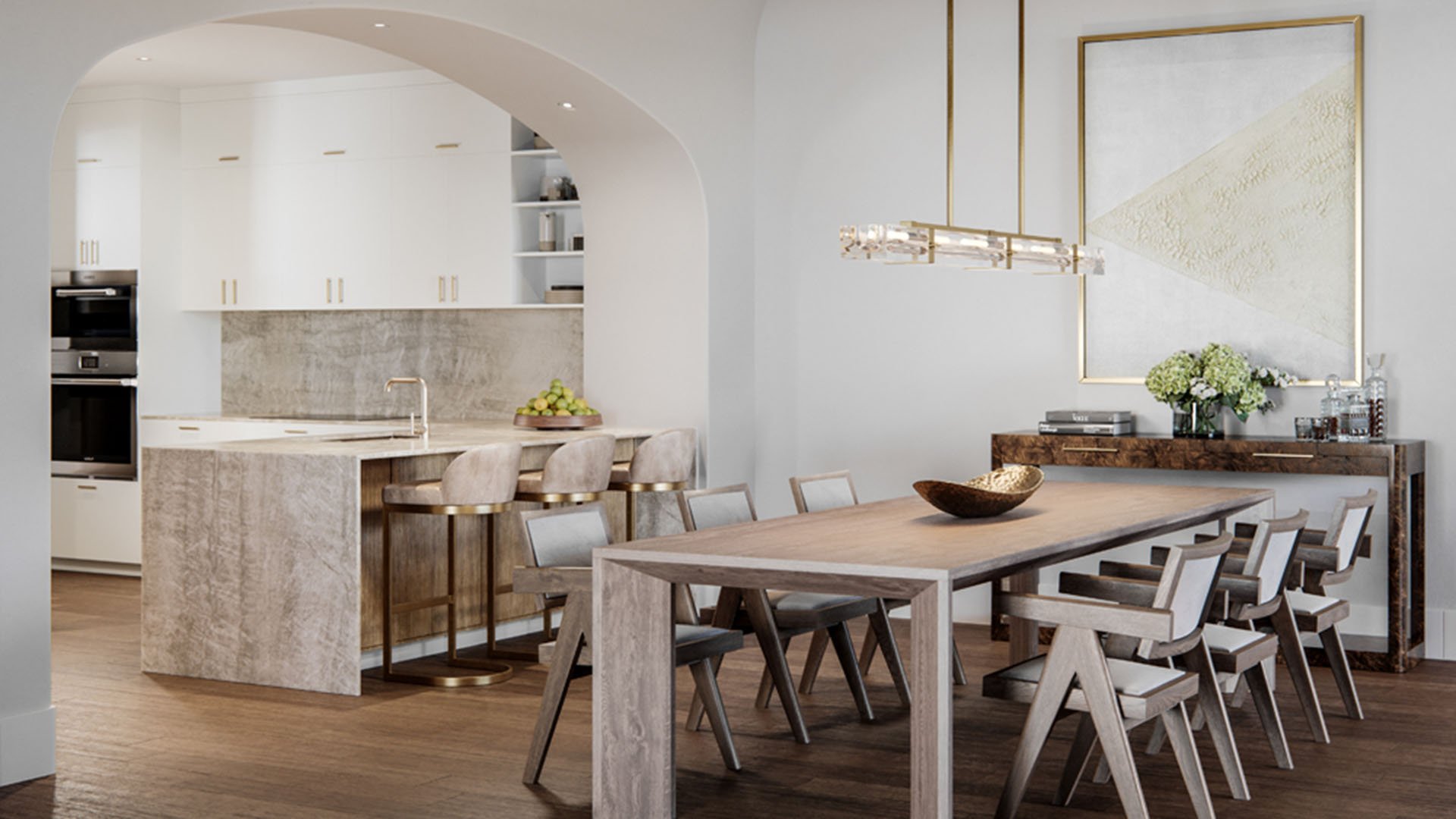
For a buyer arriving from Geneva, the question is rarely whether a South Florida residence can be secured. The more refined question is whether it can be secured without appearing secured. At the top of the market, theatrical gestures often signal the opposite of confidence. High walls, obvious cameras, aggressive lighting, and fortress-like gates can make a home feel reactive. Discretion comes from proportion, choreography, and restraint.
South Florida rewards this quieter approach. The region offers private streets, full-service towers, guarded islands, intimate enclaves, and residences where landscape architecture does as much work as hardware. The best home is not the one with the loudest perimeter. It is the one where arrivals feel calm, staff movement is logical, guest access is controlled, children move comfortably, and the principal never feels on display.
Security begins before the front door. A discreet home should reveal itself gradually: street, threshold, forecourt, lobby, vestibule, then private interior. Each layer should feel architectural rather than defensive. In Coral Gables, that may mean a shaded approach, a garage that does not dominate the facade, and planting that screens views without creating a closed-off mood.
For buyers considering new residences near the city’s established residential fabric, Ponce Park Coral Gables speaks to the appeal of a walkable, composed setting where privacy is achieved through scale and planning rather than spectacle. The same principle applies in larger homes: the ideal arrival lets invited guests feel welcomed while giving the household clear control over who moves deeper into the property.
Ask three questions during every showing. Can a driver, family member, or guest enter without unnecessary exposure? Is there a dignified place for screening, waiting, or receiving deliveries? Does the architecture make security feel natural, or does it require visible correction?
Coral Gables appeals to buyers who want order, canopy, heritage, and residential continuity. That makes it a natural counterpoint to more overtly branded or vertical forms of luxury. The security brief here should be especially precise. A heavy-handed intervention can feel out of character, while a well-designed one can disappear into the language of courtyards, walls, hedges, loggias, and interior gardens.
At The Village at Coral Gables, the idea of village living offers a useful lens: security is most elegant when it is embedded in place-making. Human scale, defined passages, controlled access points, and thoughtful transitions can make a residence feel both sociable and protected.
For a Geneva buyer, the parallel is not climate or architecture. It is the expectation of composure. A home should allow privacy without isolation, staff without intrusion, entertaining without exposure, and family life without a visible apparatus around it.
In a tower, discretion depends on operations. A beautiful lobby is not enough. Buyers should understand how residents, guests, deliveries, contractors, valet, domestic staff, and private security move through the building. The question is not whether access control exists. The question is whether it is calm, consistent, and invisible to daily life.
In Brickell, for example, the appeal of vertical living is strongest when the building separates public energy from private residence. At The Residences at 1428 Brickell, buyers can use the broader idea of a high-design urban residence to frame due diligence: elevator strategy, staff protocol, package handling, parking flow, and the experience of coming home at different hours all matter.
A tower may feel safer because it has layers of staff and controlled circulation. Yet the most important test is experiential. Does the principal have to pass through crowded amenity zones? Are guests announced with discretion? Can a family arrive from dinner, school, or the airport without becoming part of a lobby scene? If the answer is no, the amenities do not compensate for the loss of privacy.
A gated community can be useful, but the phrase itself should not end the conversation. Gates create an outer layer. They do not automatically create discretion inside the home. The more valuable inquiry is how many transitions exist between the public realm and the private rooms, and whether those transitions are handled gracefully.
For buyers who prioritize separation, island and enclave living can be compelling. The Links Estates at Fisher Island illustrates the appeal of a setting where privacy is part of the overall residential premise. Still, even in the most private setting, the individual residence must be studied: sightlines from neighboring homes, service access, dock or vehicle movement, garden exposure, and the relationship between entertaining areas and family spaces.
The goal is not to hide from the world. It is to choose a home where the world does not enter by accident.
New construction can offer a major advantage because privacy and security can be integrated before finishes are selected. Retrofitting often introduces compromise: cameras placed where wiring allows, shades added after glare becomes obvious, doors reinforced without regard to sightlines, or staff paths improvised once the household is already in motion.
During due diligence, ask for the security conversation to be paired with the design conversation. Landscape, lighting, glass, entry hardware, garage configuration, elevator access, smart-home systems, safe rooms, staff quarters, and storage all interact. A serene home is usually the result of early coordination, not late anxiety.
The most successful residences make everyday life frictionless. Deliveries do not interrupt dinner. Vendors do not cross family zones. Guests are welcomed without confusion. Children and relatives know where to go. The principal’s suite has privacy not only from outsiders, but also from the normal working life of the home.
A serious security-minded purchase should be evaluated in layers. First, the neighborhood: approach roads, privacy of arrival, street rhythm, visibility, and the character of adjacent properties. Second, the site: setbacks, landscape depth, lighting, service access, and views into principal rooms. Third, the building or house: entry sequence, internal zoning, garage and elevator logic, glazing, terraces, and outdoor rooms. Fourth, operations: staff training, guest protocol, technology management, and maintenance.
Avoid buying a security image. Buy a security experience. The difference is visible in small moments: a car door opening under cover, a guest greeted by name, a package received without entering private space, a terrace that feels open to the sky but not to neighboring eyes.
For the Geneva buyer, South Florida’s best homes offer a rare combination: warmth, resort ease, and privacy that can be tuned to a very high level. The right choice will not feel theatrical. It will feel quiet, exact, and inevitable.
What does discreet residential security mean in South Florida? It means layered privacy, controlled access, and calm daily operations without making the home feel defensive or overexposed.
Is a gated setting always the best choice? Not always. A gate is only one layer, while sightlines, arrivals, staff flow, and interior zoning often matter more.
Why is Coral Gables appealing to privacy-focused buyers? Its residential character, canopy, and composed streetscapes can support a security approach that feels elegant rather than conspicuous.
What should condominium buyers evaluate first? Study elevator access, lobby flow, valet operations, delivery handling, guest protocol, and how residents move from car to residence.
How can landscaping improve security discreetly? Planting can soften views, guide movement, create privacy buffers, and reduce exposure without the visual weight of hard barriers.
Should security technology be visible? Ideally, no. Cameras, access systems, lighting, and sensors should be integrated into the architecture and landscape whenever possible.
What is the biggest mistake luxury buyers make? They focus on visible features instead of how the home actually functions during arrivals, entertaining, staffing, and family life.
Is new construction better for a discreet security plan? It can be, because privacy, wiring, access, and service circulation can be coordinated before the residence is completed.
How should international buyers compare towers and estates? Towers offer managed layers and staff, while estates offer control of the site; the better choice depends on lifestyle and privacy needs.
When should a buyer bring in security advisers? Early in the search, ideally before design changes or contract decisions, so security can support the architecture rather than distort it.
For a discreet conversation and a curated building-by-building shortlist, connect with MILLION.
If branded residences are on your mind — as a home or as an allocation — we would be glad to share what we are seeing, privately.
Begin a quiet conversation