A discreet underwriting view of how arrival design shapes perceived value, operating risk, and buyer confidence at the upper end of South Florida residential real estate.
At the ultra-premium end of South Florida residential real estate, the earliest moments of arrival can do more than set a mood. They can confirm pricing power, expose operational weakness, and determine whether a building feels composed under pressure. That is the useful lens for comparing Five Park Miami Beach with Nora House West Palm Beach: not as a beauty contest, but as an underwriting exercise across lobby volume, porte-cochère privacy, and valet choreography.
Five Park Miami Beach should be evaluated in a Miami Beach context where arrival is central to perceived value. The street interface becomes more than a design condition. It becomes a risk surface. A buyer should ask whether the building can absorb resident arrivals, guest arrivals, deliveries, rideshare activity, and valet turnover without allowing friction to become part of the brand memory.
Nora House West Palm Beach should be examined with equal discipline, even if the questions may feel more intimate. A West Palm Beach buyer may read privacy, neighborhood cadence, and service ease differently than a Miami Beach buyer, but the diligence should not be softer. For portfolio classification, Miami Beach and West Palm Beach are not interchangeable underwriting labels. Each market asks the arrival sequence to perform in a different social and operational setting.
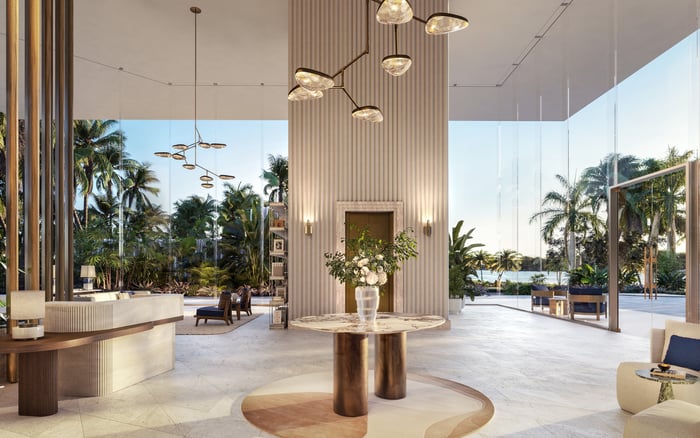
Lobby volume is often sold as emotion: height, light, art, procession, and the confidence of space. For underwriting, the question is narrower and more consequential. Does the lobby support absorption velocity, buyer perception, and long-term positioning, or does it simply create a photogenic moment that is expensive to maintain?
At Five Park Miami Beach, lobby volume should be read as part of brand durability. A generous lobby can signal permanence, hospitality-level service, and a controlled arrival that affluent buyers recognize quickly. But the value case depends on whether the space remains persuasive when the building is busy. A lobby that feels grand only when empty is not doing the same work as one that handles peak use with calm.
For Nora House West Palm Beach, the buyer should ask whether the lobby is scaled to the promise. Boutique does not automatically mean better, and large does not automatically mean impersonal. The correct test is alignment: does the volume match the resident profile, staffing model, service rhythm, and expectation of privacy? Boutique scale can be powerful when it creates recognition and ease, but it can become fragile if every arrival feels visible.
The underwriting translation is straightforward. Lobby volume belongs in the model through pricing confidence, amenity comparability, operating expense, and resale defensibility. New-construction buyers are not simply purchasing square footage. They are buying a repeated experience of arrival, greeting, transition, and release from the public realm.
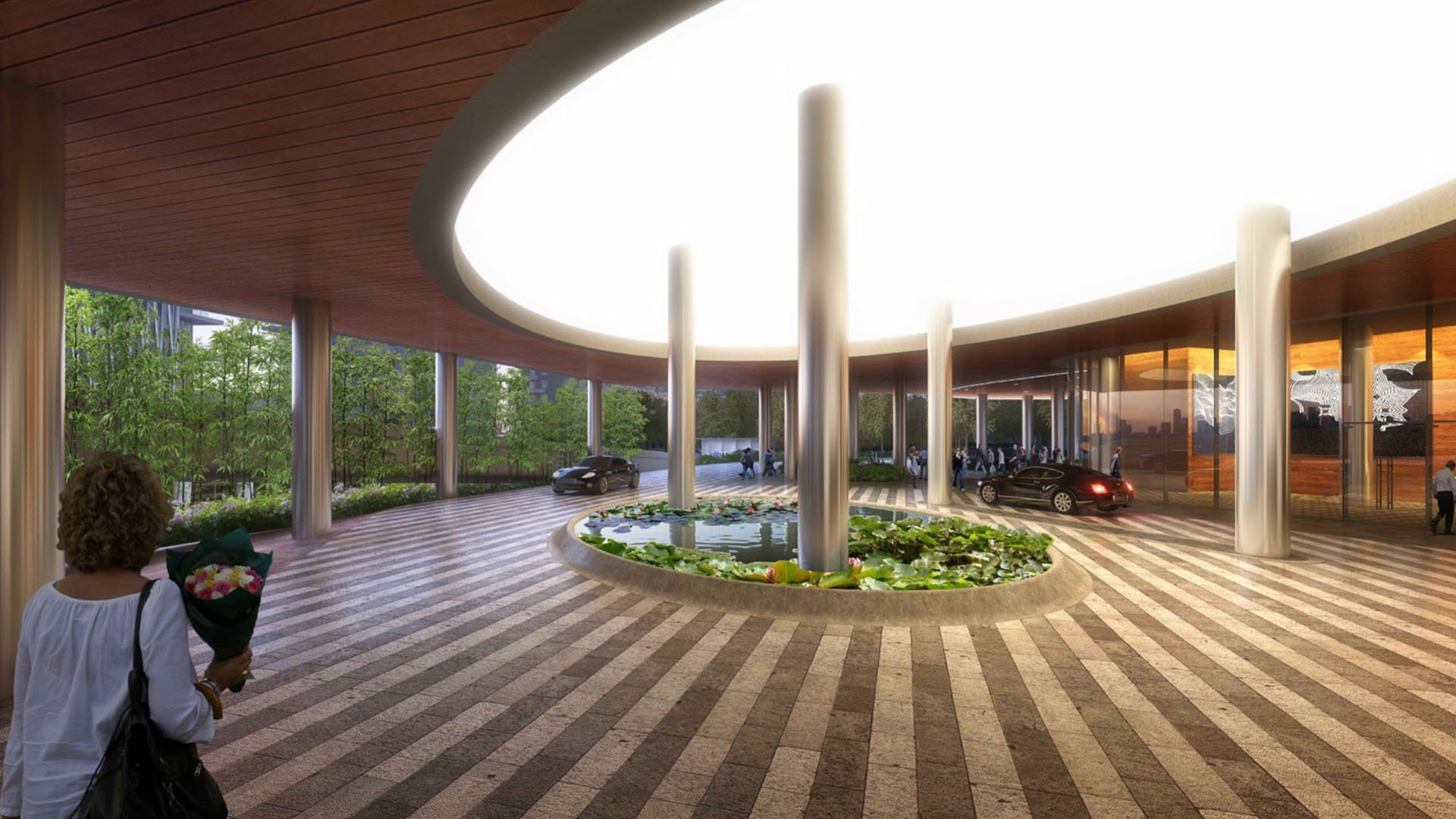
The porte-cochère is where exclusivity either holds or leaks. In South Florida’s luxury market, visual separation from the street can materially affect perceived privacy. This is especially true where the public realm is active, the building profile is prominent, and the buyer expects a transition from city energy to residential control.
For Five Park, porte-cochère privacy deserves specific underwriting attention because the project is being considered through a Miami Beach lens. The diligence is not limited to whether a covered drop-off exists. It should consider sight lines, queue depth, turning movements, pedestrian interface, and whether residents can arrive without feeling displayed.
Privacy is not only about concealment. It is about choreography. A well-resolved porte-cochère allows the resident to feel expected, not processed. It gives staff enough space to perform well, guests enough clarity to move naturally, and vehicles enough room to avoid the awkward compression that erodes luxury.
For Nora House West Palm Beach, the same principle applies through a different filter. A quieter setting can create a sense of discretion, but discretion should not be assumed. The underwriting questions remain practical: what is visible from the street, where does a vehicle wait, how does a guest understand the arrival path, and does the drop-off protect the resident’s sense of separation?
Valet is often treated as a service amenity. In a serious underwriting model, it is an operating-risk variable. If valet turnover is slow, if queues spill into the wrong place, or if rideshare and delivery movements compete with residents, the building’s luxury promise becomes vulnerable at precisely the moment it should feel most controlled.
Five Park Miami Beach should be stress-tested across peak periods. The relevant scenarios include resident returns after dinner, simultaneous guest arrivals, delivery windows, rideshare pickups, and staff shift changes. The question is not whether the arrival looks elegant in plan. The question is whether the choreography survives real use.
Queue depth and curb management are especially important when public movement and private expectation meet at the same threshold. Resident and guest separation also matters. A buyer who has committed to a premier residence does not want the first experience home to feel like a hotel driveway at capacity. Hospitality-level expectations can support pricing, but they also raise the standard for staffing, training, and daily execution.
For Nora House West Palm Beach, valet diligence should focus on proportionality. A smaller or more neighborhood-driven project may not require the same infrastructure as a larger Miami Beach building, but it still must make service feel effortless. Underwriting should ask whether the operating plan matches the sales promise and whether staffing costs have been realistically contemplated.
Investment discipline begins when aesthetic language becomes measurable. Lobby volume can be translated into pricing confidence and buyer retention. Porte-cochère privacy can be translated into premium positioning and reputational resilience. Valet choreography can be translated into operating expense, service risk, and resident satisfaction.
For Five Park, the arrival sequence should not be treated as a decorative amenity package. It is part of the building’s competitive thesis in Miami Beach. The more exposed the setting, the more important it becomes to model the points where public movement and private expectation meet.
For Nora House West Palm Beach, the best approach is to avoid importing assumptions from a different market. A West Palm Beach arrival may succeed through quietness, recognition, and neighborhood fit, but those qualities must still be verified through plans, service programming, and the resident journey. The most valuable comparison is not which project feels grander. It is which project’s arrival logic is better matched to its buyer.
A sophisticated buyer or lender should ask for the arrival to be demonstrated, not merely described. How many vehicles can be accommodated without visible tension? Where do deliveries go? Can staff distinguish residents from guests without creating awkward pauses? What happens when several residents arrive at once? Does the lobby still feel composed when the building is active?
The most resilient luxury buildings make these answers feel invisible. That invisibility is expensive, deliberate, and worthy of underwriting. When it works, it strengthens absorption, protects resale confidence, and reinforces the building’s place in the market. When it fails, the weakness is repeated every day at the front door.
Why is arrival design so important in luxury residential underwriting? Arrival design shapes the buyer’s first and repeated impression while revealing service capacity and operational discipline.
How should lobby volume be evaluated at Five Park Miami Beach? It should be tested as a contributor to pricing power, buyer confidence, and brand durability, not only as visual drama.
Does a larger lobby always create more value? No. Scale matters only when it supports service, comfort, circulation, and the building’s long-term positioning.
Why does porte-cochère privacy matter? It helps create visual separation from the street, reinforcing exclusivity and a calmer residential transition.
What is the key valet risk for an urban luxury building? Congestion. If vehicles, guests, rideshare activity, and deliveries compete in the same space, the luxury experience can weaken quickly.
How should Nora House West Palm Beach be compared with Five Park? Compare the arrival logic rather than assuming the same standard applies in both markets. West Palm Beach may reward discretion differently than Miami Beach.
What should lenders focus on in the arrival sequence? Lenders should connect arrival features to absorption, operating expense, service risk, and long-term competitive positioning.
Can valet service affect resale confidence? Yes. Repeated service friction can influence resident satisfaction and how future buyers perceive the building’s quality.
Is boutique scale automatically more private? Not necessarily. Privacy depends on sight lines, staffing, circulation, and how visible the arrival feels in daily use.
What is the simplest test for arrival quality? Ask whether the building still feels calm, private, and controlled during peak activity, not only during a quiet tour.
If you'd like a private walkthrough and a curated shortlist, connect with MILLION.
If branded residences are on your mind — as a home or as an allocation — we would be glad to share what we are seeing, privately.
Begin a quiet conversation