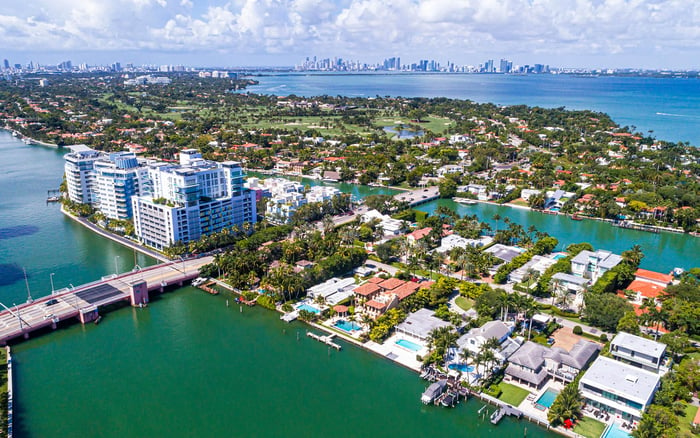
A strategic guide for Aspen buyers considering Miami as a business and residential base, with a focus on neighborhood fit, privacy, service, and portfolio flexibility.

For a buyer moving from Aspen to Miami, the strongest residential decision rarely begins with a floor plan. It begins with a business map. Where will meetings happen most often? How much time will be spent in the office, at home, in private aviation, at a club, or moving between schools and family commitments? The residence should not merely be beautiful. It should reduce friction.
Aspen owners are often disciplined about environment, privacy, and seasonal rhythm. Miami requires a different kind of precision. The city rewards buyers who understand whether they need a true weekday base, a family compound, a formal entertaining residence, a lock-and-leave pied-a-terre, or a long-term South Florida anchor. The answer may be one property, or it may be a phased strategy that begins with a condominium and later expands into a single-family or estate position.
A written brief might label priorities as Brickell, Miami Beach, Coconut Grove, West Palm Beach, investment, second home, or new construction. The real work is translating those labels into daily routine.
The first decision is not whether Miami feels more urban, coastal, or social. It is how the buyer intends to operate. A principal who expects regular meetings in the financial core may view Brickell differently from someone who prizes a quieter residential cadence. In that context, a project such as The Residences at 1428 Brickell belongs in a conversation about vertical living close to the center of the city.
For buyers who want hospitality, privacy, and a recognizable service standard, branded residential towers can serve as both lifestyle infrastructure and operational convenience. St. Regis® Residences Brickell is the kind of address a relocating buyer may consider when the residence must support formal arrivals, hosted meetings, and a polished daily environment.
The important distinction is not simply neighborhood prestige. It is whether the address supports the buyer’s week. A spectacular residence in the wrong pattern can become inefficient quickly. A well-chosen residence can make Miami feel immediately legible.
Relocation is not only a financial decision. It is an emotional and logistical one. Families often need to consider school commutes, household staff, guest patterns, pets, security expectations, and how often extended family or business guests will visit. A buyer arriving from a mountain resort environment may prioritize quiet, retreat, and a building culture that does not feel transient.
Coconut Grove can appeal to buyers who want a more residential atmosphere while remaining connected to Miami’s commercial and cultural life. Four Seasons Residences Coconut Grove may enter the conversation for buyers who want service and greenery without defaulting to the most urban version of Miami living.
This is where the best advisory work becomes highly personal. The right home should answer questions that are not visible in a listing: how the family enters, where guests wait, how staff circulate, whether elevators feel discreet, how terraces are used, and whether the residence can support both a quiet morning and a formal evening.
Some buyers are not relocating to Miami simply to work. They are choosing a South Florida identity. Miami Beach carries a different tone from Brickell or the Grove. It can be more expressive, more social, and more closely tied to the cultural idea of Miami. For a buyer who entertains often, values beach proximity, or wants the residence to feel like a destination, Miami Beach may be central to the brief.
A residence such as Shore Club Private Collections Miami Beach can be evaluated through the lens of how a buyer wants to live when business ends. The after-hours setting matters: where dinner happens, how guests arrive, how often the beach is part of the day, and whether the building’s personality matches the owner’s own discretion.
Not every relocating executive wants the same visibility. Some want a residence that announces arrival. Others want a quieter address that protects the family from the social expectations of a prominent move. Both can be correct if the choice is intentional.
For some Aspen-to-South Florida buyers, Miami is the business gateway while Palm Beach offers a different residential register. The question is not which is better. It is whether the buyer needs one base or a dual-market approach. A principal might want Miami access during the workweek and a more composed coastal rhythm at other times.
In that conversation, The Ritz-Carlton Residences® West Palm Beach may suit buyers evaluating service-led living in a setting that feels distinct from Miami’s core. West Palm Beach can also be part of a broader family and lifestyle plan, particularly when the buyer wants South Florida optionality without concentrating every need in one city.
The key is to avoid making the first purchase do too much. A residence chosen as an office-adjacent base should be judged differently from a legacy-style family residence. Confusing those purposes can lead to overbuying in one category and underperforming in another.
New development and resale should be treated as separate tools. New construction can offer modern layouts, fresh services, contemporary wellness programming, and the ability to plan ahead. Resale can offer immediacy, established building culture, and a clearer sense of how an address lives day to day. Neither is automatically superior.
For a relocating buyer, timing often becomes decisive. If the business move is immediate, a finished or near-term residence may have practical value. If the move is being staged, pre-construction may allow the buyer to align a future home with a longer-term corporate or family plan.
The best approach is to underwrite lifestyle with the same discipline used for business. Compare carrying costs, service expectations, resale flexibility, view corridors, parking, arrival sequence, guest access, and the probability that the residence still fits three years from now.
An Aspen owner understands that place is more than real estate. It is an operating system. Miami is no different. The strongest residential strategy begins with clarity: business radius, privacy threshold, family rhythm, service expectations, and exit flexibility.
Buyers should resist the temptation to solve every question in a single tour. The stronger exercise is to build a short list of scenarios: urban business base, beach residence, family-oriented retreat, Palm Beach complement, and longer-term legacy asset. From there, the right property will feel less like a trophy and more like infrastructure.
For high-net-worth buyers, this is the quiet advantage of planning well. The right Miami residence can support the company, protect the family, host the right people, and preserve optionality. That is the difference between buying a beautiful apartment and building a South Florida strategy.
Should an Aspen buyer choose a Miami neighborhood before touring properties? Yes. The neighborhood should be tied to business radius, family rhythm, and privacy needs before individual residences are compared.
Is Brickell best for business relocation? Brickell can be compelling for buyers who want an urban base near the center of Miami’s business activity, but it is not the only valid strategy.
Should a relocating buyer consider Miami Beach? Yes, especially if the residence is meant to support entertaining, beach access, or a more destination-oriented lifestyle.
Where does Coconut Grove fit in a relocation plan? Coconut Grove may suit buyers seeking a more residential atmosphere while keeping access to Miami’s commercial and cultural life.
Can Palm Beach be part of a Miami relocation strategy? Yes. Some buyers use Palm Beach as a parallel residential option when they want a different pace within South Florida.
Is new construction better than resale? Not always. New construction may offer future-facing design and services, while resale may offer immediacy and established building culture.
What should buyers decide before making an offer? Buyers should clarify use pattern, privacy expectations, service needs, timing, guest flow, and long-term flexibility.
Should the residence be chosen around schools and family routines? For many relocating families, yes. Daily logistics can matter as much as views, amenities, or architectural pedigree.
Is a condominium enough for a business relocation? It can be, particularly for a lock-and-leave or office-adjacent lifestyle, but some buyers later add a larger family residence.
How should buyers compare multiple South Florida options? Compare each option by function: weekday base, beach residence, family retreat, service platform, or long-term portfolio asset.
When you're ready to tour or underwrite the options, connect with MILLION.
If branded residences are on your mind — as a home or as an allocation — we would be glad to share what we are seeing, privately.
Begin a quiet conversation