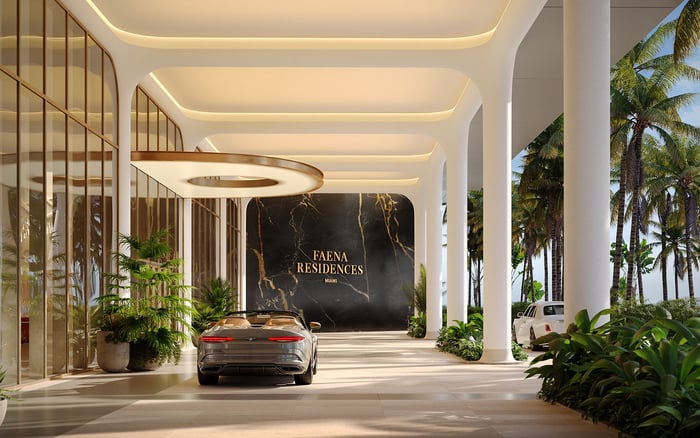
An editorial look at how Faena Residences Miami Downtown Miami can balance lock-and-leave ease with the practical staff needs of ultra-luxury owners.

For a buyer considering Faena Residences Miami Downtown Miami, the staff-room question is not simply whether a floor plan includes a room with a certain label. It is whether the residence can remain genuinely lock-and-leave while still supporting how ultra-luxury households operate when the owner is in town.
That distinction matters. Many Miami buyers at this level move among several homes, arriving for a season, a long weekend, a cultural calendar moment, or a family interval. The ideal residence can be prepared before arrival, secured after departure, and maintained without constant owner supervision. Yet the same household may also travel with a nanny, assistant, chef, security professional, stylist, nurse, or other private staff. A purely minimal lock-and-leave model can read elegantly on paper, then feel strained in practice.
Faena’s Downtown opportunity is to treat staff accommodation as part of a branded-service platform rather than as an awkward private workaround. The modern luxury answer may be flexibility, not a traditional maid’s room.
The phrase lock-and-leave has become shorthand for freedom. It promises that an owner can close the door, board a flight, and trust that the residence will remain cared for, secure, and ready to receive them again. In South Florida’s ultra-premium market, that promise carries particular weight because so many owners treat Miami as one address within a broader portfolio.
But the most sophisticated version of lock-and-leave is not empty. It includes concierge depth, housekeeping, access control, package handling, security, maintenance, and residence-preparation services. It also includes a plan for the owner’s private team. If the building does not anticipate that reality, the burden falls on the residence itself, often at the expense of privacy, circulation, storage, and daily calm.
In Downtown, the issue becomes more precise. The vertical city offers cultural access, urban connectivity, and a metropolitan rhythm distinct from Miami Beach. The appeal is not simply sun and arrival theatre, but the ability to live close to restaurants, performance, business, and the waterfront energy of the city. A Faena residence in this setting would need to translate hospitality, art, theatre, and curated lifestyle into a denser urban context.
Resale value in ultra-luxury real estate is often shaped by what a floor plan makes easy. A dramatic living room matters. So does the quiet ability to host a family office assistant for the afternoon, receive a chef without disrupting guests, store luggage between trips, or allow staff to arrive before the owner without turning the private residence into a staging area.
That is why the staff-room conversation should be viewed as a usability and Resale question, not a lifestyle preference. Some owners want no staff footprint at all, preferring that every square foot remain devoted to family, entertaining, art, and views. Others need accommodation or systems for a traveling household team. The strongest building solution serves both profiles without forcing either into an inefficient plan.
This is where Downtown peers are instructive in a broader sense. Projects such as Waldorf Astoria Residences Downtown Miami and Aston Martin Residences Downtown Miami have helped normalize the idea that branded residential value is not only about architecture or views. It is also about how convincingly the building supports the owner’s day-to-day life when the owner is present, absent, or in transition.
A fixed servant’s quarter reflects an older residential model. It can be useful for certain households, but it can also consume prime interior area in a way that feels inefficient for owners who visit intermittently or do not maintain live-in staff. The more relevant question is whether the function of staff support can be separated from the traditional form of a dedicated room.
Flexible in-unit service suites are one possible answer. A room might function as an office, wellness support space, packing room, secondary den, or occasional staff accommodation depending on the household’s needs. The value is not in the label. It is in privacy, adjacency, bath access, storage logic, and the ability to absorb service activity without disturbing the public rooms of the residence.
The best version of this thinking preserves the residence’s ceremonial areas. Owners should not have to choose between generous entertaining space and practical staff logistics. In a New-construction context, that balance can be addressed from the beginning through thoughtful circulation, discreet service access, durable support areas, and building-managed options that reduce pressure on the private floor plan.
For a branded residence, the more elegant solution may sit partly outside the unit. Building-managed staff facilities, storage, lockers, service areas, and support protocols can make staff accommodation feel like an extension of the operating model. This is especially relevant for owners who arrive with rotating teams rather than permanent household employees.
A building-level platform could help resolve the unglamorous details that determine whether a residence lives effortlessly: where luggage waits, how packages are handled, how access is permissioned, where household staff can coordinate, and how the home is prepared before the family arrives. These are not decorative amenities. They are the invisible architecture of ease.
That is why the Faena brand is particularly interesting in Downtown. Its identity is associated with hospitality, art, theatre, and curated experience. If applied thoughtfully, that sensibility could turn staff-room practicality into part of the residence’s service advantage. The point is not to make staff logistics visible. The point is to make them disappear.
The Downtown and Brickell buyer is often choosing a more connected, vertical, and urban lifestyle than a beachfront owner. That does not make the residence less luxurious. It changes the nature of luxury. Convenience, access, arrival choreography, and operational competence become as important as the view.
In Brickell, buildings such as Baccarat Residences Brickell and St. Regis® Residences Brickell sit within a market where buyers already understand that service is part of the architecture. Downtown Miami adds a cultural and metropolitan layer, making the staff question even more relevant for a Faena-branded product.
For Second-home owners, the decisive question is simple: can the residence operate at a high level before, during, and after occupancy? If the answer depends entirely on the owner improvising with private staff, storage units, and ad hoc access permissions, the lock-and-leave promise weakens. If the building anticipates those needs, the promise becomes more credible.
Buyers should ask how the residence handles staff without reducing the elegance of the owner’s experience. Is there flexible space within the unit? Can a secondary room serve multiple purposes? Are service routes and access controls discreet? Can the building prepare the residence before arrival? Are housekeeping, package handling, storage, and security coordinated enough to support intermittent ownership?
The answer does not need to be identical for every buyer. A collector who visits twice a year may value building-managed readiness above any staff suite. A family spending long school breaks in Miami may need more in-unit flexibility. An owner with a traveling chef or security detail may care less about labels and more about circulation, privacy, and operational discretion.
For Faena Residences Miami Downtown Miami, the most compelling path is to make this nuance part of the luxury proposition. Staff-room practicality should not dilute lock-and-leave living. Properly handled, it proves that lock-and-leave has matured.
Is Faena Residences Miami Downtown Miami confirmed to have staff rooms? Specific floor-plan features should not be assumed unless formally disclosed. The more important buyer question is how the building and residence may support staff needs in practice.
Why does staff accommodation matter for lock-and-leave owners? Many owners use Miami intermittently, but still arrive with private staff or need support when in residence. A true lock-and-leave home must account for both absence and active use.
Is a traditional maid’s room always the best solution? Not necessarily. Flexible service space can sometimes preserve prime living area while still supporting staff, storage, office, or preparation needs.
How does Downtown change the staff-room conversation? Downtown living is more vertical and urban, so logistics, access control, package handling, and building operations become central to the ownership experience.
Should buyers compare this issue with Brickell residences? Yes, because Brickell buyers often evaluate branded residences through the lens of service depth and daily convenience. The comparison can clarify expectations for Downtown.
Does staff-room practicality affect Resale? It can, because future buyers may value a residence that handles household operations without compromising privacy or usable living space.
What should Second-home buyers prioritize? They should prioritize residence preparation, security, access permissions, housekeeping, and the ability to support staff during short or seasonal stays.
Can building-managed spaces replace in-unit staff rooms? They may help, especially when paired with strong concierge, storage, and service protocols. The best answer depends on the household’s staffing pattern.
Is New-construction better suited to solve this issue? New-construction can address service circulation, flexible rooms, and operational support from the planning stage. That can make the solution feel integrated rather than improvised.
What is the core question for Faena buyers? The core question is whether the residence can remain effortless to leave while still functioning beautifully when the owner, family, and staff are present.
To compare the best-fit options with clarity, connect with MILLION.
If branded residences are on your mind — as a home or as an allocation — we would be glad to share what we are seeing, privately.
Begin a quiet conversation