A buyer-oriented look at what truly matters when a listing highlights Sub-Zero and Wolf: the integration details, cabinet execution, ventilation strategy, serviceability, and how these choices read in Boca Ratón’s luxury resale market.

In South Florida’s top tier, Sub-Zero and Wolf often serve as shorthand for quality. For a sophisticated buyer, though, the brand badge is only the starting point. The real evaluation is integration: how the appliances are physically and visually resolved into the millwork, how heat and air are managed, how service is handled without collateral damage, and how the kitchen performs at entertaining scale.
At 749 Bamboo Dr Boca Raton, approach the integration conversation the way you would evaluate glazing, rooflines, or a pool system: insist on specifics, confirm execution, and treat the kitchen as built-in architecture rather than a collection of products.
A serious review starts with an appliance schedule or specification sheet listing model numbers, configurations, and finish choices. From there, integration becomes something you can verify.
Key items to request and review:
Model numbers for every Sub-Zero and Wolf component, including refrigeration columns, cooking, and any undercounter units.
The intended front treatment: stainless, glass, or fully panel-ready with custom fronts.
Confirmation of any specialty pieces that affect planning, such as a steam oven, speed oven, warming drawer, or integrated coffee system.
Why it matters: two kitchens can both claim “Sub-Zero and Wolf,” yet one presents as calm, furniture-grade integration while the other reads like a standard appliance package dropped into cabinetry.
If the kitchen is designed for a concealed, panel-ready look, craftsmanship shows up in the tolerances. Evaluate the installation with a designer’s eye.
What to look for on site:
Consistent reveals around refrigerator and freezer doors, with clean lines that stay true across the full run.
Door alignment that remains even at the top and bottom. Misalignment can signal rushed installation or substrate issues.
Handles that are intentionally selected and placed consistently, or a deliberate handle-less approach executed with the right hardware.
Panels that feel rigid and substantial, not drummy or flimsy.
If the intent is a statement kitchen with professional stainless, the test shifts: symmetry across the appliance wall, clean end-panel finishing, and a stainless composition that’s balanced against stone, wood, and lighting.
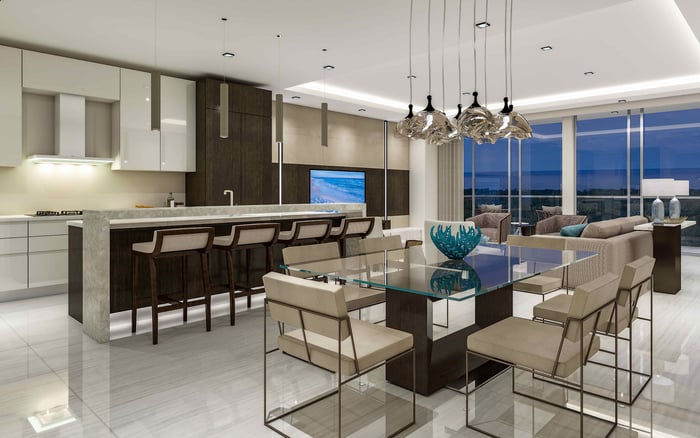
For context, luxury new developments often lean into “integrated calm” as a baseline expectation, which can shape buyer perception even in single-family homes. Consider how kitchens in Alina Residences Boca Raton are positioned to feel tailored and restrained, with appliances reading as part of the architecture rather than the centerpiece.
In South Florida, kitchens routinely work harder: open plans, frequent entertaining, high-heat searing, and humidity that makes odor control feel more urgent. Ventilation isn’t a footnote-it’s a performance feature.
Evaluation points that separate a design-forward kitchen from a truly livable one:
Hood capture: the hood should be appropriately sized and positioned relative to the cooktop, especially for high-output burners.
Ducting strategy: short, direct duct runs generally outperform long, complex routes.
Makeup air: in tighter, newer construction, makeup air can be essential to avoid pressure issues and keep the system operating as designed.
Noise control: a well-considered system feels powerful without sounding industrial.
Don’t hesitate to ask for the ventilation plan and the exact hood or blower specifications. When the kitchen claims Wolf, the expectation is that the room can comfortably handle Wolf-level cooking.
Luxury integration often relies on concealment-which can become a liability if clearances and airflow are treated casually. Refrigeration, in particular, needs breathing room and the right surround conditions.
Smart questions to ask:
Were the cabinetry cutouts built to the manufacturer’s installation requirements for each specific model?
Are there proper ventilation openings for integrated refrigeration when required?
Are there heat shields, insulating panels, or appropriate gaps around ovens and cooktops?
If there is a built-in coffee or steam appliance, is there moisture management so the surrounding millwork ages gracefully?
The point isn’t to interrogate. It’s to protect your future experience. The best kitchens feel effortless because they’re engineered to be.
Even a beautiful appliance wall can fall short if power distribution and lighting weren’t planned for real use.
Look for:
Properly placed outlets in prep zones, not awkwardly hidden behind stools or too far from where appliances actually sit.
Dedicated circuits for high-demand appliances, with clean panel labeling.
Integrated task lighting that eliminates shadows at primary prep areas.
These are the details that separate a kitchen designed for photography from one designed for a household that truly cooks.
Sub-Zero and Wolf ownership isn’t only about performance; it’s about sustaining performance over time. In a fully integrated kitchen, service access has to be designed in from day one.
Buyer-oriented service checks:
Can refrigeration units be accessed, serviced, and, if necessary, removed without destroying panels or stone?
Are shutoff valves, filters, and key connections reachable?
Is there adequate toe-kick access and removable panels where appropriate?
The strongest installations anticipate the entire lifecycle. The clearest proof is documentation: receipts, warranty registrations, and as-built drawings showing how the kitchen was executed.
In a high-design home, appliances shouldn’t compete with the materials-they should punctuate them. Sub-Zero and Wolf can sit beautifully within nearly any palette, but the integration must be deliberate.
Consider how the appliance finish complements:
Countertop reflectivity and veining direction.
Cabinet sheen and grain.
Hardware finish and lighting temperature.
If you’re comparing across markets, note how certain neighborhoods and towers have trained buyers to expect a cohesive composition. In Brickell, for example, kitchens in 2200 Brickell often pursue a polished, integrated look that reads as turnkey luxury. Even if your target is a single-family address, the reference point travels with the buyer.
A luxury kitchen is judged quickly when guests arrive. The moment you host, the room becomes choreography.
Integration considerations that support entertaining:
Refrigeration location: can someone access drinks without crossing the main cooking path?
Prep-to-cooktop distance: is there a logical landing zone for hot pans and plating?
Cleanup strategy: is the dishwasher location convenient but not visually dominant?
If the home includes a secondary prep area or pantry, integration becomes even more important-appliance noise and visual activity are typically meant to recede.
Boca Ratón buyers respond to prestige, and they respond to discretion. Sub-Zero and Wolf can support value when they’re installed in a way that feels inevitable rather than performative. Overly specific stylistic choices can date quickly; disciplined integration tends to age well.
Within the broader South Florida market, beachfront and resort-adjacent product reinforces this preference for timeless execution. A kitchen that feels calm and resolved can mirror the expectations buyers bring from places like 57 Ocean Miami Beach, where the luxury proposition leans toward quiet refinement.
The takeaway for Boca-ratón is simple: brand matters, but integration is what reads as true luxury over time.
A private showing should include a deliberate, five-minute “integration audit.” You’re looking for confirmation that the kitchen is built, not merely outfitted.
A practical walkthrough:
Open every integrated door and check for smooth travel, consistent gaps, and solid panel attachment.
Run the ventilation briefly to gauge noise and vibration.
Inspect transition points: appliance-to-cabinet, appliance-to-stone, and end-panel finishing.
Ask for model numbers and any available install documentation.
When these items are handled well, the kitchen becomes an asset that supports daily life and long-term positioning-aligned with the expectations of single-family-homes buyers who want both performance and polish.
What does “integrated” mean for Sub-Zero refrigeration? It typically refers to panel-ready units that accept custom fronts so the refrigerator visually disappears into the cabinetry.
Is a panel-ready kitchen always better for resale? Not always, but clean, consistent integration often reads as more timeless to luxury buyers.
What’s the fastest way to spot a weak integration install? Uneven reveals, misaligned doors, and panels that flex or rub when opened are quick indicators.
Why is ventilation such a big deal with Wolf cooking? Higher-output cooking demands proper capture and ducting to control heat, smoke, and odor.
Should I ask for model numbers even if the listing says Sub-Zero and Wolf? Yes. Model numbers confirm the configuration, performance tier, and installation requirements.
Can integrated appliances be serviced easily? They can-but only if the cabinetry was designed with access and removal in mind.
Do integrated refrigerators require special cabinetry? Yes. They require precise cutouts, correct clearances, and, in some cases, specific ventilation provisions.
How important is appliance placement for entertaining? Very. Traffic flow around refrigeration, cooking, and cleanup largely determines how the kitchen feels in use.
Will humidity in South Florida affect an integrated kitchen? It can, which is why moisture management, ventilation, and quality millwork matter.
What should I review before closing if I’m satisfied with the kitchen? Request the appliance schedule, warranty information, and any available as-built or shop drawings.
For a discreet conversation and a curated building-by-building shortlist, connect with MILLION Luxury.
If branded residences are on your mind — as a home or as an allocation — we would be glad to share what we are seeing, privately.
Begin a quiet conversation