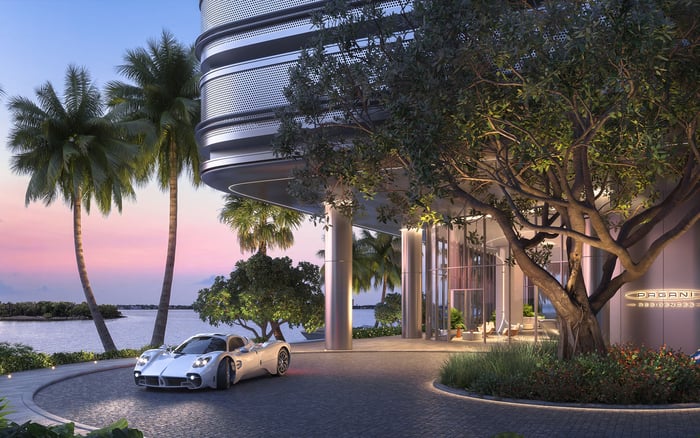
For collectors, a “garage” in a high-rise is less about square footage and more about choreography: arrival, discretion, security, and day-to-day usability. This editorial compares the practical logistics a supercar owner should scrutinize when considering Pagani North Bay Village versus Waldorf Astoria Residences Downtown Miami, with a focus on how each neighborhood and tower profile tends to shape the ownership experience.
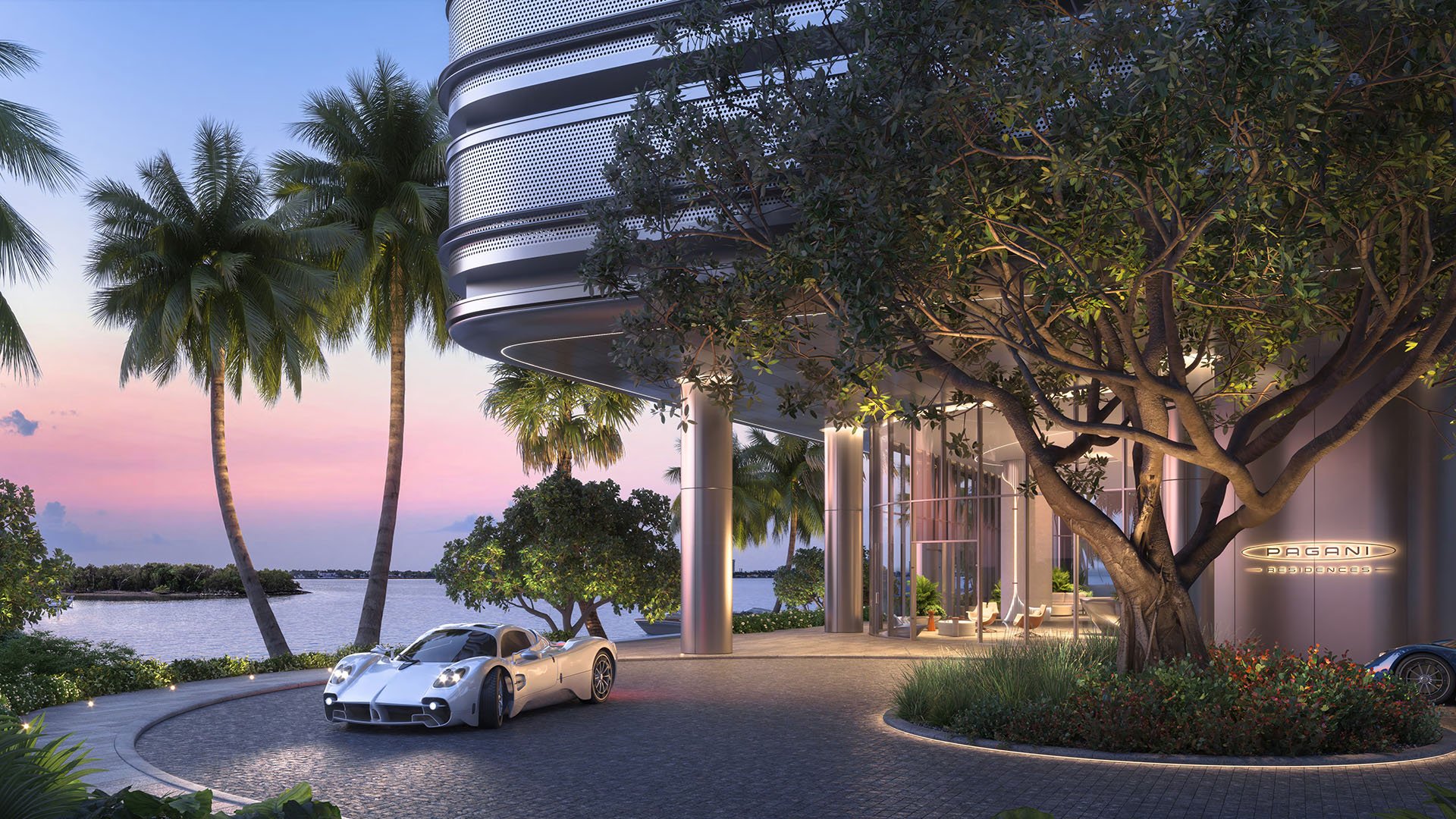
In South Florida’s most design-forward residences, the difference between an elegant car life and a frustrating one rarely comes down to horsepower. It comes down to the details around the car: how you arrive, where you stage, what you touch, who can see you, and how reliably the system performs at midnight in August.
Supercar garages in a condominium context come with constraints private homes don’t: shared circulation, mechanical systems, operating policies, and human factors. When you evaluate Pagani North Bay Village and Waldorf Astoria Residences Downtown Miami, you’re not just comparing two branded environments-you’re weighing two logistical ecosystems shaped by neighborhood geometry, tower configuration, and the rhythms of each district.
The objective is to match the building’s “car choreography” to how you actually drive. A frequently driven collection demands effortless access and predictable timing. A curated collection that rotates occasionally can place more emphasis on privacy, environmental stability, and exceptional detailing.
North Bay Village, by design, is a causeway lifestyle. The practical upside for a supercar owner is both psychological and physical: fewer tight street grids, fewer surprise delivery vehicles, and a more direct shot onto the causeways when you want a clean, smooth run. It often feels like departing from a private enclave-even when you’re only minutes from Miami Beach.
Downtown Miami is the inverse: vertically efficient and socially convenient, with heavier rideshare traffic, event surges, and more complex curbside conditions. For many owners, that’s the appeal. If you want a pedestrian-forward day-to-day and reserve the car for intentional drives, Downtown’s density becomes a feature rather than a burden.
This is also where your “second property logic” matters. Some buyers pair a primary, car-forward residence with a more walkable pied-à-terre. In that context, Downtown can complement a more insulated home base. For example, an owner who keeps a weekend-focused vehicle lifestyle in Pagani North Bay Village may also value the urban convenience of Waldorf Astoria Residences Downtown Miami for business-facing weeks.
The most revealing test isn’t a glossy render-it’s the first 90 seconds from street to secure zone.
For a supercar, the arrival sequence should answer a few practical questions:
Can you enter without scraping? The transition from street grade to ramp, and ramp to garage deck, should be forgiving. Short nose overhangs and low splitters don’t tolerate abrupt slope changes.
Is there a dedicated staging zone? If the arrival system forces you to pause in a public driveway while gates cycle, you’ll feel the exposure immediately.
How many “touch points” are required? Key fobs, concierge calls, QR scans, security intercoms-each additional step adds friction and visibility.
In North Bay Village settings, the arrival experience often benefits from less curbside chaos and fewer competing uses at the front door. In Downtown settings, the arrival experience can be exceptional, but it must be engineered to separate residents from constant curb turnover.
A useful comparator is how other nearby luxury towers handle the balance of glamour and flow. In Downtown, Aston Martin Residences Downtown Miami often comes up in the same buyer conversations because it reinforces a broader theme: in a dense core, arrival needs to function as a controlled, layered transition-not a simple driveway.
Even experienced collectors underestimate how completely geometry shapes day-to-day satisfaction.
Get clear on turning radii and the width of the circulation path. A garage can read as generous in a brochure and still require a three-point maneuver the moment you meet another vehicle in a tight corner. That’s when the car starts staying home.
A two-car household introduces a quiet complication: even if you park perfectly, your neighbor’s door swing may not respect your carbon-ceramic calm. Look for:
Stall widths that feel genuinely comfortable, not merely code-compliant.
Protective measures that reduce door-ding risk.
A circulation plan that doesn’t force awkward passing in narrow aisles.
If you keep a daily driver plus a low-slung weekend car, the ideal setup lets you access either without moving the other. In practice, many frustrations come from stacking or sequencing: one car gets trapped behind the other, or retrieval depends on staff availability. The more you drive, the more you should prioritize independent access.
In ultra-premium ownership, security isn’t only about stopping threats. It’s about reducing exposure.
Evaluate the garage through a privacy lens:
Sightlines: Can visitors or casual foot traffic see into the resident vehicle zone?
Cameras and coverage: Are there obvious blind spots at corners, entrances, or near elevators?
Access control: Is entry controlled by layered credentials, or a single point of failure?
Downtown towers can deliver highly sophisticated controlled environments, but they also sit within a higher-volume public realm. North Bay Village can feel naturally buffered, though the best outcomes still come from deliberate design and policy.
If you’re comparing neighborhoods, it can help to consider other branded environments that treat discretion as part of the value proposition. In Brickell, for instance, 888 Brickell by Dolce & Gabbana frequently enters the conversation among buyers who want a tightly managed, brand-forward experience where arrival and separation are carefully choreographed.
A supercar garage can be concierge-led, self-park, valet-heavy, or some hybrid. Each comes with trade-offs.
Pros: polish, fewer hands on your keys if managed properly, and a smoother arrival in formal settings.
Cons: timing dependency. If your lifestyle includes spontaneous late-night drives or early departures, even minor friction becomes magnified.
Pros: control, predictability, and the reassurance that only you move the car.
Cons: you must be comfortable navigating the garage yourself, and the building must be designed to support it.
When evaluating Pagani North Bay Village against Waldorf Astoria Residences Downtown Miami, clarify which operational model is intended-and how it performs during peak moments: holidays, major events, or storms. Logistics that feel seamless on a quiet Tuesday can degrade quickly if the system relies on perfect staffing or flawless coordination.
South Florida’s climate is not gentle on mechanical objects. Your garage should function as a preservation environment.
Key considerations:
Humidity management: Corrosion and interior material wear can accelerate in poorly ventilated or damp garages.
Drainage and water management: Even without naming thresholds or elevations, the question is straightforward: where does water go, and how quickly?
Backup power: A controlled-access garage that fails open-or fails closed-during outages is a different kind of risk. The strongest systems maintain access control, lighting, and essential ventilation.
If you keep vehicles on battery tenders, or you own a modern performance car with storage requirements, confirm how power is handled at the stall. Details vary by building policy and design, but the principle is consistent: preservation is logistics.
In many luxury towers, the garage experience is only half the story. The other half is vertical circulation.
Ask yourself:
How many transitions occur from car to residence: garage to elevator lobby, elevator to private foyer, and so on?
Are elevators dedicated to residents, or shared with heavier traffic patterns?
Is there a secure, direct route from the vehicle zone to residential circulation?
Downtown properties can excel here when they treat circulation as a layered experience with clear separations. North Bay Village can feel simpler, which some owners prefer: fewer steps, fewer encounters, fewer opportunities for delay.
When you tour, use a structured lens. A supercar garage should be evaluated like a private facility.
Arrival friction test: Can you enter smoothly, quickly, and discreetly?
Geometry test: Can you make every key turn without stress, including when another car is present?
Risk test: What are the real-world chances of door dings, curbed wheels, or scraping?
Access test: How quickly can you retrieve the car at odd hours without assistance?
Resilience test: What happens during a power outage or extreme weather day?
This framework keeps the evaluation practical-especially when both projects are visually compelling and lifestyle-rich.
A supercar collection rarely exists in isolation. It’s usually part of a portfolio: a Downtown base for access, a beach retreat, and possibly a quieter enclave that supports storage and privacy.
If your calendar is split between urban dining, meetings, and events, a Downtown address can reduce driving needs and make car time more intentional. If your priority is low-friction departure for scenic routes, North Bay Village can feel like a launchpad.
Many buyers also balance this with coastal living where the “car moment” is less frequent and the lifestyle is more barefoot-luxury. When that’s part of the plan, a property like 57 Ocean Miami Beach can serve as the counterpoint: an oceanfront retreat where the garage matters, but the horizon matters more.
In short, the best decision isn’t which garage sounds most exclusive. It’s which garage and neighborhood system best protects your time, your privacy, and your vehicle condition.
Pagani North Bay Village
Tends to appeal to owners who want the car to remain central to the lifestyle: quick access, a less congested departure sequence, and a calmer perimeter.
Waldorf Astoria Residences Downtown Miami
Tends to appeal to owners who want a highly curated urban life where driving is optional, and the building’s operational polish can carry much of the daily load.
The right choice is the one that aligns with how often you drive, how much you value absolute discretion, and whether you prefer human-managed service or self-directed control.
Is a “supercar garage” mostly about the number of spaces? Not really. The daily experience is defined by access, geometry, privacy, and operations.
What is the first thing to check on a garage tour? The entry slope and the first turn off the ramp-scraping risk shows up immediately.
Do valet systems help or hurt supercar ownership? They help if retrieval is fast and protocols are strict; they hurt if timing and handling vary.
How important is stall width for exotic cars? It’s critical for door clearance and peace of mind, especially next to other high-value vehicles.
Does Downtown Miami make garage logistics harder? It can, due to curbside volume and traffic patterns, but strong design can offset the density.
Why do collectors care about privacy in the garage? The garage is often the most revealing place in a building, so controlled sightlines matter.
Should I prioritize self-park access if I drive often? Usually, yes-because it reduces dependence on staff timing and supports spontaneous use.
What resilience features matter most in South Florida garages? Drainage, ventilation, and backup power for access control and lighting are the essentials.
How do I compare two luxury buildings without getting lost in finishes? Use a checklist: arrival friction, turning geometry, retrieval time, privacy, and resilience.
Can one residence serve both walkability and supercar convenience? Sometimes, but it depends on the neighborhood; many owners split these priorities across homes.
To compare the best-fit options with clarity, connect with MILLION Luxury.
If branded residences are on your mind — as a home or as an allocation — we would be glad to share what we are seeing, privately.
Begin a quiet conversation