A buyer-oriented guide to evaluating double-height living rooms at Delano Residences & Hotel Miami, focused on proportion, privacy, furniture planning, climate, entertaining, and long-term livability.
For buyers considering Delano Residences & Hotel Miami, a double-height living room can be among the residence’s most emotionally persuasive features. It creates arrival, lightness and a sense of occasion that a conventional ceiling rarely delivers. Yet for a serious household, the more important question is not whether the space impresses on first viewing. It is whether the volume supports the way the home will actually be used.
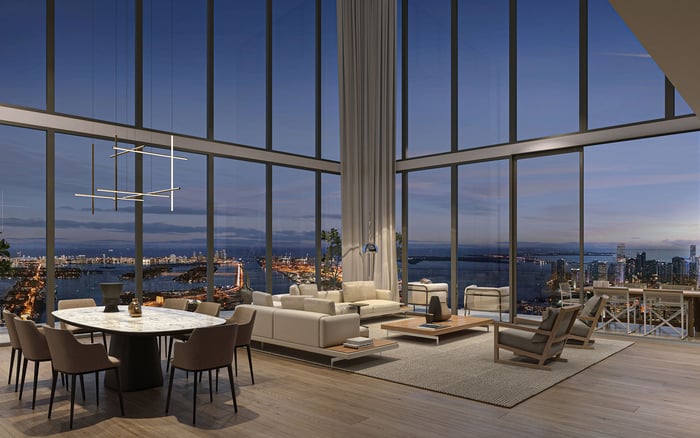
A double-height room changes the hierarchy of a residence. It can make the living area feel less like one room and more like the architectural center of the home. That can be magnificent when the plan is disciplined. It can also feel under-furnished, echoing or overly exposed when the space is treated only as a visual statement. The most successful buyers evaluate it as both architecture and daily infrastructure.
In South Florida, light, climate and views are not background conditions. They shape how a home feels at breakfast, during afternoon heat, at sunset and late at night. A higher living volume can amplify all of those qualities. The aim is to make the height feel serene, not theatrical.
A double-height living room should have a clear relationship between width, depth and ceiling height. If the room is too narrow, the height can feel like a vertical shaft. If it is too deep without enough natural light, the lower zone may feel heavier than the upper volume suggests. The best spaces balance vertical grandeur with a floor plate that still allows intimate seating, natural circulation and easy conversation.
Households should study where the eye naturally lands on entry. Is the view framed, or does the height pull attention upward at the expense of the horizon? Does the room have a comfortable wall for art, millwork or a media solution, or is every surface interrupted by glass and volume? A double-height room is not automatically more flexible. In fact, its scale often demands more exact planning.
This is where restraint becomes a form of luxury. A disciplined furniture plan, a few generous pieces and well-placed lighting often do more for the room than a series of decorative gestures. The architecture should carry the drama. The interior should give it composure.
In Miami, a soaring living space can be luminous, but households should think carefully about solar exposure and privacy. Tall glazing may invite exceptional daylight, yet it also raises practical questions about glare, fabric protection, cooling loads and window treatment strategy. These are not minor finishing details. They influence how often the room is used and how comfortable it feels throughout the day.
The ideal solution is usually layered. Architectural shading, high-quality window treatments, thoughtful furniture placement and lighting control should work together. A room that feels spectacular at noon should also feel comfortable for reading at 4 p.m. and hosting after dark.
Privacy deserves the same attention. A taller room may be visible from more angles, especially in dense urban or waterfront contexts. Buyers should stand in the room and imagine real routines: children moving through the space, guests gathering near the windows, evening lighting turned on and the household settling into casual use. The question is whether the room allows both openness and discretion.
Double-height living rooms succeed or fail at human scale. The upper volume provides atmosphere, but the lower eight to ten feet determine comfort. Seating groups should feel anchored. Rugs need enough presence to define the room. Coffee tables, side tables and lamps should make the space usable without forcing people to speak across a grand void.
A common mistake is choosing furniture that is large only because the ceiling is high. Oversized pieces can still feel awkward if they do not support conversation. Better is a composition that creates smaller social zones within the larger room: a primary seating area for gathering, a quieter reading corner, perhaps a sculptural chair near the view. The volume becomes a backdrop rather than a burden.
Art and lighting require similar discipline. One exceptional vertical artwork may be more successful than a crowded wall. A dramatic pendant can be beautiful, but it must be evaluated from both below and above if the residence has an overlooking mezzanine or adjacent upper-level circulation. The piece should not merely fill air. It should clarify the space.
Acoustics are often overlooked in double-height rooms. Hard floors, glass, stone and tall ceilings can create reverberation that makes daily life less pleasant. A beautiful room that amplifies every footstep or conversation may impress briefly and fatigue quickly.
Households should think about softening the space through textiles, rugs, upholstered furniture, drapery and, where appropriate, acoustic design concealed within finishes. This is especially important for families that entertain, work from home or use the living room as the main gathering place. A home can be grand and quiet at the same time, but that result is usually planned.
Sound also affects hospitality. In a residence connected to a hotel environment, the living room may be used for hosting with a more polished cadence. Music, conversation and movement should feel controlled, not scattered. For many buyers, this is the difference between a room that photographs beautifully and a room that becomes the preferred place to spend time.
A double-height living room can make entertaining feel effortless because it gives guests room to arrive, circulate and pause. It allows a gathering to expand without immediately feeling crowded. It can also make a dinner or cocktail evening feel more ceremonial, especially when the living area connects naturally to dining, terrace or view-facing spaces.
Still, flow matters more than scale. Buyers should observe whether guests can move from entry to seating to outdoor areas without crossing private zones. If the living room is the heart of the plan, it should gather people naturally. If circulation cuts through the main seating group, the room may feel busy even when sparsely occupied.
For households comparing luxury product types, labels such as condo-hotel, high-floor, balcony, terrace and new construction are only useful if they connect to lived experience. A dramatic room on paper must still answer practical questions: where drinks are set down, where children sit, where a host stands, where the best conversation happens and how the room feels when the party is over.
For families, double-height space can be inspiring, but it should be assessed with routines in mind. If children use the living room daily, durable finishes, acoustic softness and furniture placement become more important than pure formality. A magnificent room should not become a space everyone avoids because it feels too precious.
Sight lines also matter. Some households appreciate an upper-level overlook into the living area because it creates connection across floors. Others prefer separation, especially if bedrooms or workspaces are nearby. Neither is universally better. The right answer depends on how the household balances togetherness, quiet and privacy.
Storage should not be ignored. Large volumes can make ordinary clutter more visible. If the residence lacks discreet places for books, throws, games, technology and daily objects, the room may become difficult to keep composed. True luxury is not the absence of real life. It is the ability to accommodate real life elegantly.
Double-height living rooms often create strong emotional differentiation, but value depends on execution. Buyers should consider whether the feature broadens the audience for the residence or narrows it. A well-proportioned, comfortable double-height room can feel rare and memorable. A poorly resolved one can feel expensive to furnish and difficult to control.
The strongest version has architectural clarity, usable walls, controlled light, good acoustics and a furniture plan that looks inevitable. It does not rely on height alone. It feels better each time someone enters because the details support the original impression.
For a household thinking long term, the question is simple: will this volume still feel intelligent after the novelty fades? If the answer is yes, the room can become one of the residence’s defining pleasures.
During a private tour, spend time in the living room without rushing. Stand at the entry, at the main seating area, near the glass and at the transition to dining or outdoor space. Notice whether the height creates calm or distraction. Look for glare, echo, awkward corners and natural furniture anchors.
Then imagine the room furnished for three versions of life: a quiet weekday morning, a family evening and a hosted occasion. If the space works in all three scenarios, the double-height volume is likely doing more than making a statement. It is serving the household.
The best residences do not ask buyers to choose between beauty and practicality. They make practicality beautiful.
Is a double-height living room always better for luxury buyers? Not always. It is strongest when the room has clear proportions, controlled light and a well-resolved furniture plan.
What is the main risk of a double-height living room? The main risk is a space that looks impressive but feels noisy, exposed or difficult to furnish.
Should households worry about cooling a taller living room? Yes. Comfort, solar exposure and window treatments should be reviewed early, especially in South Florida.
Can a double-height room feel intimate? Yes. Intimacy comes from the lower zone, including seating, rugs, lighting and acoustics.
Is a large chandelier necessary? No. A statement fixture can help, but it should support the architecture rather than simply fill empty height.
How should families evaluate the space? Families should consider durability, sound, storage and whether the room can handle daily use gracefully.
Does double-height living help resale? It can help when the room is well executed and memorable without sacrificing comfort or flexibility.
What should buyers test during a showing? Buyers should test sight lines, glare, echo, circulation and where furniture would naturally be placed.
Is privacy a concern with tall glass? It can be. Evening visibility, neighboring sight lines and window treatments should all be considered.
What makes the feature feel truly luxurious? True luxury is when the height, light, sound and furniture plan make daily life feel more effortless.
For a tailored shortlist and next-step guidance, connect with MILLION.
If branded residences are on your mind — as a home or as an allocation — we would be glad to share what we are seeing, privately.
Begin a quiet conversation