A buyer-oriented design comparison of how natural stone tends to perform and read inside two marquee coastal towers, with practical considerations for longevity, maintenance, and resale positioning.
In the ultra-premium segment, natural stone is rarely about overt opulence. It is about calibration. The strongest projects use stone the way a great tailor uses cloth: in proportions that flatter the architecture, with joins and transitions that visually disappear, and with a finish that holds up in coastal light.
For buyers comparing Riva Residenze Fort Lauderdale with The Ritz-Carlton Residences® Pompano Beach, the most useful lens is not simply “more stone” versus “less stone.” The decisive question is integration: where stone appears, how continuously it is carried, what it meets, and how it is expected to age in a humid, salt-air environment.
Because finish schedules and exact stone selections can evolve through design development and procurement, the most sophisticated comparison focuses on what you can assess from any public offering: composition, continuity, transition detailing, and the performance logic of stone in high-use and high-moisture zones.
Across South Florida’s new-construction landscape, natural stone typically supports one of two philosophies.
The first is sculptural continuity. Here, stone functions as a material “spine” tying arrival, amenity, and residence into one idea. You see it as a continuous plane on lobby walls, elevator portals, and sometimes along corridor wainscoting or at entry thresholds. When executed well, the building reads edited-almost gallery-like.
The second philosophy is resort-grade refinement. Stone is used to elevate touchpoints and establish a hospitality cadence: a dramatic lobby moment, a composed bar or lounge backdrop, stone-forward spa wet areas, and then more restrained residential applications where comfort and maintenance are prioritized.
Either approach can be excellent. What matters is coherence. Look for whether stone is doing architectural work (defining space, providing rhythm, controlling light) or merely cosmetic work (a veneer placed where it photographs well).
In Fort Lauderdale and Pompano Beach, the coastal context adds a practical constraint: materials must contend with strong daylight, airborne salt, and year-round HVAC cycles. Stone can be an ideal choice when it is detailed for movement, sealed appropriately, and paired with compatible metals and grouts.
When you walk a sales gallery or review finish narratives, focus on three zones where stone integration is most revealing.
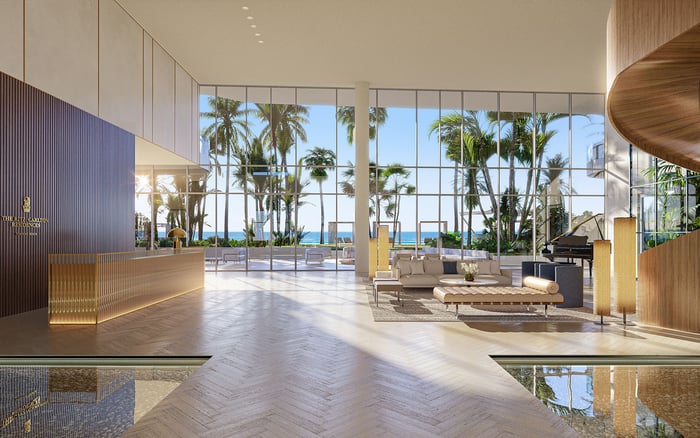
Lobbies take the most punishment: rolling luggage, sand, occasional rainwater, and constant foot traffic. Stone that is carefully selected and precisely detailed here signals intent. Look for larger-format slabs (so fewer grout lines read as “tile”), crisp corner returns, and transitions that don’t depend on thick metal trims.
A refined lobby stone concept also anticipates South Florida light. Polished surfaces can be spectacular, but they can also amplify glare and telegraph micro-scratches under strong sun angles. Honed or satin finishes often read calmer and more architectural.
Elevator portals, corridor bases, and entry thresholds are where continuity is either protected or surrendered. When stone wraps these “in-between” spaces, the building can read more like a private club than a typical condominium.
If stone stops abruptly at the lobby and disappears into painted drywall hallways, the experience can shift from couture to conventional quickly. This is not inherently negative, but it does change the tone-and tone can shape how a residence is perceived by guests, future buyers, and renters.
Kitchens and baths are where stone proves itself. In kitchens, consider whether stone is planned only for countertops and backsplashes or also for waterfall edges and full-height slab walls. In baths, stone can deliver a true spa quality, but it is also exposed to frequent moisture, cleaning agents, and temperature swings.
From a lifestyle standpoint, understand the maintenance reality: marble may etch; softer limestones may patina; some stones are more porous than they look. None of this is a dealbreaker in luxury living. It simply points to choosing a finish you will enjoy living with-not just photographing.
For comparison, consider how other South Florida towers frame this material conversation. In Surfside, The Delmore Surfside shows how stone can project restraint and permanence, while in Brickell, 2200 Brickell illustrates how stone can pair with a more urban, tailored interior language. The lesson for Fort Lauderdale and Pompano Beach is the same: the best stone work feels inevitable, not applied.
Stone selection is not only about color. Finish is the day-to-day experience.
Polished stone maximizes drama and reflection. It can feel more formal and can intensify view-facing brightness inside a coastal residence.
Honed stone reduces glare, reads more contemporary, and tends to conceal minor wear. Many buyers perceive it as more “quiet luxury.”
Brushed or leathered finishes add tactility. They can be forgiving in high-traffic areas but may hold more residue if not cleaned thoughtfully.
In South Florida, where natural light is abundant and often directional, a finish that looks perfect in controlled showroom lighting may behave differently at 10 a.m. with sun bouncing off the ocean. Imagine the stone not only at sunset, but at noon.
The most expensive stone is not always the most convincing. True integration shows up in the restraint of the detailing.
Slab logic.
If a design implies full-height slab walls, look for alignment at corners and around openings. Misaligned veining can make even premium stone feel restless.
Bookmatching and symmetry.
Bookmatching can be breathtaking when used sparingly as an intentional focal moment-behind a reception desk, for example, or in a feature powder room. When overused, it can tip into spectacle.
Edge profiles.
Thick, rounded edges can read traditional; crisp, minimal profiles read more contemporary. A project’s edge language should track with its overall interior architecture.
When you compare Riva Residenze Fort Lauderdale against The Ritz-Carlton Residences® Pompano Beach through this lens, the key question is simple: does the stone reinforce a consistent architectural idea from arrival to residence, or is it concentrated only in marketing-forward moments?
Luxury buyers tend to be comfortable with stewardship, but they still value predictability. Natural stone will age. The goal is for it to age well.
In practical terms, integration includes the building’s tolerance for real life: sandy feet, wet swimsuits, cocktail spills, and frequent cleaning. Ask about sealing cycles, recommended cleaners, and how the design minimizes risk in wet areas.
A smart sign is stone placed where it performs best, with other materials taking over where they perform better. For example, stone may excel as lobby wall cladding or a vanity top, while engineered surfaces or porcelain might be used for certain shower walls to reduce upkeep. The highest-end interiors often mix materials with this level of discipline.
If you are also comparing nearby coastal options, Ocean 580 Pompano Beach provides another reference point for how Pompano Beach product positions itself in terms of elevated finishes and overall polish.
In a region where design trends can swing quickly, natural stone tends to stay on the right side of time-provided the palette is calm and the detailing is architectural.
The resale advantage usually comes from three characteristics:
Material honesty. Buyers can sense when a building invested in real, substantial surfaces.
Neutral permanence. A restrained stone palette can harmonize with many furniture styles.
Photographic depth. Stone reads with dimensionality in listing photography, especially in entry moments and baths.
However, don’t assume all stone performs the same. Highly distinctive stones can polarize. For long-term appeal, the most resilient strategy is stone used to support the building’s lines rather than compete with them.
When you are evaluating Riva Residenze Fort Lauderdale versus The Ritz-Carlton Residences® Pompano Beach, bring the conversation back to observable decisions.
Continuity: Is stone repeated across arrival, amenity, and residential thresholds?
Hierarchy: Is there a clear “statement” moment, supported by quieter stone elsewhere?
Light behavior: Does the finish control glare and still feel luminous?
Wet-area logic: Are shower and spa zones designed for longevity, not only impact?
Transitions: Do stone-to-wood, stone-to-metal, and stone-to-glass joints feel precise?
Stone is one of the few materials that can make a new building feel instantly established. When integrated with discipline, it signals a design that can still read elegant after years of coastal living.
Is more natural stone always better in a luxury residence? Not necessarily. The best results come from stone placed where it adds architectural value and performs well.
What stone finish tends to feel most “quiet luxury” in South Florida? Honed and satin finishes often feel calmer in bright coastal light and can be more forgiving day to day.
Does polished stone show wear faster? It can reveal micro-scratches and glare more readily, especially in high-traffic areas and strong sunlight.
Are marble bathrooms practical for full-time living? They can be, but they may patina and etch over time; owners should be comfortable with regular care.
What should I look for in lobby stone to judge quality? Favor larger slabs, clean corner returns, minimal trim reliance, and crisp alignment around openings.
How can I tell if stone is integrated rather than decorative? Integrated stone typically continues into thresholds and circulation areas, not just a single feature wall.
Do stone selections affect resale value? Timeless palettes and disciplined detailing generally support resale because they photograph well and age gracefully.
Is stone in kitchens mainly a design choice or a performance choice? It is both. It affects visual weight and also how you live with heat, acids, and daily cleaning.
Can I change stone finishes after closing? Sometimes, but it depends on the building’s alteration rules and the scope; many owners update surfaces selectively.
What is the simplest way to compare two projects on finishes? Compare continuity, finish behavior in daylight, and the wet-area maintenance plan rather than focusing on labels.
To compare the best-fit options with clarity, connect with MILLION Luxury.
If branded residences are on your mind — as a home or as an allocation — we would be glad to share what we are seeing, privately.
Begin a quiet conversation