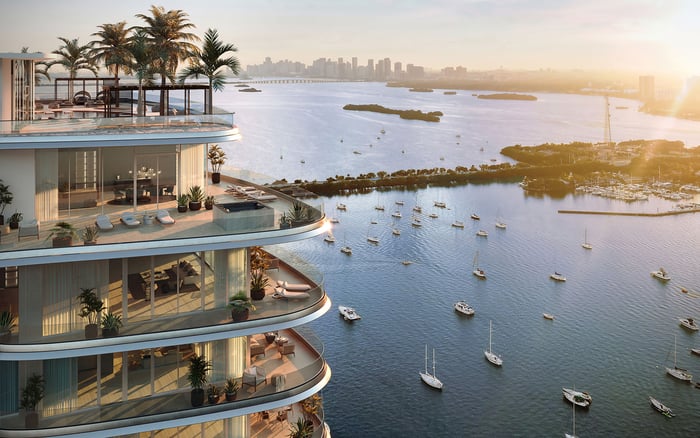
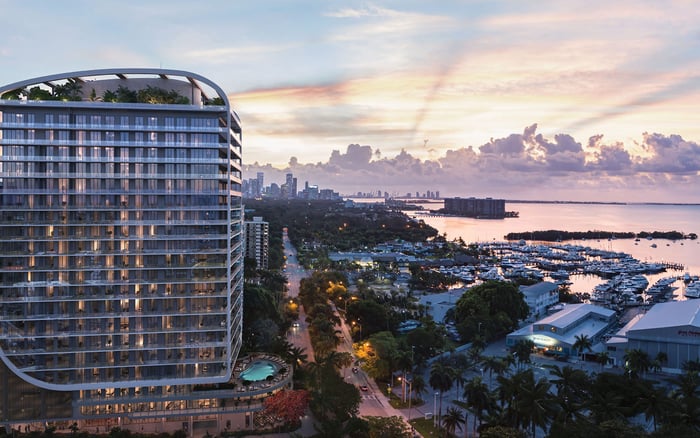
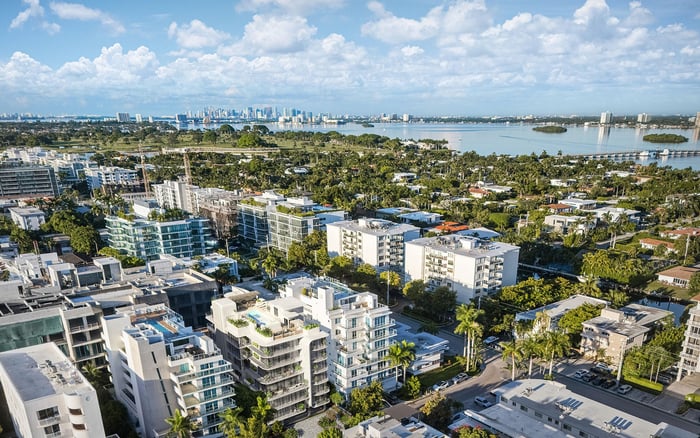
A discreet buyer’s analysis of how three South Florida luxury residential settings approach arrival sequence, risk mitigation, and resident visibility.
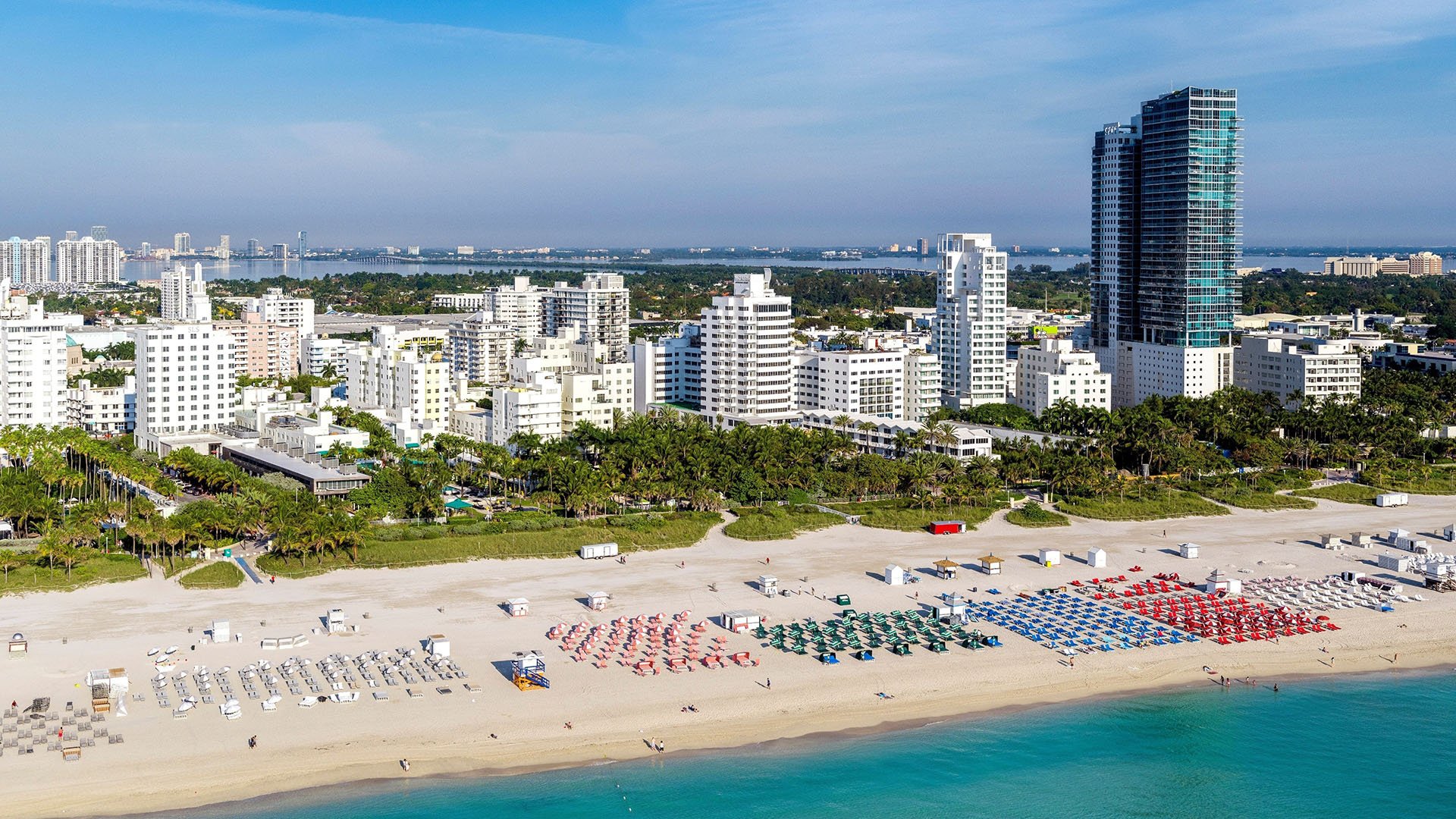
For the ultra-premium buyer in South Florida, the first meaningful amenity may not be a spa, a pool deck, or a private dining room. It may be the way a building receives a resident, filters a guest, absorbs a vehicle, and allows a household to move without becoming part of the spectacle. Arrival sequence, security posture, and guest discretion have become core value drivers, especially for buyers whose lives involve public visibility, family-office complexity, domestic staff, visiting guests, and seasonal patterns.
That is why Armani Casa Residences Pompano Beach, St. Regis® Residences Bahia Mar Fort Lauderdale, and Mila Bay Harbor Islands are useful to examine together. They are not simply three luxury addresses in three markets. They represent three distinct South Florida residential conditions: the beachfront tower, the resort-marina compound, and the boutique island-enclave model.
This is not a conventional amenity comparison. The more revealing question is how each setting shapes the experience before the elevator, before the residence door, and before a guest ever enters the private realm.
Armani Casa Residences Pompano Beach occupies the Pompano Beach side of this comparison, where the raw appeal of the beachfront-tower model is immediately legible. A beachfront tower has clarity. It offers a direct relationship between home, horizon, and coastal arrival. For buyers who want their residence to read as elegant and vertical rather than sprawling, that setting can feel highly controlled.
The arrival challenge in a beachfront tower is compression. Oceanfront environments tend to concentrate desire, visibility, and movement into a limited band between road, lobby, and shoreline. The best version of this model is not about theatrical grandeur. It is about reducing friction at the threshold: a clean handoff from vehicle to lobby, a clear sense that guests know where they are meant to go, and a resident experience that remains composed even during high-demand seasonal moments.
For a buyer evaluating Armani Casa Residences Pompano Beach, the important lens is not merely the brand association or the beachfront address. It is whether the building’s daily choreography supports privacy in ordinary use. The most refined luxury towers make security feel ambient rather than defensive. They allow residents to feel known without feeling watched, assisted without feeling processed, and protected without living inside a visible protocol.
St. Regis® Residences Bahia Mar Fort Lauderdale represents the Fort Lauderdale and Bahia Mar component of the comparison. Its broader model differs from the beachfront tower because the resort-marina compound introduces another layer of movement. Water, vehicles, service circulation, residents, guests, and destination energy can all become part of the same environment.
That complexity can be a virtue when choreographed well. A resort-marina setting can stage arrival as a sequence rather than a single doorway. There may be a stronger sense of approach, pause, orientation, and transition. For buyers accustomed to private clubs, yachts, hotels, and service-rich environments, that layered arrival can feel familiar and natural.
The security question here is not whether the setting feels closed off. It is whether it can separate audiences without making the separation feel severe. Residents want privacy; guests want welcome; staff need efficiency; the environment still needs to feel gracious. In this model, discretion is not achieved by invisibility alone. It is achieved by hierarchy: knowing which paths are ceremonial, which are residential, which are operational, and which should never compete for attention.
The word marina matters in this context because marina-adjacent living often attracts a different rhythm of use. Guests may arrive for a dinner, a vessel, a weekend, or a longer stay. The finest version of the compound model absorbs that dynamism into the property without exposing residents to unnecessary visibility.
Mila Bay Harbor Islands brings the Bay Harbor Islands component into focus, framed here as the boutique island-enclave model. Its contrast with the other two settings is instructive. Where a beachfront tower is defined by vertical clarity and a resort-marina compound by layered destination energy, an island enclave often trades scale for intimacy.
The boutique model can be especially compelling for buyers who value a lower public profile. Arrival may feel less like entering a major destination and more like transitioning into a residential neighborhood. Guest discretion, in this context, is often tied to social temperature. The environment can feel calmer, less performative, and less exposed to the transient intensity of major beachfront and marina settings.
Boutique does not automatically mean more private, just as larger does not automatically mean less discreet. The question is whether the smaller setting preserves order. Does the arrival feel intuitive? Is the guest experience polished without being overly familiar? Can residents move through the building without repeated social contact when they prefer not to be seen? These are subtle questions, but for high-net-worth households they are rarely secondary.
Mila Bay Harbor Islands is useful in this comparison because it shows that discretion can be architectural, operational, and atmospheric at once. The island-enclave model may appeal to those who want proximity to South Florida’s luxury ecosystem without the constant sense of being on display.
The most disciplined way to compare these residences is to set aside generic amenity checklists and study the life of a single arrival. Imagine a weekday return, a visiting guest, a family member arriving separately, a driver waiting, or a private dinner with multiple invitees. The answers will tell you more than a brochure adjective.
In buyer shorthand, Pompano Beach signals the beachfront-tower lens, Fort Lauderdale signals the marina-resort setting, and Bay Harbor signals the island-enclave mood. Oceanfront, marina, and boutique are not merely listing labels here. They describe three different privacy equations.
The beachfront tower depends on elegance under compression. The resort-marina compound depends on hierarchy within complexity. The boutique island enclave depends on intimacy without informality. Each can be highly desirable, but each solves a different problem.
For some buyers, the right answer is the address that feels most private. For others, it is the one that receives guests most gracefully. For many, it is the property whose security posture disappears into the service culture, allowing the residence to feel serene rather than guarded.
True discretion is not silence. It is the absence of unnecessary exposure. A buyer should be able to picture the residence during peak season, in poor weather, during a hosted evening, and during a quiet morning departure. If the building or enclave still feels composed in those scenarios, the privacy proposition is stronger.
Armani Casa Residences Pompano Beach, St. Regis® Residences Bahia Mar Fort Lauderdale, and Mila Bay Harbor Islands show three distinct ways South Florida luxury is evolving beyond the visible amenity race. The next generation of value is less about what can be photographed and more about what can be protected: time, movement, privacy, and control.
Why compare these three residences together? They represent three different South Florida luxury settings: beachfront tower, resort-marina compound, and boutique island enclave.
Is this an amenity comparison? No. The focus is arrival sequence, security posture, and guest discretion rather than conventional lifestyle amenities.
What is the main buyer lens for Armani Casa Residences Pompano Beach? It is best read as the beachfront-tower model, where arrival clarity and privacy under compression become important.
What distinguishes St. Regis® Residences Bahia Mar Fort Lauderdale in this framework? It fits the resort-marina compound model, where layered movement and guest hierarchy are central to discretion.
How does Mila Bay Harbor Islands differ from the other two? It reflects the boutique island-enclave model, with a more intimate residential character and a quieter arrival mood.
Does a smaller building always mean more privacy? Not automatically. Privacy depends on circulation, operational discipline, guest management, and the social rhythm of the setting.
What should buyers observe during a property visit? They should study how vehicles, guests, residents, and service functions move before focusing on decorative finishes.
Why does arrival sequence matter so much? Arrival is where privacy either begins smoothly or starts to erode through friction, visibility, and confusion.
What does a strong security posture feel like in luxury residential design? It feels calm, layered, and integrated into service rather than overtly defensive or visually intrusive.
What is the best way to shortlist comparable options for touring? Start with location fit, delivery status, and daily lifestyle priorities, then compare stacks and elevations to validate views and privacy.
For a tailored shortlist and next-step guidance, connect with MILLION.
If branded residences are on your mind — as a home or as an allocation — we would be glad to share what we are seeing, privately.
Begin a quiet conversation