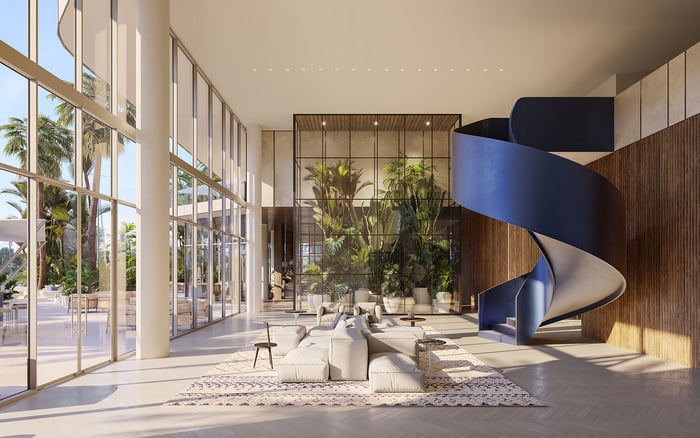
A discreet buyer’s analysis of how commercial ownership, easements, and association control can shape long-term quiet, privacy, and predictability at The Ritz-Carlton Residences® Pompano Beach.

The Ritz-Carlton Residences® Pompano Beach belongs to a category of branded residential development where buyers often begin with the visible language of luxury: architecture, service, finishes, arrival sequence, water views, and the promise of a recognized operating culture. Yet for the most discerning buyer, the more consequential question may be quieter and more legalistic: who controls the spaces that could affect daily residential calm?
That question matters because the long-term livability envelope is not defined only by glass, slab thickness, balcony depth, or elevator programming. It is also defined by sound, privacy, access, operational discipline, and predictability. In an oceanfront setting, where lifestyle programming can be part of the appeal, the same amenity energy that gives a property vitality may also require careful governance.
For Pompano Beach buyers considering The Ritz-Carlton Residences® Pompano Beach Pompano Beach, the issue is not whether branding implies quality. Ritz-Carlton branding can signal a luxury operating standard. The more precise issue is whether residential owners, through their association, actually hold the legal authority to regulate commercial or quasi-commercial uses that could create noise, traffic, late activity, deliveries, valet flow, or guest movement.
Commercial-tenant noise is often discussed as if it were primarily an acoustic matter. Better glazing, thoughtful mechanical placement, vertical separation, and sound attenuation all matter. But in a luxury condominium, sound control is also a governance question.
If a restaurant, lounge, beach-club-style use, marina-related area, event space, valet zone, service corridor, or other operational component has independent ownership rights, the association may not be able to treat that space like a standard residential amenity. The practical question becomes: is the area controlled by the residential association, retained by the developer, or held as a separate commercial condominium parcel?
The answer can change the entire balance of authority. A residential board may be able to set rules for association-owned amenities. It may have more limited power over a separately owned commercial parcel, especially if the declaration, reciprocal easement agreements, or operating documents grant that parcel durable rights. Those rights may include access, delivery routes, service corridors, signage, parking, valet interaction, hours of use, or shared facilities.
This is why marketing language needs translation. Phrases such as private restaurant, club-style service, marina access, or curated hospitality may describe experience rather than ownership. They may not disclose who owns the space, who profits from it, who manages it, or what rights that owner holds against the residential association.
In new-construction purchases, the sales gallery can make a project feel complete before its legal ecosystem is fully understood by the buyer. The model residence may communicate calm. The renderings may communicate serenity. The brand may communicate service. But the documents communicate control.
Noise-sensitive buyers should review the condominium declaration, offering materials, reciprocal easement agreements, management agreements, use restrictions, and any schedules that identify commercial units, shared facilities, limited common elements, easement areas, and reserved developer rights. The review should be less about skepticism than precision.
The most useful buyer question is direct: who owns the potentially noisy-use area, and what legal rights does that owner have against the residential association? A second question follows immediately: can the association regulate hours, amplified music, outdoor events, valet flow, deliveries, guest traffic, and service access?
If the answer is yes, the buyer should still ask how that authority is exercised and whether it can be amended. If the answer is no, or only partly, the buyer should understand the specific carveouts. The risk is not that commercial activity is inherently undesirable. The risk is that operating rights may be long-term, transferable, or insulated from the preferences of future residents.
Luxury branding can blur categories that are legally distinct. Brand management is not the same as association control. Developer control is not the same as resident control. A branded standard is not the same as a recorded restriction. A hospitality promise is not the same as a board remedy.
At The Ritz-Carlton Residences® Pompano Beach, a buyer’s diligence should separate four concepts. First, what is the role of the brand in setting service standards? Second, what rights, if any, does the developer retain after sales begin and after turnover? Third, what spaces are owned or controlled by the residential association? Fourth, are any components held by a third party or as separate commercial condominium parcels?
This distinction becomes especially important when a use produces sound or movement beyond normal residential expectations. A private dining concept, lounge, event-capable room, waterfront arrival area, or service operation can be benign under one governance structure and more difficult under another. The same physical space may feel very different depending on who can set the rules.
In the ultra-premium market, buyers are not simply purchasing square footage. They are purchasing the ability to live without surprises. Privacy, discretion, and control are part of the value proposition. A residence can be beautifully designed and still be exposed to operational friction if the legal structure gives nearby commercial uses broad autonomy.
That does not mean buyers should avoid mixed-use or hospitality-influenced residential environments. On the contrary, many of the most compelling coastal residences are animated by service, food and beverage, waterfront access, and curated lifestyle programming. The point is to understand whether those elements are resident amenities, commercial businesses, retained developer assets, or separately owned parcels.
For a buyer choosing The Ritz-Carlton Residences® Pompano Beach, the ownership map may matter as much as the floor plan. The strongest diligence does not stop at asking whether a wall is insulated. It asks whether a future board can respond if music, events, deliveries, or vehicle circulation become intrusive.
The cleanest approach is to create a simple matrix before contract deadlines pass. Identify each potentially active use. Determine who owns it. Determine who manages it. Identify the governing document that controls it. Then ask what remedies exist if the use affects residential sound, privacy, or access.
Buyers should also focus on timing. Daytime activation may feel elegant. Late-evening operation may feel different. Occasional private events may be acceptable. Recurring amplified music may be more sensitive. Delivery access that is invisible during a tour may matter at 6 a.m. Valet flow that feels gracious in a rendering may require discipline in daily life.
The essential point is predictability. In a luxury condominium, a buyer should know not only what the lifestyle is intended to be, but who has authority to keep it that way.
Is this article saying The Ritz-Carlton Residences® Pompano Beach has a noise problem? No. It frames a buyer due diligence issue around ownership, control, and future livability rather than alleging a specific problem.
Why does commercial ownership matter to a residential buyer? Ownership may determine whether the association can regulate hours, music, deliveries, valet activity, events, and guest movement.
Is acoustic design enough to protect residents from noise? Acoustic design helps, but governance determines who can control the source, timing, and intensity of potentially noisy uses.
What documents should a buyer review? Buyers should review the declaration, offering materials, reciprocal easement agreements, management agreements, and use restrictions.
Can branding guarantee resident control over commercial areas? No. Branding may signal a luxury operating standard, but legal control depends on the governing documents and ownership structure.
What is the most important question to ask? Ask who owns the potentially noisy-use area and what legal rights that owner has against the residential association.
Could a restaurant or lounge be an amenity and still have separate rights? Yes. A space marketed as part of the lifestyle may still be owned or controlled separately from the residential association.
Why do easements matter? Easements can grant access, service, delivery, parking, or operational rights that affect residential areas over time.
Should noise-sensitive buyers avoid hospitality-style residences? Not necessarily. They should understand the documents, the ownership structure, and the association’s enforcement authority before buying.
What makes this issue especially important in luxury real estate? At the top of the market, privacy and predictability are part of the value, not afterthoughts.
If you'd like a private walkthrough and a curated shortlist, connect with MILLION.
If branded residences are on your mind — as a home or as an allocation — we would be glad to share what we are seeing, privately.
Begin a quiet conversation