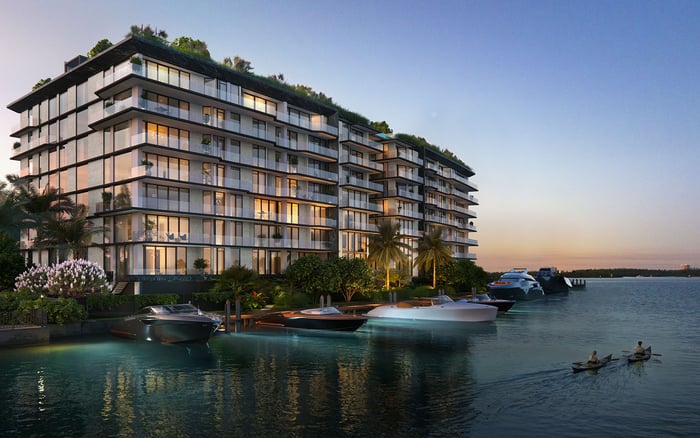
Bay Harbor Towers positions hotel-guest separation as a refined luxury strategy for privacy-oriented buyers who want service, calm, and residential permanence in Bay Harbor Islands.

Bay Harbor Towers enters the South Florida luxury conversation with a premise that feels increasingly relevant: the most meaningful amenity may be the absence of intrusion. In a market often defined by spectacle, branding, nightlife proximity, and hospitality theater, the project advances a quieter proposition. It frames luxury not only through finishes, views, or recognizable names, but through the structure of daily life within the building.
That distinction matters. Many affluent buyers are not rejecting service-rich living. They are rejecting the friction that can come with a mixed hotel and residential environment: unfamiliar faces moving through shared spaces, shifting lobby rhythms, and the persistent sense that home is also part of someone else’s short stay. Bay Harbor Towers makes the case that hotel-level attentiveness and residential privacy do not have to compete.
The result is a different luxury language. It is less about being seen and more about being shielded. Less about public energy and more about controlled access. Less about the performance of exclusivity and more about the practical benefit of living among owners whose relationship to the property is long-term.
In the ultra-premium segment, privacy has moved from a preference to a central measure of value. A residence can be beautifully designed and still feel compromised if the building’s circulation feels too public. The question is no longer only what a buyer sees from the living room. It is who they encounter on the way there, how predictable the environment feels, and whether the building behaves like a residence first.
Hotel-guest separation addresses that issue directly. By reducing transient foot traffic within residential areas, a project can create a more composed everyday atmosphere. Owners are not navigating the same patterns as short-term guests. Shared spaces can feel less performative and more residential, with a rhythm shaped by permanence rather than turnover.
This is the heart of the quiet luxury case for Bay Harbor Towers. The project is best understood as a counterpoint to branded hospitality towers, not as a less serviced product. Its value proposition is not austerity. It is selectivity. Service can remain refined while the residential experience is protected from the constant motion associated with resort-style use.
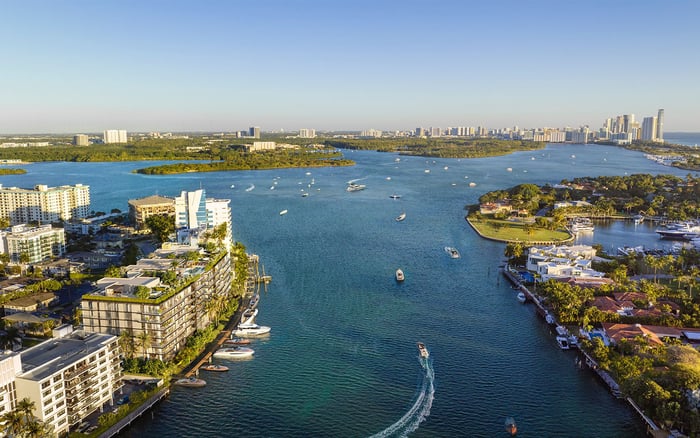
Bay Harbor Islands gives this thesis a natural address. The area is residential in tone and connected to South Florida’s broader luxury market without placing residents inside the most heavily trafficked resort corridors. That balance is precisely what makes the neighborhood compelling for buyers who want access without exposure.
The setting also contrasts with more spectacle-driven districts. Those markets can be magnetic for buyers who want energy, visibility, and urban density. Bay Harbor Islands appeals to a different sensibility: calmer daily rhythms, a more residential framework, and a lifestyle that filters luxury through a more private lens.
Proximity to Bal Harbour adds another layer. Residents can remain close to ultra-luxury retail and hospitality while living outside a resort-heavy corridor. For many buyers, that is the ideal arrangement: convenience nearby, calm at home.
The most sophisticated buyers understand that service and hospitality are not identical. Service is about responsiveness, discretion, and consistency. Hospitality, in the hotel sense, often involves a broader public program. The quiet luxury argument separates those ideas.
Bay Harbor Towers is positioned around the idea that residents can value a service-oriented lifestyle while still preferring an owner-focused environment. This is not a rejection of comfort. It is a refinement of what comfort should feel like when the residence is a primary home, a second home, or a long-term family base.
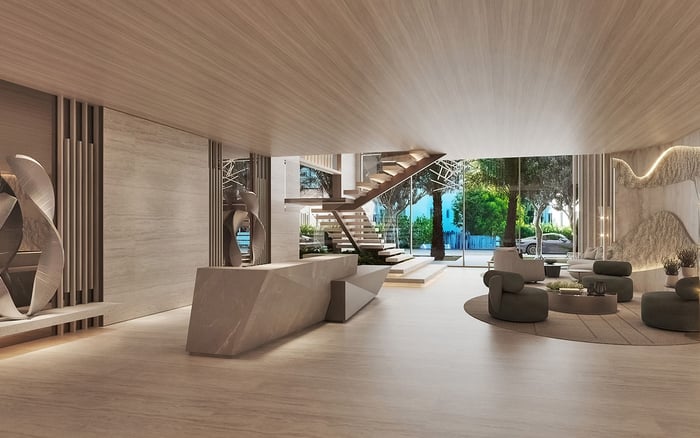
The distinction becomes especially important in shared areas. Lobbies, elevators, arrival sequences, and amenity-adjacent spaces shape the emotional experience of ownership. When those areas are populated primarily by residents and their invited guests, the building can feel calmer and more predictable. That predictability is not merely operational. It is psychological. It allows home to feel like home.
Luxury real estate buyers often evaluate value through visible factors: views, waterfront orientation, architecture, interiors, and address. Those remain important. Yet Bay Harbor Towers brings another factor to the foreground: operational predictability.
Owner-focused environments can feel more stable than mixed hotel-residential operations. They are less exposed to the changing tempo of guest turnover and the public-facing energy that can define hospitality-driven properties. For buyers with a long horizon, that stability can become part of the asset story.
Privacy, exclusivity, and operational clarity are not abstract lifestyle benefits. They can influence how a property is perceived, how it is lived in, and how confidently it fits within a long-term portfolio. In this sense, the quiet luxury thesis is not merely aesthetic. It is strategic. It suggests that the future of high-end differentiation may be shaped as much by governance, access, and daily rhythm as by design language.
The likely buyer for Bay Harbor Towers is affluent, privacy-oriented, and comfortable with restraint. This buyer may already know Miami’s more visible luxury corridors and may even enjoy them socially. But at home, the priority is discretion. They want fewer unknowns in the lobby, less nightlife spillover, and a building culture that feels residential rather than transient.
That profile includes buyers who are not impressed by branding alone. They are looking for a lifestyle structure that protects time, privacy, and ease. They may want the polish of a serviced building, but they do not want to feel as if their residence is one component in a larger hospitality machine.
Bay Harbor Towers therefore reads as part of a broader evolution in South Florida luxury. The market is no longer defined only by the loudest address or the most recognizable name. Increasingly, the highest form of privilege is control: who enters, how the building moves, and how quietly daily life unfolds.
For the right buyer, the appeal of Bay Harbor Towers is not simply that it is quieter. It is that quiet is treated as an organizing principle. The project’s core argument is that lifestyle structure can be a luxury differentiator in its own right.
That is a subtle but important shift. In many luxury buildings, privacy is presented as one feature among many. Here, separation between hotel guests and residential owners becomes central to the value proposition. It supports calm, exclusivity, permanence, and a more controlled residential experience.
In a region where high-end offerings often compete through spectacle, Bay Harbor Towers makes a disciplined case for restraint. It suggests that the next chapter of luxury may belong not only to the tallest, boldest, or most branded projects, but to residences that understand how deeply privacy shapes value.
What is the main quiet luxury argument for Bay Harbor Towers? Bay Harbor Towers positions privacy, calm, and controlled access as defining luxury features rather than relying only on spectacle or branding.
Does hotel-guest separation mean less service? No. The concept is framed as hotel-level service without the intrusion of hotel-guest traffic in residential spaces.
Why is reduced transient traffic important to buyers? It can make lobbies, elevators, and shared residential areas feel more private, consistent, and owner-oriented.
How does Bay Harbor Islands support this concept? Its residential character and quieter setting align naturally with a more private luxury lifestyle.
How is this different from a resort-residence model? A resort-residence model often brings more public hospitality activity, while this thesis emphasizes residential permanence and separation.
Is Bay Harbor Towers positioned against branded hospitality towers? It is best read as a counterpoint, offering service-oriented living while prioritizing privacy over hotel-style visibility.
Who is the likely buyer for this type of property? The likely buyer values discretion, controlled access, and a calmer home environment over nightlife energy or lobby spectacle.
Why does proximity to Bal Harbour matter? It gives residents access to nearby luxury retail and hospitality without requiring a home base inside a resort-heavy corridor.
Can privacy influence long-term value? Privacy, exclusivity, and operational predictability can support how a property is perceived and evaluated over time.
What should buyers compare when evaluating this concept? Buyers should compare not only views and finishes, but also access control, building rhythm, and the degree of residential separation.
If you'd like a private walkthrough and a curated shortlist, connect with MILLION.
If branded residences are on your mind — as a home or as an allocation — we would be glad to share what we are seeing, privately.
Begin a quiet conversation