Bal Harbour and Sunny Isles Beach sit minutes apart on the same oceanfront stretch, yet they deliver two distinct definitions of luxury. One is compact, mature, and discreet, anchored by Bal Harbour Shops and a tightly held residential inventory. The other is a high-rise skyline with resort-style amenity culture and a broader range of luxury choices. This guide compares pricing signals, lifestyle fit, and what to prioritize when buying in each market.
Bal Harbour and Sunny Isles Beach are close enough that a casual observer might group them together. Buyers rarely do. The difference isn’t only about height or skyline density - it’s about the rhythm of daily life and how each market manages visibility.
Bal Harbour Village occupies roughly 0.6 square miles in total area at the northern end of Miami Beach’s barrier island, with about 0.3 square miles of land. That compact scale shapes everything. It reads as a village because it is one, and its 2020 population was 3,093. Demographic summaries also point to a relatively mature community, with a median age reported around 49.9 years.
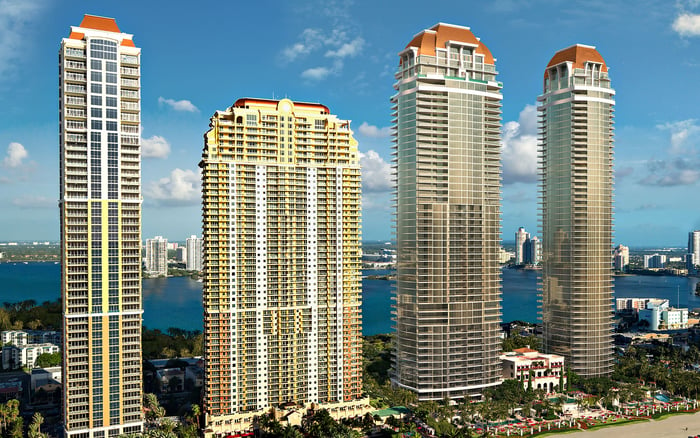
Sunny Isles Beach, by contrast, is defined by verticality and momentum. Neighborhood profiles describe a population of 22,125, a density listed at 21,893.47 people per square mile, and a household count that signals a larger day-to-day churn. In practical terms, that translates into more building options, more lifestyle formats, and greater variation in how owners use their residences.
For the ultra-premium buyer, the decision often collapses to one question: do you want luxury that recedes into discretion, or luxury that makes its point through scale and amenity theater?
A clear way to read the market’s current posture is to look at luxury pricing signals in dollars per square foot.
In Q3 2025, a Miami Beach luxury condo report placed Surfside and Bal Harbour around $1,297 per square foot, up about 4.5% year over year from $1,241. The same report placed Sunny Isles Beach luxury condos around $977 per square foot, down about 3.5% year over year.
Those figures are not a verdict on quality. They function more as a proxy for scarcity and buyer priorities. Bal Harbour’s “smaller by design” footprint compresses inventory and concentrates prestige, while Sunny Isles offers more choice and, as a result, more price dispersion.
How to interpret this as a buyer:
Bal Harbour’s luxury identity is inseparable from its retail core. Bal Harbour Shops is an open-air luxury shopping center known for high-end retail and is widely regarded as the area’s gravitational pull. The Village of Bal Harbour itself promotes it as a key local attraction. For residents, that proximity becomes a walkable luxury routine that feels curated rather than sprawling.
The residential character follows the same logic. Buildings here tend to feel intentional: fewer distractions, a more club-like atmosphere, and a social scene that’s present without being performative.
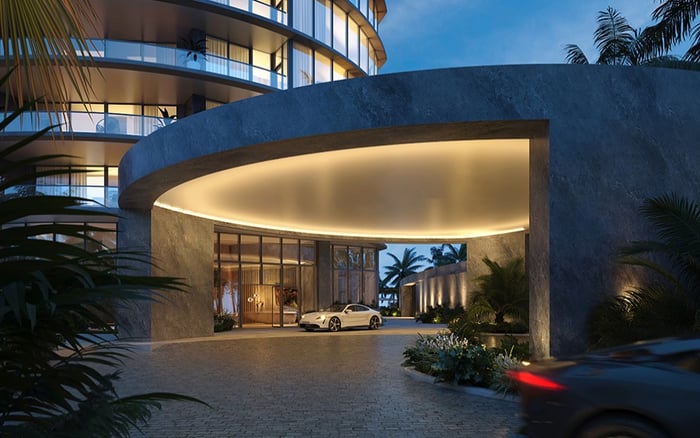
A reference point for this sensibility is Oceana Bal Harbour, described as a 28-story condominium with 239 residences. Its landscape approach has been documented publicly by Enzo Enea - an example of how, at the top end, Bal Harbour buyers often treat outdoor space and arrival sequences as part of the design brief.
For those looking toward the next chapter of oceanfront living, Rivage Bal Harbour reflects the area’s forward-looking profile. Public project material describes it as a 24-story oceanfront residential tower, and it has been marketed as 61 exclusive residences. In a market defined by limited land and tightly held inventory, that small number isn’t incidental - it’s the entire thesis.
Sunny Isles Beach has become synonymous with oceanfront towers and a modern, service-forward approach to condo living. The city’s scale supports variety, and buyers can align a purchase with how they actually live: seasonal, full-time, or as a second-home pattern built around lock-and-leave ease.
The skyline continues to evolve. Widely covered development reporting has described Bentley Residences in Sunny Isles Beach as approximately 749 feet tall, and separate reporting in January 2026 detailed a planned 62-story, 820-foot condominium tower intended to become the city’s tallest. The takeaway isn’t the headline height - it’s what the trajectory signals: Sunny Isles is still actively re-defining the high-rise luxury experience.
In that context, branded residences often carry weight. They can clarify the service promise and offer international buyers a familiar standard. A relevant example is St. Regis® Residences Sunny Isles, positioned publicly as an amenity-forward branded residential offering in Sunny Isles Beach.
Sunny Isles can also suit buyers who want a distinctly residential tower but still expect a resort vocabulary: robust wellness spaces, social rooms that read like private clubs, and the kind of view corridors that only height can deliver.
The most expensive mistake in a luxury condo purchase is assuming a market’s reputation will automatically match your routine. Tour with a checklist that reflects how you will actually use the home.
In Bal Harbour, prioritize:
In Sunny Isles, prioritize:
For buyers comparing multiple coastal options beyond these two enclaves, it can be instructive to tour a Miami Beach branded residence as a baseline for service expectations. The Ritz-Carlton Residences® Miami Beach offers that point of reference, especially for those who want hospitality DNA without stepping fully into a condo-hotel format.
While every purchase is personal, patterns do emerge.
Bal Harbour tends to attract:
Sunny Isles tends to attract:
If you’re deciding between the two, use a simple litmus test. If the ideal day begins with a quiet walk and ends with a discreet dinner, Bal Harbour may feel inevitable. If it begins with an ocean view from height and ends on a building’s amenity deck, Sunny Isles may fit more naturally.
Luxury condos do not trade like starter homes. Liquidity is often a function of how unique the asset is and how many comparable options exist.
Bal Harbour’s scarcity can support premium pricing, but it can also mean fewer direct comps. That can work in your favor if you own something truly distinctive, but it can also require patience and an expert pricing strategy.
Sunny Isles’ broader inventory can create more transparent comparables and potentially a larger buyer pool for certain unit types. At the same time, more choice can increase competition at resale, making positioning and timing more important.
For real-time context, many buyers monitor local dashboards and active inventory portals to understand what is actually on the market, not just what has traded historically.
Is Bal Harbour more expensive than Sunny Isles Beach for luxury condos? Recent market reporting shows Surfside/Bal Harbour with higher $/sf than Sunny Isles in Q3 2025.
What lifestyle does Bal Harbour offer compared to Sunny Isles? Bal Harbour is compact and discreet, while Sunny Isles leans into a vertical resort style.
Is Bal Harbour a small community? Yes. Bal Harbour’s 2020 population was 3,093 and the village footprint is notably small.
How dense is Sunny Isles Beach? Neighborhood profiles list Sunny Isles at 21,893.47 people per square mile.
What is the role of Bal Harbour Shops for residents? It is a flagship luxury destination and a core convenience that shapes daily routines nearby.
Are there newer oceanfront options in Bal Harbour? Projects like Rivage Bal Harbour have been publicly described as a new oceanfront tower concept.
Does Sunny Isles have significant new tower activity? Yes. Public reporting has covered multiple very tall planned and proposed condo towers.
Do branded residences matter more in Sunny Isles? They can, because the market often emphasizes amenity and service standards tied to brands.
Which market is better for privacy? Bal Harbour typically suits privacy-focused buyers due to its village scale and edited inventory.
How should I choose between the two? Decide whether you want discretion and scarcity, or height, amenities, and broader selection.
For a confidential assessment and a building-by-building shortlist, connect with MILLION Luxury.
If branded residences are on your mind — as a home or as an allocation — we would be glad to share what we are seeing, privately.
Begin a quiet conversation