A discreet guide for luxury buyers comparing mountain-minded wellness living with Miami Beach, bayfront, and urban South Florida residences.
For the Aspen buyer considering Miami Beach, the question is not simply where to find sunshine, water, and a beautiful lobby. It is how to translate a life organized around privacy, ritual, and restorative space into a coastal residence that performs every day. A wellness-led home should feel less like a themed amenity package and more like an operating system for the owner’s routines.
That begins with honesty. Some buyers want an oceanfront setting with morning walks, salt air, and a direct relationship to the horizon. Others want a quieter bay address, a more residential village rhythm, or proximity to Brickell for dining, culture, and business. A Miami Beach search can still mean many different residential tempos, from resort-like energy to hushed privacy behind controlled arrivals.
The strongest purchase is rarely the one with the longest amenity menu. It is the residence that reduces friction: better sleep, easier movement, intuitive service, natural light, usable terraces, and spaces that allow the household to reset without leaving home.
Wellness buyers often arrive with a mental checklist: spa, fitness room, treatment space, pool, garden, beach access, concierge, private dining. Those details matter, but they should be sequenced around a more revealing question: what does a perfect ordinary day look like?
If your morning begins with quiet movement, evaluate how easily you can move from bedroom to terrace, from elevator to beach path, or from home to training space without navigating crowds. If sleep is the priority, study bedroom placement, window exposure, acoustic separation, elevator adjacency, and the relationship between entertainment areas and private quarters. If recovery is central, consider whether the building supports quiet, temperature control, easy circulation, and service that never feels performative.
A residence such as 57 Ocean Miami Beach may enter the conversation for buyers focused on the beachside version of this lifestyle, while other buyers may decide that wellness means more distance from the sand and more control over privacy, arrivals, and daily pace.
Oceanfront is not a single lifestyle. For some, it is direct contact with the beach and an elemental view. For others, it can feel too exposed, too active, or too tied to a resort mood. The right oceanfront residence should be judged by approach, privacy, elevator experience, terrace usability, and how the building manages the transition from public shoreline to private sanctuary.
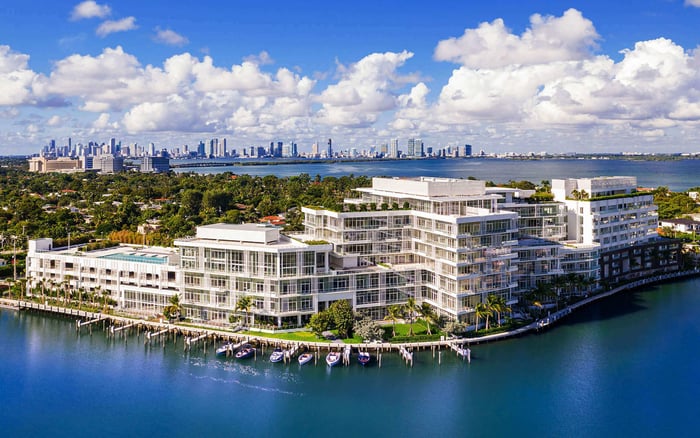
Bayfront and island settings can offer a different kind of calm. The water may feel more residential, the pace more measured, and the arrival less theatrical. Buyers considering The Well Bay Harbor Islands are often thinking beyond scenery, toward a daily framework where wellness is embedded in the building identity rather than treated as a decorative extra.
Urban wellness is another category altogether. In Brickell, the appeal may be the ability to compress a high-functioning life into fewer transitions: home, work, dining, fitness, and social connection within a compact radius. For the buyer who does not want to choose between city energy and personal restoration, The Residences at 1428 Brickell belongs in a very different comparison set than a purely beachfront purchase.
Floor plan quality is the quiet separator in wellness-led real estate. A home that looks serene in photography can live poorly if circulation is awkward, storage is insufficient, staff access is unresolved, or bedrooms lack meaningful separation. A plan that supports wellness gives each part of the day its own place.
Look for a clear arrival sequence, ideally one that allows the owner to decompress before entering the main living space. Evaluate whether the kitchen supports the way you actually eat and entertain. Consider where luggage, sports gear, wellness equipment, pets, and visiting family will go. Study the terrace as a true outdoor room, not merely a visual appendage. In South Florida, shade, orientation, and wind comfort can matter as much as view.
A building like The Perigon Miami Beach may be discussed by buyers who want Miami Beach presence with a refined residential sensibility, but the decisive question remains personal: does the plan make your routines easier, calmer, and more private?
Wellness-led living depends on service, but not spectacle. The best service environment anticipates without intruding. It protects the owner’s time, simplifies arrivals, handles guests gracefully, and keeps the building feeling composed even when fully occupied.
Ask how the residence will function during peak periods, holidays, dinner parties, family visits, and quick weekend arrivals. Where do cars queue? How are packages handled? Can trainers, chefs, treatment providers, and guests enter without disrupting the household? Is there a credible sense of privacy from lobby to elevator to residence?
This is where brand and operations can matter, provided the service culture aligns with the buyer’s temperament. The Ritz-Carlton Residences® Miami Beach may appeal to buyers who value hospitality language, but even then, the fit should be tested through practical questions about discretion, staffing, and daily ease.
The Aspen-to-Miami Beach buyer often understands that luxury is not volume. It is proportion, quiet, materials, light, and the confidence that a home supports recovery. In South Florida, that philosophy should be applied with coastal intelligence.
Prioritize orientation and natural light, but do not confuse brightness with comfort. Study terrace depth and privacy. Ask how the residence feels at different times of day. Consider elevator count, parking flow, guest management, and whether the building’s social culture matches your household. A highly programmed building may be ideal for one owner and too visible for another.
Also consider the relationship between residence and neighborhood. Wellness is not confined to the spa level. It includes how easily you can walk, swim, dine, host, retreat, and leave town. A second home that requires too much coordination can become another obligation. The better residence makes arrival feel immediate and departure feel effortless.
Avoid buying a wellness narrative without testing the physical reality. A meditation room does not compensate for a noisy bedroom. A beautiful pool deck does not solve weak privacy. A fitness suite does not matter if the daily route through the building feels congested. Wellness is cumulative, and weak details reveal themselves quickly.
Be cautious with oversized amenity programs that appear impressive but do not match how you live. If you travel often, operational reliability may matter more than a long roster of spaces. If you host extended family, floor plan separation may matter more than a club room. If your priority is recovery, quiet may be more valuable than social energy.
The right residence should not ask you to perform wellness. It should make wellness ordinary.
Is a wellness-led residence the same as a spa residence? No. Spa amenities can be part of the experience, but wellness-led living is broader: layout, privacy, light, service, air, sound, and daily rhythm all matter.
Should an Aspen buyer automatically choose Miami Beach? Not automatically. Miami Beach may be ideal for a beach-centered lifestyle, while bayfront, island, grove, or urban settings may better support privacy or convenience.
What is the first thing to evaluate in a wellness residence? Start with your daily routine. The best building is the one that supports how you sleep, move, recover, entertain, and arrive.
Are ocean views enough to justify a purchase? Views are powerful, but they should be weighed against plan quality, privacy, terrace usability, building operations, and long-term comfort.
How important is the floor plan? It is essential. Wellness depends on circulation, separation, storage, quiet bedrooms, usable outdoor space, and intuitive transitions.
What service questions should buyers ask? Ask how arrivals, guests, deliveries, parking, private providers, and peak-season activity are handled. Discretion is part of wellness.
Can Brickell work for a wellness-focused buyer? Yes, for buyers who value efficiency, dining, business access, and a more urban routine. The key is choosing a residence with calm interiors and strong operations.
Is a branded residence always better for wellness? Not always. Brand can support service and consistency, but the building must still fit the owner’s temperament, privacy needs, and daily habits.
What should second-home buyers prioritize? Ease of arrival, reliable service, low-friction ownership, secure access, and a residence that feels ready the moment they land.
What is the biggest mistake in choosing a wellness-led residence? Buying the amenity story instead of the lived experience. The home should make restorative living feel natural, not staged.
For a confidential assessment and a building-by-building shortlist, connect with MILLION.
If branded residences are on your mind — as a home or as an allocation — we would be glad to share what we are seeing, privately.
Begin a quiet conversation