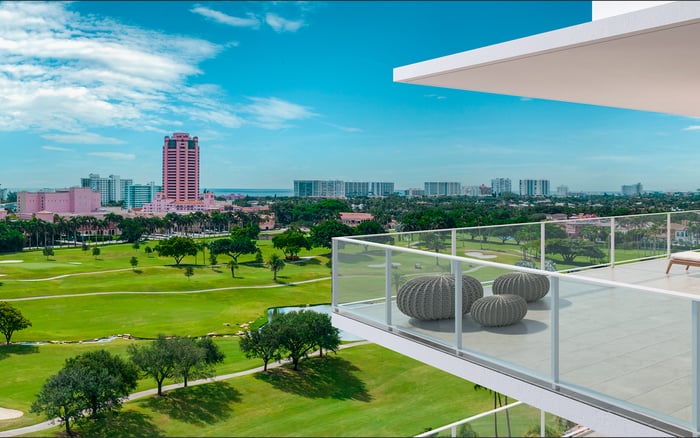
A discreet buyer’s guide to reviewing The Residences at Mandarin Oriental Boca Raton before reservation, with emphasis on brand obligations, Via Mizner execution, operating costs, amenity access and resale considerations.

The Residences at Mandarin Oriental Boca Raton is not simply a luxury condominium with a famous name attached. Its premise is more layered: private ownership supported by hotel-level service, the prestige of a global hospitality brand, and the daily convenience of a larger mixed-use urban resort environment. That combination is exactly why the reservation decision warrants a more forensic review than a conventional floor plan comparison.
The residences are tied to the Via Mizner setting in downtown Boca Raton, where the surrounding environment can matter as much as the private home. For buyers accustomed to South Florida’s familiar choices, this is a distinct proposition. It is neither a pure oceanfront tower nor a gated golf-community purchase. It is an urban-core lifestyle bet, and the experience depends on how well the entire district performs.
That distinction should shape every question before reserving. The residence matters, but so do the hotel, the ground-floor environment, the dining program, the service protocols, and the long-term quality of management. In Boca Raton, buyers may compare this urban branded model with Alina Residences Boca Raton or Glass House Boca Raton, but the Mandarin Oriental concept places unusual weight on the surrounding hospitality ecosystem.
The Mandarin Oriental name is one of the project’s central intangible assets. It signals service expectations, design discipline, and global recognition. Yet sophisticated buyers should separate brand aura from contractual obligation. The critical question is not only what the marketing language suggests, but what the legal and operating agreements require.
Before reserving, buyers should review the documents that define which services are included, which are optional, which are subject to separate charges, and which depend on the hotel or broader Via Mizner operations. If the brand relationship can be modified, assigned, suspended, or terminated over time, that risk should be understood before a deposit becomes emotionally committed capital.
This is also where comparison becomes useful. A buyer considering The Residences at Mandarin Oriental, Miami may be evaluating the same broad branded-residence idea in a different city context, while a buyer looking north to The Ritz-Carlton Residences® West Palm Beach is weighing another hospitality name with its own structure. The exercise is not about ranking logos. It is about reading the agreements behind them.
Because the residences are part of a broader development setting, the building cannot be evaluated in isolation. The value proposition depends heavily on Via Mizner’s execution as a place: construction phasing, retail leasing, dining mix, parking experience, pedestrian flow, and the ability to maintain a polished environment over time.
A reservation review should therefore move beyond the unit. Which phases are complete, in progress, or still to come? How will construction activity affect residents after initial occupancy? Which retail and dining concepts are contemplated, and how much of that environment is committed rather than aspirational? How will residents move between home, hotel amenities, parking, and the public-facing portions of the district?
Downtown Boca Raton’s ability to support a Mandarin Oriental-level offering is central to the thesis. The buyer is not only purchasing finishes, views, and service access. The buyer is purchasing into an urban lifestyle that must feel effortless, curated, and durable.
Luxury service is compelling, but its economics matter. Buyers should understand the full ownership-cost picture, including assessments, potential service charges, shared-area obligations, reserve requirements, and any fees tied to hotel-style privileges. A service that sounds included in conversation may be treated differently in the operating documents.
Amenity access deserves the same scrutiny. Buyers should clarify which amenities are private to residents, which are shared with the hotel, which require reservations, and whether access rights can change. The most attractive branded residences often feel seamless because the boundaries are intelligently managed. Poorly defined boundaries can create friction.
For new-construction and pre-construction buyers, the review should also include construction status, delivery timing, developer capitalization, prior project quality, schedule performance, and any relevant litigation. None of these items necessarily undermines the opportunity. They determine whether the purchase is being priced with adequate awareness of risk.
The branded-residence premium is most resilient when future buyers understand and desire the same experience. That means resale liquidity may depend on more than square footage. It may depend on whether Via Mizner matures into a true district, whether the hotel service culture remains strong, and whether the Mandarin Oriental relationship continues to carry the expected prestige.
The specific residence still deserves a disciplined review. Layout, ceiling feel, exposure, terrace usability, privacy, elevator access, parking convenience, and proximity to shared spaces all affect livability and eventual resale. Investment discipline begins with the individual home, but in this case it extends outward to the brand contract and the district plan.
The Residences at Mandarin Oriental Boca Raton may appeal most to buyers who want Boca Raton with a more cosmopolitan daily rhythm: walkable, serviced, and brand-led, rather than beachfront or country-club oriented. For that buyer, the reservation decision should be measured, not rushed.
What is the core concept behind The Residences at Mandarin Oriental Boca Raton? It combines private residences with hotel-level services within the larger Via Mizner environment in downtown Boca Raton.
Why is Via Mizner important to the purchase decision? The value proposition depends on the broader district, including hotel operations, retail, dining, parking, and the quality of public-facing spaces.
Should buyers rely on the Mandarin Oriental name alone? No. The brand is valuable, but buyers should review the agreements that define actual obligations, rights, and limitations.
What brand-related risk should be reviewed? Buyers should understand whether the Mandarin Oriental relationship can change, terminate, or be modified over time.
Which ownership costs deserve attention before reserving? Buyers should review assessments, shared operating costs, amenity charges, service fees, and any obligations tied to mixed-use operations.
How should amenity access be evaluated? Buyers should distinguish resident-only amenities from hotel-shared amenities and confirm any reservation rules or access limitations.
What should be reviewed about construction and phasing? Buyers should assess project status, future phases, delivery timelines, and how ongoing work could affect the resident experience.
How does this differ from a typical Boca Raton luxury purchase? It emphasizes a walkable downtown lifestyle and branded hospitality rather than the oceanfront-tower or gated-golf-community model.
What matters most for future resale? Resale strength may depend on the residence itself, the durability of the brand relationship, and the success of Via Mizner as a district.
What is the best way to shortlist comparable options for touring? Start with location fit, delivery status, and daily lifestyle priorities, then compare stacks and elevations to validate views and privacy.
When you're ready to tour or underwrite the options, connect with MILLION.
If branded residences are on your mind — as a home or as an allocation — we would be glad to share what we are seeing, privately.
Begin a quiet conversation