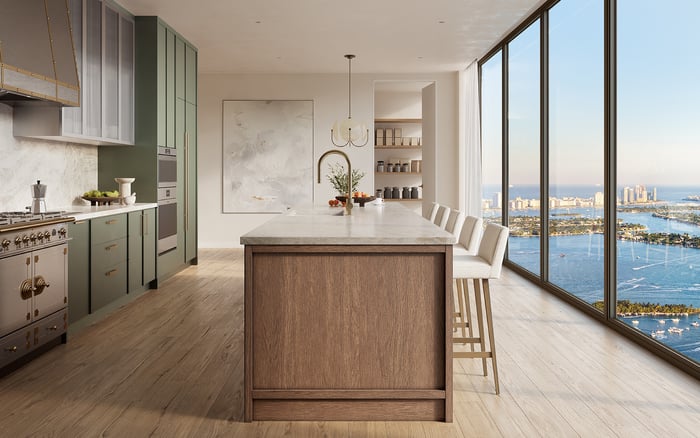
A discreet buyer’s framework for evaluating access control, staffing, privacy, emergency readiness and operational discipline before selecting an Edgewater residence.

For an Edgewater buyer, security planning should begin well before comparing finishes, views or amenity decks. The decisive question is not whether a building advertises controlled access, but how its architecture, staffing, technology and management work together on an ordinary day, a crowded evening and during an unexpected disruption.
Treat the residence as part of a larger operating system. Trace the path from the street to the garage, lobby, elevator and private front door. Then repeat the exercise for guests, household staff, contractors, deliveries and vehicles. Each route may reveal a different balance of convenience, discretion and oversight.
Security is also personal. A primary resident with a predictable routine may prioritize controlled circulation differently from a second-home owner who leaves the property unoccupied. Families, collectors, public figures and buyers with household teams each require distinct protocols. The strongest choice is the building whose procedures align with how the household actually lives.
Begin at the property line. Observe how pedestrians and vehicles approach, where visitors pause and whether arrivals feel orderly. Inside, ask how credentials are issued, replaced and revoked. Clarify whether access permissions can be limited by floor, elevator, time or destination, without assuming any particular capability is included.
The garage deserves equal scrutiny. Inspect the transition from parking to residential circulation, the handling of guest vehicles and the route used when carrying luggage or valuable purchases. Private elevators can feel discreet, but their value depends on the controls and procedures surrounding them.
Apply these questions consistently to every residence under consideration, including Aria Reserve Miami and EDITION Edgewater. Project presentations are only a starting point. Written building documents, direct demonstrations and professional review should establish what is actually available.
Technology is only one layer. Ask who monitors entry points, how shifts are structured, what happens during breaks and how incidents are escalated. Buyers need not request sensitive operational details, but they do need enough clarity to understand accountability, after-hours coverage and the management chain.
Guest procedures should feel polished without becoming casual. Consider advance registration, identity confirmation, host notification and access expiration. Ask how recurring vendors are handled, particularly housekeepers, assistants, pet-care providers and maintenance teams. An effective system should accommodate trusted people while preserving a record of permissions and changes.
Privacy extends beyond the front door. Inquire about directories, resident information, package labels, service requests and camera access. Determine who may view records and how long information is retained. When touring Lilli Miami Edgewater or The Cove Residences Edgewater, use the same privacy checklist to keep comparisons disciplined rather than impressionistic.
A scheduled presentation rarely captures a building at its busiest. If access is permitted, visit at more than one time. Notice delivery activity, rideshare pickups, garage movement and how easily unfamiliar people can follow residents through controlled doors. Observe whether staff apply procedures consistently and courteously.
Inside the prospective home, evaluate sightlines from neighboring buildings, terraces and common corridors. Higher floors may alter visibility and elevator dependence, while lower positions can change arrival patterns and exterior exposure. Neither is inherently superior. The right decision depends on the buyer’s privacy preferences, mobility needs and contingency planning.
For a waterfront residence, also consider how any secondary edge, promenade connection or service approach relates to the building’s controlled perimeter. The aim is not to create anxiety, but to understand every practical approach to the property and how management expects it to function.
Security planning includes events beyond deliberate intrusion. Ask for the documents available to purchasers regarding emergency communication, evacuation, backup access and resident responsibilities. Determine how management communicates when elevators, gates, power, connectivity or water service is interrupted.
Buyers should understand stair access, mobility considerations and procedures affecting pets, guests or household employees during an emergency. If the residence will remain vacant for long periods, ask about permitted monitoring arrangements, key custody, leak response and authorization for emergency entry.
Insurance advisers, attorneys, inspectors and security consultants can examine different aspects of this picture. Their roles are complementary. A specialist can also help assess whether planned in-unit systems integrate appropriately with building rules, shared infrastructure and privacy expectations.
During due diligence, request the governing documents, budgets, relevant policies and available meeting records. Focus on who can approve operational changes, how vendors are selected and which expenses belong to the association rather than the owner. Security quality depends on consistent execution, not simply equipment installed at a single moment.
Ask whether proposed in-unit cameras, alarms, safes, access devices or communications equipment require approval. Confirm installation constraints and responsibilities in writing. The same exercise applies to new-construction and resale opportunities, although the available evidence and timing of review may differ.
At Villa Miami, as with any candidate residence, distinguish marketing language from contractual obligations. Build a decision matrix covering staffing, access layers, visitor handling, garage circulation, information privacy, emergency continuity and recurring costs. Pair any buyer’s guide with property-specific legal and technical advice.
No condominium can promise absolute security. The objective is a coherent, well-managed environment suited to the household’s routines and risk tolerance. A buyer who values anonymity may accept different tradeoffs from one who entertains frequently. Likewise, a family with multiple caregivers may need more flexible credential management than a couple using the residence seasonally.
Before signing, rehearse realistic scenarios: a late guest, a lost credential, an urgent repair while away, a delivery requiring refrigeration or an elevator interruption. A residence that performs gracefully in these ordinary moments is more persuasive than one that relies on a single conspicuous feature.
What should an Edgewater buyer evaluate first? Start with the complete journey from the street and garage to the residence, including every route used by guests, staff and deliveries.
Is a private elevator sufficient for privacy? Not by itself. Its value depends on credential controls, visitor procedures, service circulation and management discipline.
Should buyers ask for sensitive security details? No. Request enough information to assess accountability and procedures without seeking details that could compromise residents.
How should guest access be reviewed? Ask how guests are registered, confirmed, directed and removed from the access system after a visit, as well as how hosts are notified.
Why inspect the garage carefully? The garage is a major arrival route, so its transitions, visitor handling and connection to residential elevators warrant close scrutiny.
Do higher floors automatically provide better security? No. Floor height changes sightlines and elevator reliance, but security depends on the complete building and residence plan.
What matters for a second-home owner? Review vacancy monitoring, emergency-entry authorization, key control, leak response and communication while the owner is away.
How do buyers compare new construction with resale? Apply the same checklist, then account for differences in operating history, available documents and opportunities to observe procedures.
Which professionals can assist with due diligence? Attorneys, inspectors, insurance advisers and qualified security consultants can evaluate distinct but connected areas of risk.
Can any building guarantee complete security? No. Buyers should seek layered controls, consistent operations and procedures suited to their household rather than an absolute promise.
For a discreet conversation and a curated building-by-building shortlist, connect with MILLION.
If branded residences are on your mind — as a home or as an allocation — we would be glad to share what we are seeing, privately.
Begin a quiet conversation