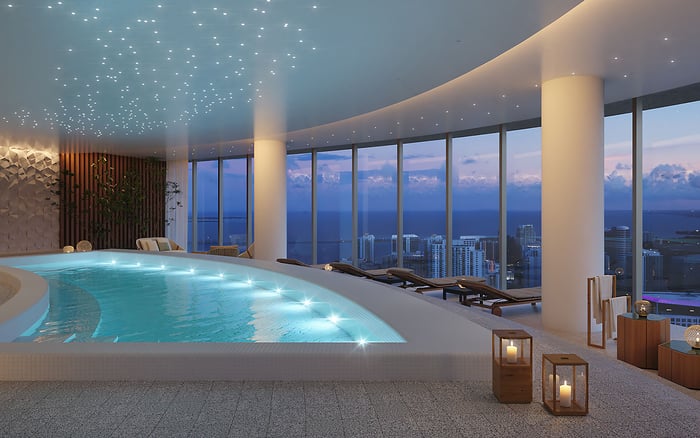
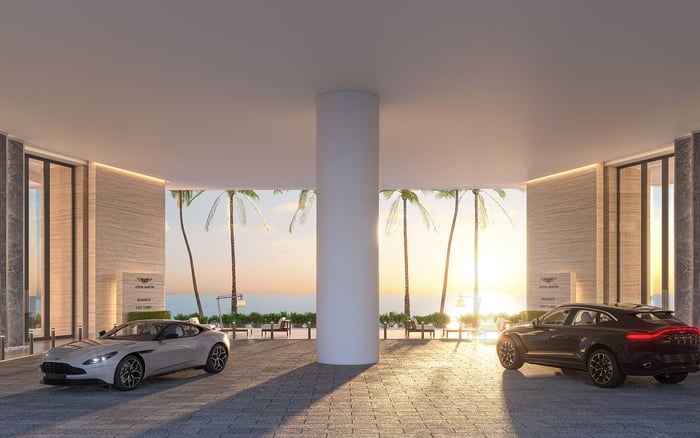
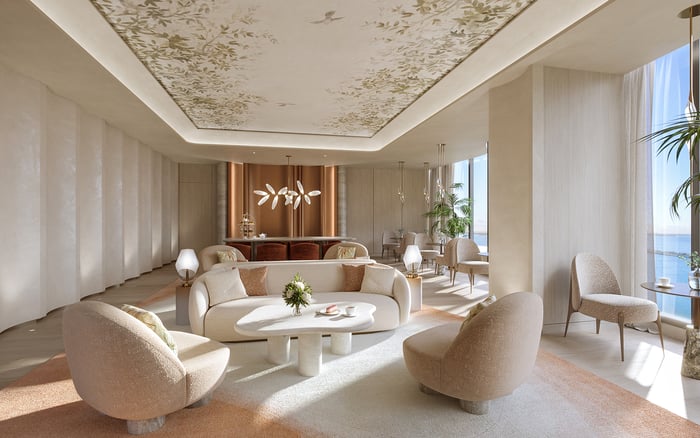
A buyer-oriented comparison of two ultra-prime Miami towers reveals a meaningful divide: 619 Residences by Foster + Partners + Nobu Hospitality is shaped around discretion, architecture, and daily service, while Aston Martin Residences Downtown Miami leans into waterfront visibility, collectible branding, and skyline spectacle.
In Miami’s rarefied residential market, not every branded tower is selling the same idea of luxury. Some projects are built around visibility: the arrival sequence, the skyline profile, the implied proximity to yachts, collectors, and spectacle. Others pursue a more private form of luxury, where the real asset is not what the building announces to the city, but how it shapes daily life for the resident.
That distinction sits at the center of the comparison between 619 Residences by Foster + Partners + Nobu Hospitality and Aston Martin Residences Downtown Miami. Both occupy Miami’s uppermost echelon. Both are aimed at buyers with access to the city’s most ambitious addresses. But they are not appealing to exactly the same instinct.
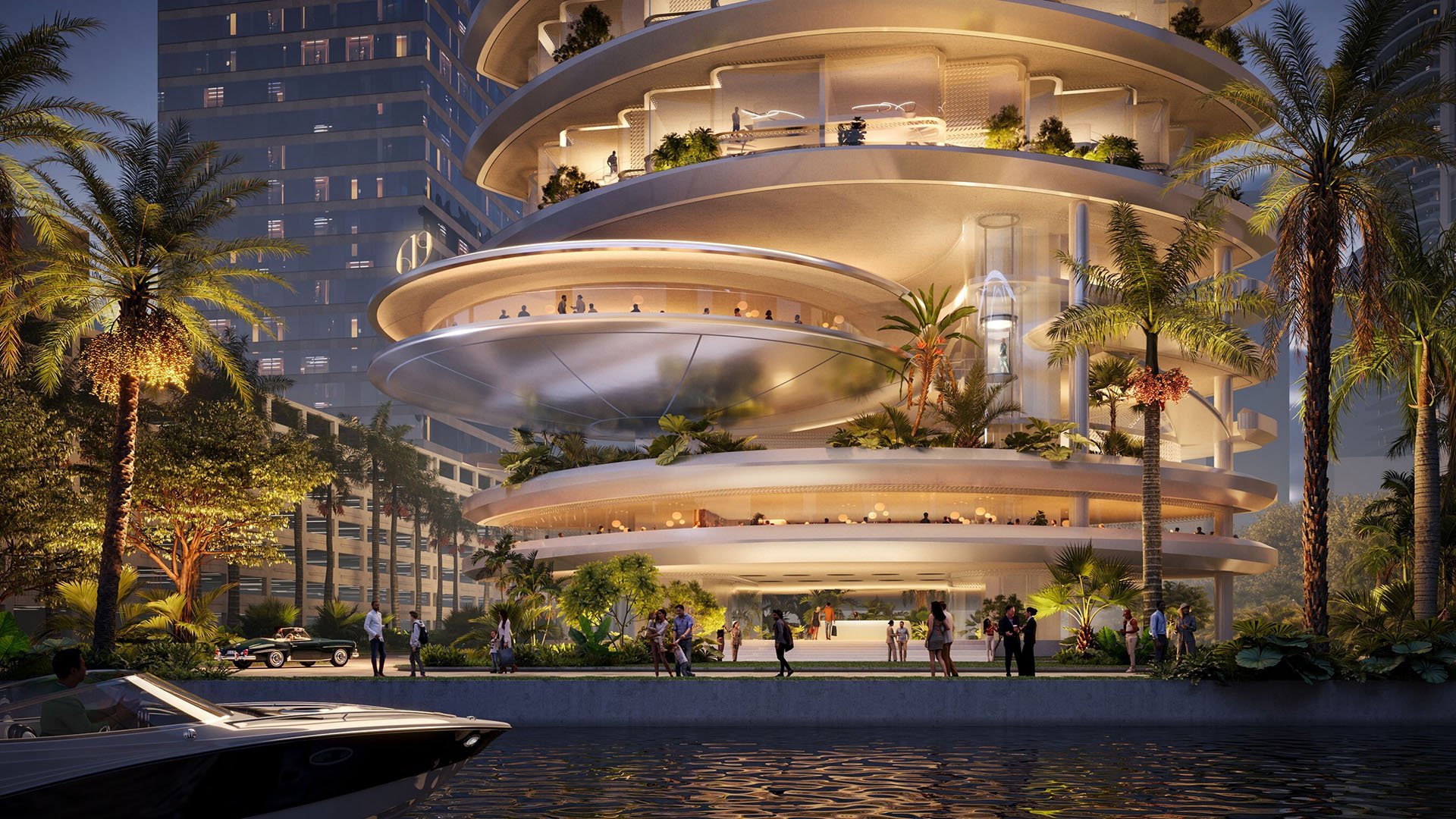
619, Planned for Brickell Avenue, is a supertall mixed-use tower designed by Foster + Partners and paired with Nobu Hospitality. Publicly disclosed details point to roughly 55 residences, an unusually low-density proposition in a market that often equates scale with prestige. The message is clear: intimacy matters. The value proposition is rooted in architecture, culinary programming, and a service environment designed to feel composed rather than performative.
Aston Martin Residences Downtown Miami approaches the luxury brief from the opposite direction. Positioned at 300 Biscayne Boulevard Way on the Miami River and Biscayne Bay edge, it channels the automotive marque’s performance-luxury identity into a waterfront residential statement. Here, branding is not background texture. It is central to the proposition, intertwined with skyline visibility, maritime imagery, and collectible-name recognition.
For a buyer deciding between these two addresses, the real question is not which one is more luxurious in the abstract. It is whether luxury should feel quieter, more ritualized, and more interior, or whether it should register immediately from the water, the skyline, and the brand itself.
The strongest case for 619 is that it does not treat hospitality as decoration. Nobu’s role is tied to actual resident experience, including restaurant and lounge components that shape how the building is lived, not merely how it is marketed. That matters in Brickell, where sophisticated buyers are often less interested in logo-heavy environments than in frictionless daily service.
This is where Foster + Partners becomes especially important. The architectural authorship gives 619 an architecture-first identity, and that shifts the tone of the offering. It places the project closer to the world of highly edited residential design than to a typical branded-residence formula. In that respect, it enters a conversation in Brickell that also includes hospitality- and service-driven peers such as Baccarat Residences Brickell and St. Regis® Residences Brickell, though 619 appears even more intentionally low-density.
The low residence count is not a minor detail. In ultra-prime real estate, scarcity within the building can be as meaningful as scarcity of the address itself. A tower with roughly 55 residences suggests fewer neighbors, fewer shared interactions, and a more controlled atmosphere. Combined with a Brickell Avenue location in Miami’s financial core, the project reads less like a marina-adjacent stage set and more like an urban private club with homes above.
That is the essence of its appeal. 619 is for the buyer who wants the home to feel edited, protected, and carefully cared for. The glamour is there, but it is meant to be absorbed through routine: a refined meal downstairs, a lounge that feels genuinely useful, service that supports a demanding schedule, and a design language that does not need to announce itself.
Aston Martin Residences Downtown Miami is compelling for an entirely different reason. It understands that in Miami, visibility is itself a form of luxury. Its setting on the water’s edge gives it a naturally cinematic identity, and the Aston Martin name intensifies that effect by importing a globally legible performance brand into the home.
This is not chef-led hospitality translated into residential life. It is a branded environment translated into a trophy address. The distinction is subtle but consequential. Where 619 offers a ritual of use, Aston Martin offers a ritual of arrival. The building’s posture is outward-facing. It is part skyline statement, part waterfront object, part collector signal.
For certain buyers, that is not a compromise. It is the point. There is a segment of the Downtown market that wants real estate to operate almost like a rare watch or a limited-production car: unmistakable, highly recognizable, and instantly communicative of taste and access. Aston Martin Residences is calibrated precisely for that audience.
In this sense, it sits comfortably among other Downtown and near-Downtown statements where visibility carries value, such as Waldorf Astoria Residences Downtown Miami and One Thousand Museum Downtown Miami. But Aston Martin adds a specifically maritime and automotive charge. The riverfront and bayfront context make the tower feel inseparable from Miami’s culture of boats, motion, and display.
It is tempting to reduce this comparison to neighborhood preference, but that would miss the more interesting distinction. Yes, Brickell offers the financial core and a more urban, service-driven identity, while Downtown’s waterfront edge can feel more panoramic and theatrical. But these projects are also operating in two different emotional registers.
619 Belongs to the buyer who values curation over exposure. Even at a very high price point, it asks whether luxury can become more private as it becomes more expensive. That proposition is increasingly resonant in Brickell, where newer developments like The Residences at 1428 Brickell have helped reinforce a market for highly specified, globally aware residences that prioritize refinement over spectacle.
Aston Martin, by contrast, belongs to the buyer who wants ownership to be legible. The building’s identity is inseparable from branded prestige, and that can be powerful in a city where the skyline itself functions as a social language. Its waterfront setting deepens that appeal. Even before one enters the residence, the project is already performing.
This does not make one model superior to the other. It makes them unusually clear. At 619, luxury is interiorized into service, design pedigree, and a low-density atmosphere. At Aston Martin, luxury is externalized into brand recognition, visual drama, and the theater of the bayfront edge.
The buyer best suited to 619 is likely someone who has already experienced visible luxury and no longer needs it to be loud. Perhaps this person spends significant time in Brickell, values a highly managed routine, and prefers architecture with enduring authorship. The attraction is the promise that daily life can be elevated through consistency rather than spectacle.
The buyer best suited to Aston Martin Residences Downtown Miami is someone who still values the thrill of iconicity. This resident may want the home to function as a statement asset, a waterfront landmark, and a branded possession all at once. The appeal is not simply comfort. It is symbolic power.
That is why the comparison in the title resolves so neatly. 619 is the quieter hospitality ritual. Aston Martin is the trophy-marina theatrical expression. Each is coherent. Each is luxurious. But they answer very different questions about what a home at the top of Miami’s market should actually do for its owner.
If your idea of prestige is a well-composed life, 619 is the more persuasive concept. Its Foster + Partners authorship, Nobu Hospitality integration, and limited residential count suggest an address built around discretion and repetition: the luxury of things being done well, every day, without overt display.
If your idea of prestige is public-facing and collectible, Aston Martin Residences Downtown Miami has the clearer edge. It capitalizes on waterfront imagery, global brand cachet, and trophy-asset signaling in a way few towers can.
For Miami buyers operating at this level, the smartest decision may come down to a single test: do you want your building to host your lifestyle, or to announce it?
What is the core difference between 619 and Aston Martin Residences Downtown Miami? 619 Is centered on hospitality, architecture, and discretion, while Aston Martin emphasizes waterfront brand theater and skyline visibility.
Where is 619 located? 619 Is planned for 619 Brickell Avenue in the Brickell district, placing it in Miami’s financial core.
Where is Aston Martin Residences Downtown Miami located? It stands at 300 Biscayne Boulevard Way on the Miami River and Biscayne Bay edge in Downtown.
Is 619 a low-density project? Publicly disclosed information describes roughly 55 residences, making it notably intimate for a supertall Miami tower.
What makes Nobu’s involvement at 619 important? The hospitality component is tied to resident life through restaurant and lounge programming rather than just name recognition.
What makes Aston Martin Residences feel different from a hospitality-led tower? Its identity is built more around branded environments, collectible cachet, and statement amenities than daily culinary ritual.
Which project is better for a buyer who wants privacy? 619 Appears more aligned with privacy, curation, and a calmer residential atmosphere.
Which project is better for a buyer who wants a trophy asset? Aston Martin Residences Downtown Miami is the clearer fit for buyers drawn to visibility, branding, and waterfront spectacle.
Does Brickell or Downtown better suit these concepts? Brickell supports 619’s urban service-driven identity, while Downtown amplifies Aston Martin’s panoramic and theatrical positioning.
How should an ultra-prime buyer choose between them? The decision turns on whether you value hospitality ritual and architectural restraint or branded drama and public presence.
When you're ready to tour or underwrite the options, connect with MILLION.
If branded residences are on your mind — as a home or as an allocation — we would be glad to share what we are seeing, privately.
Begin a quiet conversation