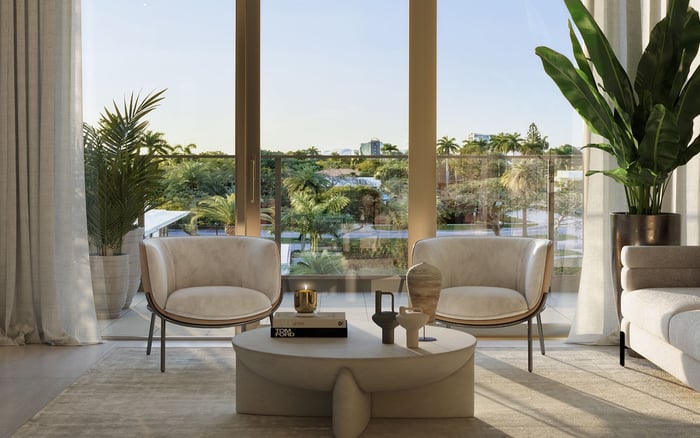
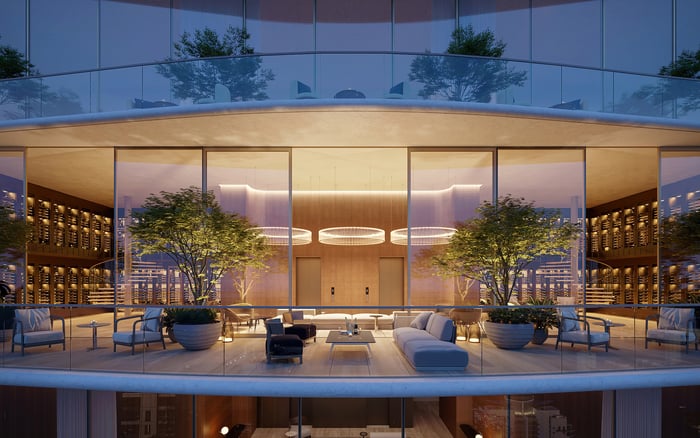
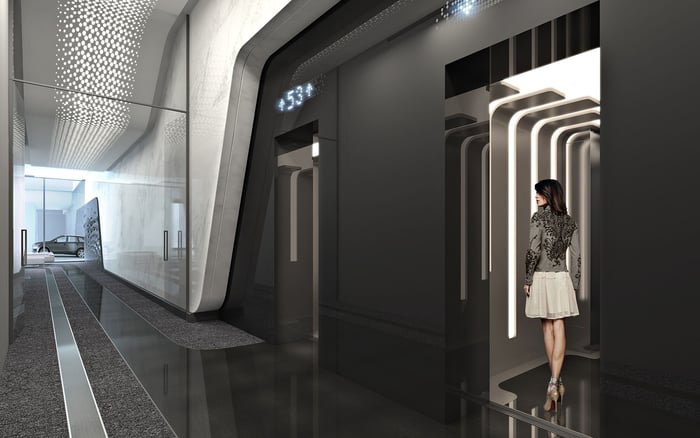
A discreet buyer’s guide to 2200 Brickell as a more intentional residential alternative for those who want Brickell convenience, high-touch service, privacy, and calm without the daily rhythm of a heavily trafficked hotel-style tower.
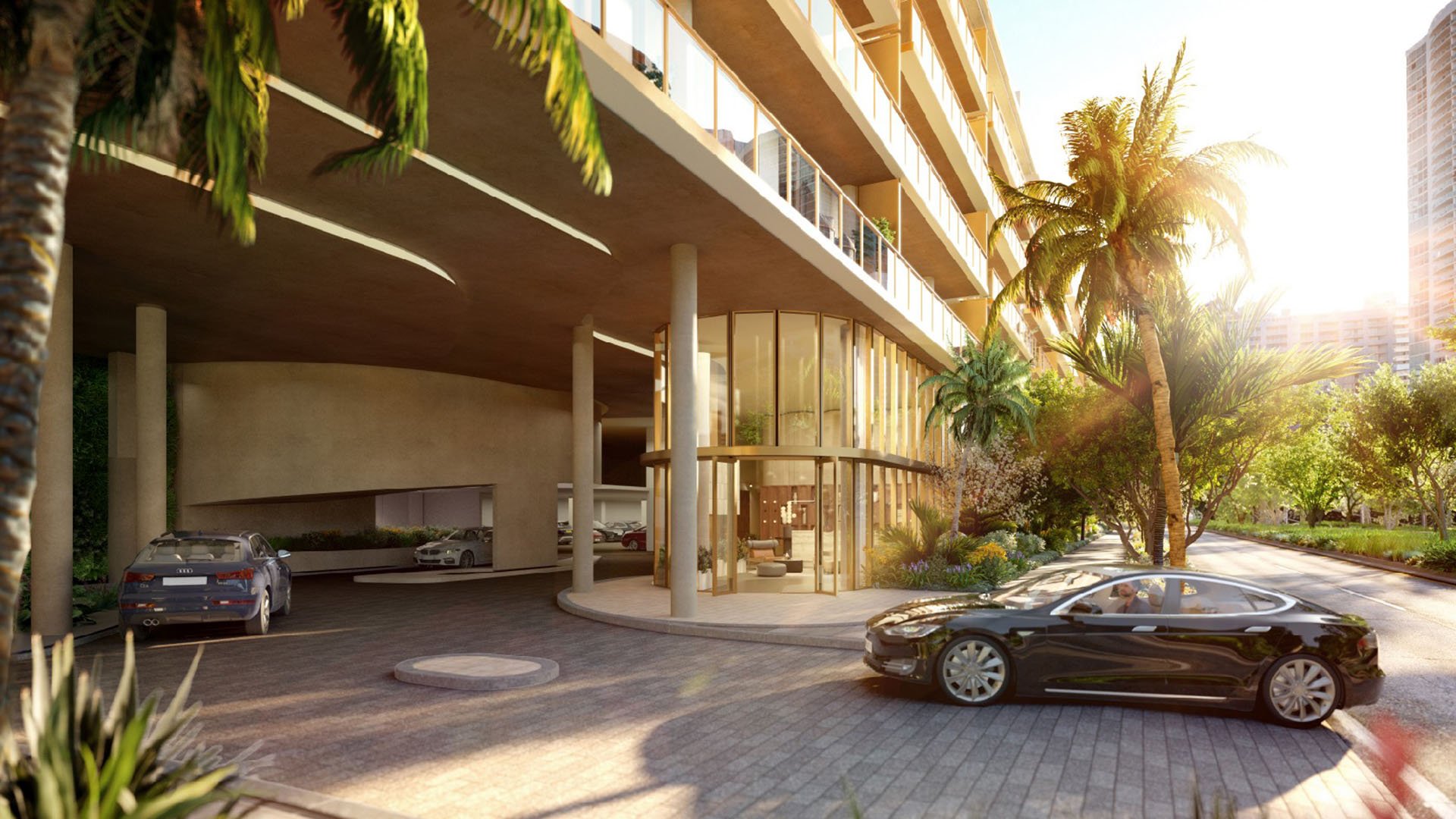
Brickell has become one of Miami’s most recognizable urban addresses, but not every luxury buyer wants the same version of it. For some, the appeal is immediate: proximity, energy, dining, offices, waterfront corridors, and a direct connection to the city’s daily rhythm. The hesitation is equally clear. A buyer may want polished service and effortless convenience without a lobby that feels like an extension of a public venue.
That distinction is where 2200 Brickell becomes especially relevant. The project is best read through the lens of a more intentional residential experience: service without spectacle, convenience without constant public-facing motion, and a daily atmosphere that privileges the resident’s sense of calm.
This is not an argument against energy. It is an argument for choosing the right kind of energy. For affluent end-users, families, and global investors, the most compelling Brickell address may be the one that offers access when desired and retreat when needed.
Location within Brickell is not a minor detail for lifestyle-driven buyers. The same neighborhood can feel different depending on the surrounding rhythm, the arrival sequence, and the degree to which a building feels oriented around residents rather than outside traffic.
A buyer focused on lifestyle may still want the convenience associated with Brickell, but prefer a setting that feels less performative. The goal is the feeling of coming home, not simply entering another high-traffic urban stage. That is why this buyer profile often values balance: close to the neighborhood’s advantages, yet framed around a calmer private experience.
This is why 2200 Brickell is useful as a case study in intentional urban living. The value proposition is not only Brickell itself. It is the way a buyer evaluates privacy, arrival, circulation, service, and quiet daily use within Brickell.
Privacy in luxury real estate is not limited to what happens inside the residence. It also involves how the building feels at the entrance, in elevators, in amenity areas, and during ordinary weekday routines. For buyers who are sensitive to the rhythm of shared spaces, these details are not secondary. They shape whether a residence feels restful or constantly activated.
The appeal of a more discreet Brickell lifestyle is that it separates hospitality from heavy public traffic. Hospitality can mean attention, responsiveness, polish, and ease. It does not have to mean constant guest churn, visible crowds, or amenities that feel designed as much for visitors as for residents.
That distinction matters for buyers who want service but do not want their home environment to behave like a destination. The luxury is not only what is available. It is how controlled, composed, and resident-oriented the experience feels.
Luxury buyers increasingly understand that amenities are not only about what is offered. They are also about who uses them, how often they are used, and whether they preserve the dignity of daily life. A resident-first mindset suggests spaces that feel available rather than over-programmed and service that supports the household rather than the public stage.
This is the contrast with hotel-condo or highly transient settings. In buildings where public-facing amenities and short-term guests are central to the experience, daily traffic can become part of the architecture of life. Some buyers enjoy that movement. Others see it as friction.
The 2200 Brickell buyer is more likely to value discretion, predictability, and a sense of ownership over shared spaces. For this profile, the right building is not the one with the loudest social identity. It is the one that makes private life easier.
For end-users, livability is often the deciding factor. The question is not only whether a residence works for a weekend in Miami. It is whether the home can support daily routines, guests, remote work, family schedules, storage, entertaining, and a longer-term relationship with the city.
That is why buyers considering 2200 Brickell may focus closely on how the residence and the building experience work together. A quieter building concept is most persuasive when the home itself feels practical, comfortable, and worthy of repeated daily use.
In this sense, the appeal is less about spectacle and more about usefulness. The strongest buyer fit is someone who wants Brickell access but does not want to sacrifice control, privacy, or the sense of a composed home base.
Brickell offers a broad range of luxury residential personalities, and the right choice depends on the buyer’s tolerance for visibility, branding, movement, and social energy. A buyer drawn to a more classic luxury-service identity may also study St. Regis® Residences Brickell. A buyer focused on skyline presence and a highly vertical expression of Brickell living may consider The Residences at 1428 Brickell. Others may gravitate toward a dining and hospitality-adjacent lifestyle conversation around ORA by Casa Tua Brickell or the polished urban identity associated with Cipriani Residences Brickell.
The distinction for 2200 Brickell is its quieter proposition. It is not best understood as a building that must become a destination for outsiders. It is better understood as a refined residential retreat within an urban neighborhood. For buyers who already know they want Brickell but are cautious about public traffic, that difference can be decisive.
This belongs in serious buyer’s guides because it addresses the daily-use questions that matter after closing: How does the arrival feel at peak hours? Do shared spaces feel resident-first? Does the building support calm? Does the home feel like a place to live well, not just visit well?
2200 Brickell is most compelling for buyers who want Brickell access without sacrificing privacy. It fits the end-user who values convenience but does not want the building to feel like a rotating hospitality venue. It can also fit families who want a calmer shared environment and global buyers who understand that residential character can be part of long-term desirability.
The ideal buyer is not avoiding the city. They are editing it. They want the restaurant reservation, the office proximity, the urban walkability, and the Miami address, but they want the home environment to feel composed. They are comfortable with service, but they do not confuse service with spectacle.
For this buyer, the most important luxury may be control: control over arrival, atmosphere, privacy, and the sense of separation between public Miami and private home.
The strongest reading of 2200 Brickell is that it reflects a maturing Brickell buyer. Earlier cycles of urban luxury often celebrated height, branding, and visible amenity density. Those elements still matter to many purchasers, but a more selective audience is asking a different question: What does the building feel like when no one is performing?
A more intentional Brickell lifestyle is not quieter because it lacks ambition. It is quieter because it is more precise. It places value on the residential experience itself, not only on the image of urban luxury. For the buyer who wants hospitality without heavy public traffic, that precision may be the defining point.
What type of buyer is 2200 Brickell best suited for? It is best suited for buyers seeking Brickell convenience with a stronger emphasis on privacy, calm, and residential control.
Is this guide focused on hotel-style living? No. The guide focuses on buyers who want hospitality-level ease without the daily feel of a heavily trafficked hotel-style environment.
Why does public traffic matter in a luxury building? Public traffic can affect arrival, shared spaces, privacy, and the overall sense of calm. Some buyers view those daily-use details as central to luxury.
Is 2200 Brickell still part of the Brickell lifestyle? Yes. The appeal is the ability to enjoy Brickell access while maintaining a more composed private home environment.
How should buyers evaluate a resident-first experience? Buyers should consider arrival, lobby flow, elevator use, amenity atmosphere, service rhythm, and whether shared spaces feel controlled.
Who may not be the ideal buyer for 2200 Brickell? Buyers who prefer a highly public, hotel-driven, constantly animated tower may prefer a different Brickell building personality.
Why is privacy important for end-users? End-users experience the building repeatedly, so privacy and predictability can become as important as design or location.
Does a quieter building mean less access to the city? Not necessarily. The goal is to separate private residential calm from the energy available throughout Brickell.
How does 2200 Brickell fit into a broader Brickell search? It fits as an option for buyers comparing service, discretion, and daily livability against more visibly social or hospitality-driven towers.
What is the main takeaway for luxury buyers? The main takeaway is that the right Brickell residence is not only about address or image; it is about how the building supports daily life.
For a discreet conversation and a curated building-by-building shortlist, connect with MILLION.
If branded residences are on your mind — as a home or as an allocation — we would be glad to share what we are seeing, privately.
Begin a quiet conversation