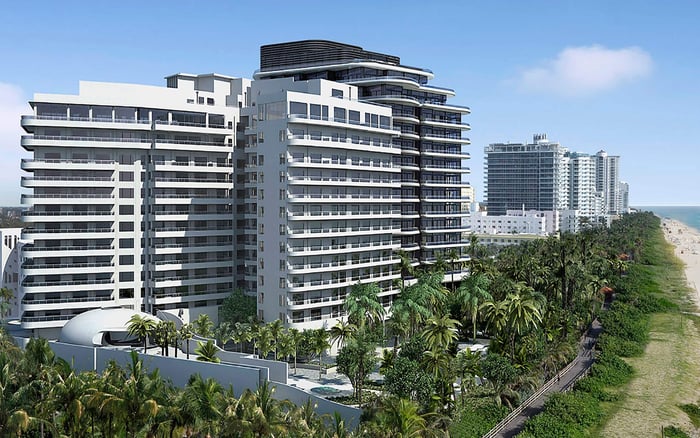
A buyer-focused guide to title review questions for Shore Club Private Collections Miami Beach, from condominium rights and waterfront access to liens, Schedule B exceptions, recorded project documents, and post-closing protection.

Buying at Shore Club Private Collections Miami Beach is not the same exercise as reviewing title for a conventional resale condominium. The context is a luxury waterfront property in Miami Beach, so the questions should move beyond clean ownership and into the specific rights, restrictions, shared obligations, and recorded documents that define the asset.
For a waterfront buyer, title is the legal architecture beneath the view. It determines what is actually being conveyed, what is shared, what is restricted, and which exceptions will remain after closing. In a high-value condominium acquisition, the objective is not merely to receive a title commitment. It is to understand it before the contract becomes irreversible, before deposits are fully exposed, and before lifestyle assumptions harden into expectations.
This is buyer due diligence guidance, not legal advice. The proper review should be led by Florida counsel experienced in luxury condominium and waterfront property transactions.
The first question is deceptively simple: what exactly am I buying? At Shore Club Private Collections Miami Beach, the buyer is acquiring a condominium interest, so counsel should explain the unit estate, the common elements, the limited common elements, and any appurtenant rights that travel with ownership.
Ask whether parking, storage, terraces, cabanas, or other rights are included in the legal description, separately assigned, licensed, or governed by project documents. A purchase agreement may describe the lifestyle elegantly, but title review should confirm whether the recorded condominium documents deliver the same rights with the same precision.
This is also where buyers should compare the legal description against the contract and condominium declaration. Any inconsistency should be resolved before closing, not dismissed as clerical. In the upper tier of Miami Beach ownership, small differences in appurtenant rights can carry meaningful investment implications.
Waterfront and beach-oriented property carries a distinct title profile. Ask whether the title commitment identifies easements, access rights, coastal-use restrictions, boundary issues, or recorded agreements that could affect use, privacy, services, or long-term value.
The critical distinction is whether waterfront access, beach-related rights, and amenity-use rights are deeded, licensed, revocable, shared, or governed only by condominium or project rules. Those categories are not interchangeable. A deeded or appurtenant right may be very different from a revocable license or an amenity policy controlled through governance documents.
Buyers looking across the Miami Beach market, including 57 Ocean Miami Beach or The Perigon Miami Beach, often focus on architecture, services, and exposure. Title review asks the quieter question: which of those experiences are anchored in recorded rights, and which depend on rules, approvals, or operating arrangements?
For a waterfront condominium acquisition at Shore Club Private Collections Miami Beach, buyers should ask whether project-related, regulatory, or recorded-use restrictions appear in title or in the recorded project documents. The point is not to assume a defect. The point is to understand whether recorded obligations could shape future alterations, operations, access, shared services, or ownership rights.
Ask for a chain-of-title review that covers prior ownership, subdivision, condominium creation, and unresolved exceptions. The paper trail can be more layered than in a stabilized resale tower. Counsel should be able to identify how the condominium was created, how prior interests were addressed, and whether any remaining exceptions are project-specific rather than standard.
A new-construction or pre-completion acquisition also deserves timing questions. What protections are delivered at contract signing? What is delivered at closing? What is delivered only after recording? If the project is still developer-controlled, buyers should understand how title insurance, releases, and recorded condominium documents mature through the closing process.
Every serious title review should include a Schedule B discussion. Ask the title agent to identify every exception that will remain after closing and to explain whether each is standard, project-specific, or potentially negotiable. This is one of the most practical conversations in the purchase process because it translates technical language into ownership consequences.
Standard exceptions may be familiar. Project-specific exceptions may be more consequential. They can relate to declarations, bylaws, rules, easements, cost-sharing agreements, reciprocal-use agreements, amenity arrangements, beach access, parking, services, or shared facilities. If the property has hotel, residential, amenity, commercial, or service components, ask whether those components share rights or operating obligations that affect the residence.
The same discipline applies beyond Shore Club. Buyers evaluating resort-style residences such as The Ritz-Carlton Residences® Miami Beach or established luxury settings such as Faena House Miami Beach should distinguish brand, service, and architecture from the recorded rights that actually govern ownership.
Ask whether any developer, construction, lender, or contractor liens could survive closing or appear as exceptions to the owner’s title policy. In a waterfront condominium context, financing history matters. Mortgages, development loans, and recorded security instruments should be released as to the buyer’s residence at closing, or counsel should explain why an exception remains and how the buyer is protected.
The owner’s title policy should also be discussed before closing. Ask whether the title insurer will issue a policy with endorsements appropriate for a luxury waterfront condominium acquisition. The availability and scope of endorsements should be reviewed in relation to the specific property interest, the condominium documents, and the exceptions that remain.
Do not treat title insurance as a substitute for every other form of diligence. A title commitment may exclude or limit matters better addressed through surveys, condominium governance review, development approvals, association budgets, insurance review, operating agreements, and physical due diligence. The cleanest transactions are often those where title counsel, condominium counsel, and financial advisors are each asked different questions rather than the same broad one.
Before signing, ask for a clear explanation of the unit interest, appurtenant rights, preliminary exceptions, required releases, and closing sequence. Before closing, ask for an updated title commitment, confirmation of releases, review of all remaining Schedule B items, and final policy expectations.
The central discipline is to separate presentation from protection. Shore Club Private Collections Miami Beach may be evaluated for design, setting, service, and rarity, but title review is where a buyer tests the legal foundation beneath those attributes. On the waterfront, that foundation should be read slowly, translated plainly, and negotiated where appropriate.
What should I ask first about title review at Shore Club Private Collections Miami Beach? Ask counsel to identify the exact condominium interest being conveyed, including common elements, limited common elements, and appurtenant rights.
Why is waterfront title review more complex? Waterfront property may involve easements, beach access rights, coastal-use restrictions, boundary issues, or shared rights that affect use and value.
Should I ask whether beach access is deeded? Yes. Ask whether beach-related rights are deeded, licensed, revocable, shared, or governed only by condominium or project rules.
What is a Schedule B exception? It is an item the title policy may not cover. Ask which exceptions remain after closing and whether each is standard, project-specific, or negotiable.
Do condominium documents affect title review? Yes. Declarations, bylaws, rules, easements, cost-sharing agreements, and reciprocal-use agreements can affect amenities, parking, services, and access.
Why does the recorded document history matter? It can show prior ownership, subdivision, condominium creation, financing, and approvals that should be reviewed in sequence.
Should liens be addressed before closing? Yes. Ask whether developer, construction, lender, or contractor liens will be released or insured over as to the residence at closing.
Can title insurance replace legal due diligence? No. Title insurance is important, but surveys, governance documents, approvals, budgets, and operating obligations may require separate review.
What should I confirm about parking, storage, terraces, or cabanas? Confirm that each right matches the purchase agreement and condominium documents, and whether it is deeded, assigned, licensed, or otherwise limited.
When should title protections be confirmed? Confirm what protections exist at contract signing, at closing, and after recording, especially if the purchase is pre-completion or developer-controlled.
To compare the best-fit options with clarity, connect with MILLION.
If branded residences are on your mind — as a home or as an allocation — we would be glad to share what we are seeing, privately.
Begin a quiet conversation