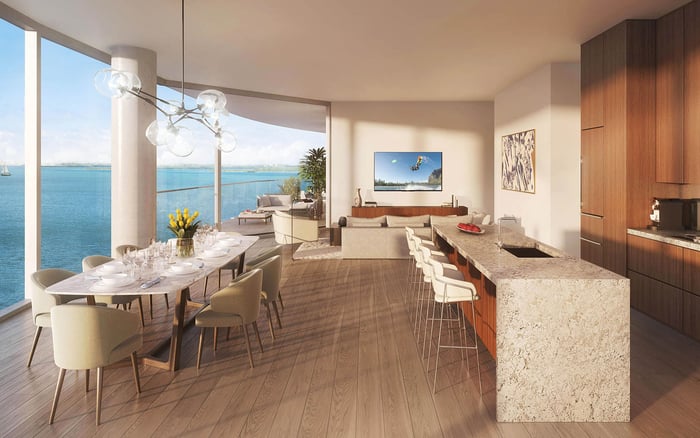
In South Florida, the strongest family purchase is often the residence that performs quietly well on school access, commute logic, carrying costs, reserve health, and resale depth rather than the one marketed most aggressively around children’s amenities. MILLION examines why disciplined buyers frequently do better by underwriting the neighborhood and the numbers before the branding.

In South Florida, the phrase family-friendly can be persuasive, but it is not a reliable investment thesis. The better question is not whether a property is visibly marketed to families, but whether the residence supports the actual mechanics of family life while preserving flexibility, financial calm, and future resale depth.
That distinction matters in a market where buyers can choose among amenity-rich towers, boutique condominiums, townhomes, and established single-family homes. A playground, splash pad, or cheerful branding package may create an immediate emotional case. Yet the purchase that tends to age best is often rooted in practical advantages: a manageable daily commute, durable neighborhood demand, credible comparable sales, straightforward association governance, and school options that have been independently confirmed.
For many households, the smartest purchase is the less theatrical one. It may sit in a quieter, more established pocket. It may offer fewer overtly child-focused amenities. It may even appear less tailored to family life at first glance. But if it reduces friction every day and remains easier to sell later, it can be the superior family residence.
Once the keys are delivered, branding disappears and operating reality begins. Families live with drive times, monthly fees, reserve contributions, insurance costs, parking logistics, and the simple convenience of moving through a weekday without unnecessary complexity.
Neighborhood quality, convenience to work, and affordability consistently sit near the top of real-world decision making. In South Florida, those factors often have more staying power than a property’s lifestyle narrative. A residence in Coconut Grove, Coral Gables, Pinecrest, Aventura, or select parts of Boca Ratón may prove more functional for a household than a more heavily marketed alternative if it simplifies the school run, shortens commuting time, and keeps carrying costs within reason.
This is one reason sophisticated buyers often favor well-situated projects with strong daily-life logic over obvious theme marketing. In Coconut Grove, for example, Arbor Coconut Grove and Opus Coconut Grove may be considered through the lens of neighborhood access and long-term livability, not just amenity language. In Brickell, buyers looking at 2200 Brickell may be better served by scrutinizing circulation, privacy, and exit liquidity than by any label aimed at a family demographic.
One of the costliest assumptions in the market is that a residence promoted to families automatically secures a preferred school outcome. It does not. In South Florida, school pathways can depend on attendance boundaries, application procedures, eligibility rules, program placement, and reassignment conditions.
That means a polished brochure or an agent remark is not enough. A family should verify the exact pathway for the child, the address, and the intended school option before underwriting a premium. The difference is material. A residence that appears less family-branded but sits in a better practical position relative to confirmed school options can be the stronger acquisition.
This is especially relevant in areas where private-school patterns, traffic routes, and bridge or causeway travel shape the day. A beautifully marketed waterfront property may be less desirable for a family if the school commute is cumbersome twice a day. By contrast, a discreetly positioned home in Bay Harbor, Coral Gables, or Pinecrest may deliver a better lived experience because the route to school, activities, and work is more coherent.
South Florida families are not only buying square footage. They are buying into an operating structure. In condominium and HOA settings, reserve health, governance quality, fee stability, and assessment exposure can matter more than visibly child-oriented amenities.
This is where the glamorous family package can become expensive. Pools, club rooms, sports spaces, landscaped grounds, and intensive service levels all require funding. In some communities, those costs are well managed. In others, they can translate into rising dues or future assessments that materially alter the real cost of ownership.
For a family, the better buy is often the residence with calmer economics. That does not mean avoiding luxury. It means asking sharper questions. Are reserves healthy? Are capital needs visible? Is the association structure disciplined? Does the monthly payment still feel rational after insurance, taxes, and dues are fully modeled?
In Bay Harbor Islands, a buyer comparing boutique options such as Onda Bay Harbor and The Well Bay Harbor Islands should be evaluating the full ownership equation, not merely the elegance of the amenity deck. The same principle applies in resort-oriented coastal buildings where visual appeal can obscure the long-term cost profile.
At the top of the market, families sometimes overpay for a narrative that may not be fully recognized later. Resale value is ultimately supported by market demand, comparable sales, location fundamentals, and the breadth of the future buyer pool.
That is why neutral, established neighborhoods often warrant more attention than highly niche positioning. A residence that appeals to professionals, downsizers, second-home buyers, and families at once can have stronger exit liquidity than one defined too narrowly by themed branding. The broader the potential audience, the more resilient the resale conversation can become.
This is not an argument against new construction or branded living. It is an argument for discipline. In Edgewater, for instance, a buyer touring Aria Reserve Miami should think beyond launch language and consider how the property may be perceived by the next wave of purchasers. In West Palm Beach, refined projects such as Alba West Palm Beach invite the same question: who is the likely resale buyer, and how deep is that demand pool?
Families who buy with resale in mind are not being cautious in the ordinary sense. They are preserving optionality. A career move, school change, lifestyle pivot, or multigenerational need can emerge quickly. A home that can be sold efficiently is often the more family-centered purchase, even if it was never marketed that way.
The residence that serves a family best is often the one that reduces the number of decisions requiring daily effort. It has a workable route to school and work. It keeps recurring costs legible. It avoids unnecessary governance drama. It sits in a neighborhood with durable demand. And it does not rely on branding to justify its price.
In practical terms, that means a family should pressure-test five fundamentals before paying a premium for any visibly family-marketed residence:
Confirm the actual school pathway for the address.
Model total carrying costs, not just purchase price.
Review reserve health, fees, and assessment exposure.
Compare resale comps in the immediate submarket.
Judge the neighborhood by daily convenience, not brochure language.
That checklist may feel less romantic than a sales gallery tour, but it is often the path to a better outcome. In South Florida, where product types vary sharply by submarket and building economics can differ significantly from one address to the next, the quietly rational choice is frequently the more luxurious one in the long run.
Why is the most family-marketed residence not always the best family purchase? Because branding does not guarantee better schools, lower costs, easier commutes, or stronger resale performance.
What matters more than kid-focused amenities? School verification, neighborhood quality, total carrying costs, reserve health, and commute logic usually matter more over time.
Can a condo be a strong family purchase in South Florida? Yes, if the building’s fees, reserves, governance, and daily practicality align with the family’s long-term budget and routine.
Should buyers rely on community branding for school access? No. School assignment and choice can depend on boundaries, eligibility, and application rules that must be checked directly.
Why do established neighborhoods often perform well for families? They can offer broader buyer appeal, more consistent comparable sales, and stronger daily convenience.
How important are HOA and condo reserves? Extremely important, because reserve weakness can lead to higher dues or special assessments that change the ownership math.
Do family amenities add resale value? Sometimes, but not automatically. Resale value is generally supported by location, demand, and comparable sales.
Is a longer commute worth it for a more visibly family-oriented property? Often not, especially when the added travel creates daily friction that affects work, school, and overall quality of life.
What should families compare before making an offer? Compare taxes, insurance, dues, reserve health, school pathways, commute times, and nearby resale comps.
What is the smartest mindset for a South Florida family buyer? Buy for durable fundamentals first and marketing language second. That approach usually preserves both comfort and optionality.
For a discreet conversation and a curated building-by-building shortlist, connect with MILLION.
If branded residences are on your mind — as a home or as an allocation — we would be glad to share what we are seeing, privately.
Begin a quiet conversation