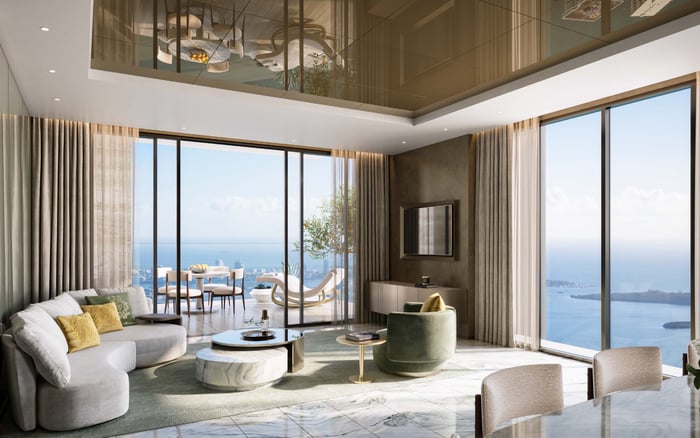
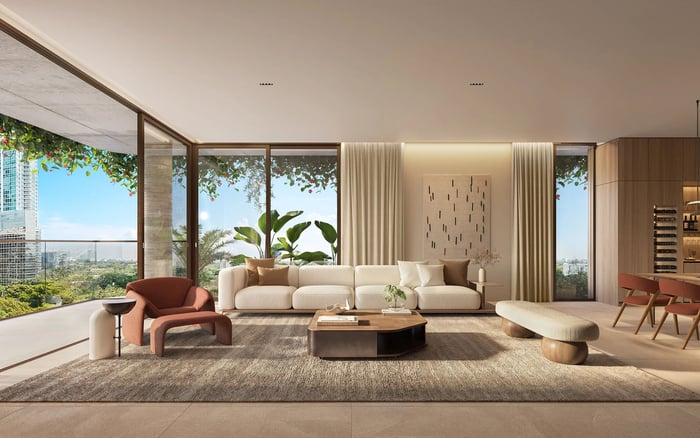
In the most considered penthouse purchases, guest-suite separation can shape daily comfort more profoundly than floor height. Privacy, circulation, sound control, and hospitality planning often determine whether a residence feels genuinely effortless.

The allure of the penthouse has long been tied to altitude. A higher floor can mean broader horizons, cleaner sightlines, more natural light, and a symbolic remove from the city below. Yet for sophisticated South Florida buyers, height is only one expression of privacy. The more enduring question is how the residence functions when the elevator doors open, guests arrive, family members stay, and the owner still wants a private retreat that remains undisturbed.
Guest-suite separation is one of the clearest signs that a large penthouse has been designed as a home, not merely as a showcase. A spectacular view can impress in the first five minutes. A well-separated guest suite proves its value over a long weekend, a holiday stay, a late arrival, or a morning when the owner wants coffee on the terrace without stepping into the role of host.
This is especially relevant in South Florida, where luxury residences often serve multiple purposes: primary home, seasonal base, family gathering point, and entertaining platform. A buyer may begin with a checklist that includes penthouse, high floors, terrace, water view, Brickell, or Miami Beach. The strongest layouts answer a more intimate question: can several people live beautifully together without feeling continuously together?
Height delivers the cinematic moment. Separation delivers daily composure. In a penthouse, those qualities are not interchangeable. A top-floor residence with every bedroom clustered off one corridor may feel impressive on arrival, but it can become less graceful when guests cross private family zones to reach breakfast, when staff circulation overlaps with bedroom doors, or when late-night entertaining carries sound toward sleeping areas.
A separated guest suite can soften all of that. Ideally, it gives visitors enough autonomy to feel comfortable and owners enough distance to maintain their own rhythm. This does not require coldness or formality. In the best residences, separation is subtle. It may appear as a secondary hallway, a den buffer, a split-bedroom plan, a guest vestibule, or a suite positioned near a secondary living area. The objective is not to isolate guests. It is to preserve dignity on both sides.
For buyers comparing multiple luxury residences, this can become more important than being a few floors higher. Additional elevation may improve the view incrementally. The right guest arrangement may improve every stay, every morning, and every hosted evening.
A strong penthouse plan usually passes three privacy tests. First, can owners reach the primary suite without crossing guest territory? Second, can guests come and go without feeling watched or misplaced? Third, can entertaining unfold in the public rooms while the bedroom zones remain genuinely quiet?
These tests matter because luxury hospitality has changed. Guests are no longer expected to simply occupy a spare bedroom. They may work remotely, travel with children, keep different hours, or stay for an extended season. A guest suite with a generous bath, useful closet space, and a position removed from the primary suite makes the invitation feel considered.
The most successful plans create layers. Public spaces welcome. Transitional spaces filter. Private spaces restore. When those layers are missing, scale alone cannot compensate. A penthouse can have immense square footage and still feel exposed if every route runs through the same social center.
South Florida living intensifies the value of guest separation because the climate encourages frequent visits. Family members may arrive for school breaks, friends may come for winter weekends, and owners may entertain across indoor and outdoor rooms. In this environment, the guest suite is not an afterthought. It is part of the home’s social architecture.
Consider the difference between a guest room beside the primary suite and a guest suite placed across the residence, near a media room, study, or secondary terrace access. The first arrangement may be acceptable for occasional overnight stays. The second supports a more relaxed form of hospitality. Guests can sleep late, take calls, or step out without entering the owner’s most personal zone.
This is where floor plan intelligence becomes more valuable than spectacle. A residence with slightly lower elevation but a stronger separation strategy may feel more luxurious than a higher penthouse that compresses every private life into one wing.
At the upper end of the market, guest-suite separation is often tied to service planning. Even when a residence is not staffed full time, owners may rely on housekeepers, private chefs, drivers, wellness providers, or event support. The practical question is how people move through the home.
A well-considered penthouse allows service to support the residence without interrupting it. Kitchen access, laundry proximity, service entries where available, and storage placement all influence how smoothly guests can be hosted. If the guest suite sits in a logical zone, visitors are less likely to overlap with operational areas. If it sits too close to the primary suite, even discreet service can feel intrusive.
Sound is part of this equation. Luxury is not only what one sees. It is also what one does not hear. Elevators, media rooms, kitchens, powder rooms, and terraces all generate movement. The best layouts keep the primary suite insulated while giving guests enough connection to enjoy the home.
A penthouse showing often emphasizes the obvious: view corridors, ceiling heights, finish quality, outdoor space, and arrival sequence. Buyers should also walk the residence as if they were living in it with guests. Start at the entry and imagine a visitor arriving after dinner. Where do they place luggage? Which bathroom do they use? Do they pass the primary suite? Can they reach coffee in the morning without feeling they have entered a private family area?
Then reverse the perspective. Imagine being the owner while guests are staying. Can you retreat without apology? Can you use the primary bath, closet, or terrace privately? If someone is watching a film or taking a video call, does that activity travel acoustically through the residence?
The answers are often visible in the plan before they are visible in the finishes. Doors, offsets, turns, vestibules, and secondary living spaces may not photograph as dramatically as a skyline view, but they often determine whether the home feels serene.
None of this diminishes the value of elevation. Height can improve light, privacy from neighboring buildings, water visibility, and the emotional character of a residence. In dense urban settings, it can be essential. The point is not that height is unimportant. The point is that height should not distract from livability.
For some buyers, the ideal answer is both: a high-floor penthouse with a disciplined separation plan. But when a choice must be made, layout can be the wiser long-term luxury. Views are enjoyed in moments. Privacy is experienced continuously.
The most compelling penthouses in South Florida understand this balance. They use altitude for drama and planning for calm. They let guests feel welcomed, not managed. They let owners host generously without surrendering the quiet rituals that made them want a private residence in the first place.
A true penthouse retreat is not merely above everything. It is arranged intelligently enough to make life feel lighter. Guest-suite separation contributes to that feeling because it respects the social nature of luxury ownership while protecting the owner’s inner life.
The buyer who studies separation is often thinking beyond first impressions. They are imagining holidays, children, parents, friends, privacy, recovery, work, wellness, and ease. They understand that a penthouse is not only a place to look out from. It is a place to return to, host from, and withdraw within.
In that sense, guest-suite separation can matter more than height because it shapes the emotional climate of the home. It turns square footage into hospitality. It turns privacy into architecture. And it allows a residence to feel not just elevated, but composed.
Why can guest-suite separation be more important than penthouse height? Height affects view and drama, while separation affects daily privacy, hosting comfort, and the owner’s ability to retreat.
What is a well-separated guest suite? It is a guest area positioned so visitors can sleep, dress, and move comfortably without crossing the owner’s most private spaces.
Does guest separation only matter for frequent hosts? No. Even occasional guests can change the feel of a home if the plan lacks privacy buffers and clear circulation.
Should a guest suite be near the main living room? It can be useful if the suite remains quiet and private, but it should not open directly into the busiest entertaining zone.
Is a higher floor always better for resale? Not always. Many buyers value views, but a superior layout can be equally persuasive in the luxury market.
What should buyers test during a penthouse tour? Walk the home as both owner and guest, noting routes, sound exposure, bathroom access, luggage space, and privacy.
How does staff circulation affect guest-suite planning? Good service flow helps guests feel cared for without bringing operational movement into bedroom or primary retreat areas.
Can outdoor space improve guest separation? Yes. Separate terrace access or nearby secondary living areas can give guests more independence during a stay.
Does guest separation reduce warmth or hospitality? No. Done well, it makes hospitality more gracious because both host and guest feel relaxed rather than imposed upon.
What is the best penthouse layout for multigenerational use? A split plan with private bedroom zones, flexible secondary living space, and calm circulation usually works best.
For a discreet conversation and a curated building-by-building shortlist, connect with MILLION.
If branded residences are on your mind — as a home or as an allocation — we would be glad to share what we are seeing, privately.
Begin a quiet conversation