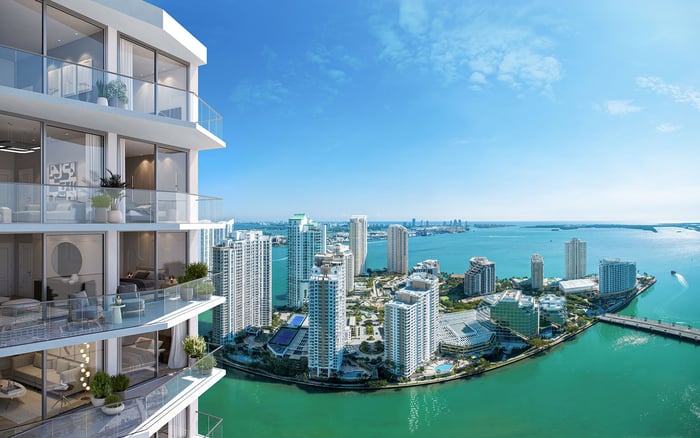
Downtown Miami increasingly resonates with luxury buyers who evaluate ownership through both lifestyle and monthly efficiency, weighing waterfront and skyline appeal against taxes, assessments, insurance, services, and rental flexibility.

For years, the most seductive question in Miami residential real estate was simple: how good is the view? In Downtown Miami, that question has not disappeared. It has matured. The buyer standing in a high-floor residence still reads the water, the skyline, the evening light, and the sense of arrival. Yet the more discerning conversation increasingly moves from spectacle to stewardship: what does it cost to own this view well?
That shift is not a retreat from luxury. It is a refinement of it. A sophisticated buyer understands that the purchase price is only the opening figure. The more enduring calculation is monthly: association dues, insurance, reserves, valet and staffing models, utilities, parking, maintenance expectations, financing costs, and the flexibility to hold, lease, or eventually sell with confidence.
Downtown answers that question differently from the beach, the private island, or the suburban estate. It offers vertical living with proximity, walkability, cultural access, business convenience, and the possibility of strong day-to-day utility. For buyers who care about carrying costs as much as views, that combination is increasingly compelling.
The luxury buyer is not necessarily more price sensitive. The luxury buyer is more information sensitive. When ownership expenses can vary widely from one building to another, the true premium is clarity. A beautiful residence with opaque monthly costs can feel less elegant than a slightly more restrained home in a building with disciplined management, appropriate reserves, and services that match how the owner actually lives.
Carrying costs are not simply fees. They are the financial architecture of the building. They reveal how much staffing is required, how amenities are maintained, how insurance is handled, how future repairs are anticipated, and how the association approaches long-term responsibility. In Downtown Miami, where towers may differ dramatically in age, amenities, scale, and management style, these costs deserve the same scrutiny as ceiling heights and balcony depth.
The best buyers now compare buildings almost as operating platforms. They ask whether they will use the spa, screening room, club lounge, fitness center, pools, private dining, or valet service enough to justify the monthly outlay. They examine whether the lifestyle feels generous or excessive. They distinguish between luxury that supports their routine and luxury that simply photographs well.
Downtown Miami is especially persuasive because the neighborhood can reduce friction in daily life. A buyer who spends meaningful time in the urban core may value the ability to move between home, office, dining, the waterfront, arts venues, and transit-adjacent corridors without treating every outing as a production. Convenience has financial meaning. Time saved, cars used less often, and services located nearby all contribute to the ownership equation.
This is where Downtown becomes more than an aesthetic choice. For a primary resident, proximity can soften the hidden costs of Miami living. For a second-home owner, the ability to arrive, settle in, and function quickly can make the property easier to use more frequently. For an investor-minded buyer, Downtown’s broad appeal to professionals, seasonal residents, and long-stay tenants can support a more practical holding strategy, subject always to building rules and market conditions.
Buyers searching by Downtown, Brickell, Waterview, Investment, New-construction, and Long-term-rentals are often looking for a precise balance: a polished residence with enough lifestyle value to enjoy and enough operational logic to justify.
Views remain one of Downtown Miami’s great emotional assets. Biscayne Bay, the Miami River, the cruise ships, the bridges, the arena lights, and the sunset reflections on glass towers are not minor details. They shape how a residence feels at breakfast, at dusk, and during a quiet evening at home.
But view premiums are increasingly evaluated with discipline. A buyer may accept a slightly less dramatic exposure if the building’s monthly structure is more efficient, the floor plan is more usable, or the association appears better positioned for future obligations. Conversely, a truly exceptional view may still justify a higher carrying profile if the residence is rare, the building is well run, and the owner expects to use the home extensively.
The point is not that views have lost value. The point is that they are no longer evaluated in isolation. A view is now part of a total ownership experience. The buyer asks: will this view remain enjoyable after the monthly statement arrives?
In Downtown Miami, two residences with similar square footage and comparable vistas can produce very different ownership experiences. The difference often lies in building operations. Staffing levels, amenity intensity, insurance exposure, reserve planning, management responsiveness, parking arrangements, guest policies, leasing rules, and capital improvement history all influence the cost and comfort of ownership.
This is why experienced buyers spend time beyond the model residence. They want to understand lobby traffic, elevator performance, valet rhythm, amenity usage, resident composition, pet policies, package handling, and the feeling of the building at different times of day. These observations are not incidental. They help determine whether the monthly dues are buying serenity, convenience, and care, or merely subsidizing complexity.
Newer buildings can appeal to buyers who prefer current systems, contemporary design, and amenity programming aligned with modern expectations. Established buildings can appeal when they offer proven operations, larger layouts, or a clearer record of how the association handles maintenance. Neither category is automatically superior. The question is whether the carrying cost matches the reality of the building.
The relationship between Brickell and Downtown is central to the conversation. Brickell has long been associated with finance, dining, and condominium density. Downtown offers a slightly different rhythm, with cultural, civic, waterfront, and entertainment anchors woven into the residential landscape. Buyers often compare the two not only by price per square foot, but by how each address supports their life.
For some, Brickell’s energy justifies a premium because it concentrates business and dining within a compact lifestyle grid. For others, Downtown provides a compelling alternative with a broader sense of urban Miami and a potentially different cost profile from tower to tower. The distinction is not purely geographic. It is personal. The best address is the one where the buyer’s actual routine and ownership costs align.
A buyer who values restaurant access three nights a week may calculate convenience differently from one who prioritizes quiet mornings, parking ease, or rapid access to the airport, port, arts district, or waterfront. Downtown’s appeal lies in giving buyers multiple ways to define value without abandoning the drama of the city.
The strongest Downtown Miami buyers approach due diligence with composure. They review current monthly assessments, what those assessments include, recent and anticipated special assessments, insurance structure, reserve posture, building rules, leasing restrictions, parking rights, storage availability, and maintenance responsibilities inside the unit. They ask how amenities are staffed, how often common areas are refreshed, and whether the building’s service model fits their expectations.
They also consider liquidity. A residence with broad appeal, a rational monthly cost, a functional floor plan, and a desirable view can be easier to understand in resale conversations. Ultra-specific layouts, unusually high recurring expenses, or restrictive policies may narrow the future buyer pool. In a luxury market, rarity is valuable, but only when it is paired with usability.
This is why the most compelling Downtown purchase is rarely the cheapest or the flashiest. It is the home where the view, building, monthly obligation, and exit strategy all speak the same language.
There is a quiet confidence in owning a residence that feels as good on paper as it does from the terrace. For the modern South Florida buyer, financial calm is part of the amenity package. It allows the owner to enjoy the home without feeling that every month requires a fresh negotiation with the building’s economics.
Downtown Miami benefits from this mindset because it offers a range of luxury expressions within a dense, useful, visually powerful environment. A buyer can pursue height, water, architecture, service, proximity, and rental optionality while still asking precise questions about monthly exposure. That combination feels timely.
The enduring appeal of Downtown is not that it is inexpensive. It is that it can be rational. In a market where views are abundant but well-balanced ownership is harder to find, rational luxury may be the rarest view of all.
Why do carrying costs matter so much in Downtown Miami? They shape the real cost of ownership after closing, including building services, insurance, reserves, maintenance, and association obligations.
Are views still important to luxury buyers? Yes. Views remain a major emotional and resale factor, but buyers increasingly evaluate them alongside monthly costs and building quality.
What should buyers compare between Downtown buildings? Buyers should compare dues, reserves, insurance structure, amenities, staffing, rules, parking, leasing policies, and long-term maintenance expectations.
Is Downtown Miami only for primary residents? No. It can suit primary residents, second-home owners, and buyers considering long-term rental flexibility, depending on the building’s rules.
How does Brickell compare with Downtown? Brickell often emphasizes business and dining density, while Downtown offers a broader urban mix with cultural, waterfront, and civic access.
Can a higher monthly fee still make sense? Yes. A higher fee can be justified when services, reserves, amenities, and building operations clearly support the owner’s lifestyle.
Should buyers prioritize new construction? Not automatically. Newer buildings may offer modern systems, while established buildings may offer proven operations and different floor plan advantages.
What makes a Downtown condo easier to resell? Broad appeal, a practical layout, strong building operations, rational monthly costs, and desirable views can all support future liquidity.
Are rental rules important even for owner-users? Yes. Leasing policies affect future flexibility, buyer demand, and the property’s usefulness if personal circumstances change.
What is the best way to evaluate value Downtown? Look at the complete ownership picture: view quality, floor plan, building health, monthly obligations, lifestyle fit, and resale logic.
When you're ready to tour or underwrite the options, connect with MILLION.
If branded residences are on your mind — as a home or as an allocation — we would be glad to share what we are seeing, privately.
Begin a quiet conversation