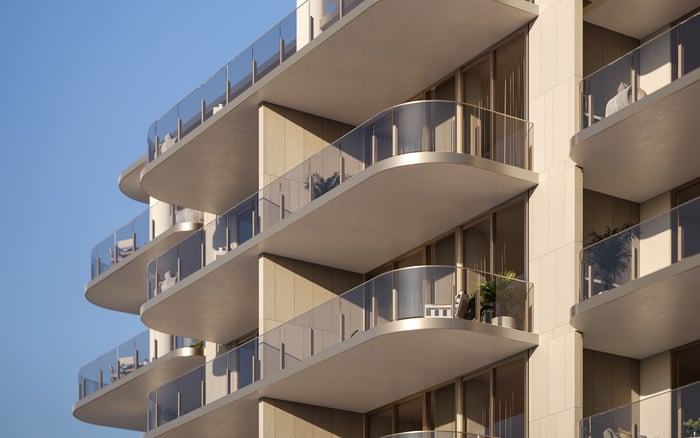
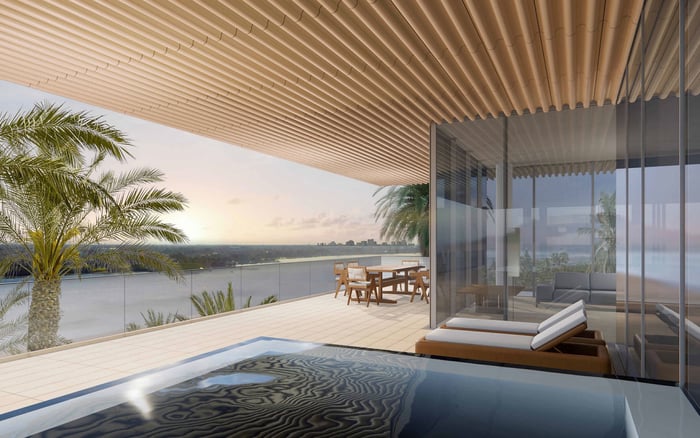
A discreet comparison of The Berkeley Palm Beach and Maison D’Or South Flagler for buyers prioritizing elevator quietness, private-entry conditions, and reduced hallway exposure in West Palm Beach.

For buyers whose first questions are not about views or finishes, but about how quietly they can live, Maison D’Or South Flagler appears to be the stronger conceptual fit. Its low-unit-count, private-elevator-oriented premise aligns more directly with the goal of reducing shared hallway encounters and limiting day-to-day circulation exposure.
The Berkeley Palm Beach should not be dismissed. It is also positioned as a boutique, privacy-forward luxury condominium, and for many buyers it may deliver a refined level of discretion. The distinction is narrower: Berkeley’s privacy outcome appears more dependent on the specific residence stack, its relationship to elevator cores, and the way residents move between entries, amenities, and shared corridors.
In short, Maison D’Or has the clearer building-concept advantage for minimizing hallway exposure. Berkeley may compete well on a residence-by-residence basis, but buyers should verify the exact floorplate before assuming equivalent privacy.
At the highest end of the market, privacy is not merely a lifestyle preference. It shapes the rhythm of daily living. A buyer who wants fewer incidental encounters may care deeply about whether the residence opens from a private elevator vestibule, whether guests pass multiple doors before arriving, and whether amenity users share the same path as residents returning home.
Hallway exposure is also psychological. A long common corridor can feel public even inside a secure building. A private elevator landing, by contrast, can create the impression of a single-family arrival within a vertical residence. The difference is subtle, but for owners who value quiet routines, staff coordination, family privacy, or low-visibility comings and goings, it can become decisive.
That is why the comparison between The Berkeley Palm Beach and Maison D’Or South Flagler is not simply about which project feels more luxurious. It is about which one better supports a specific, highly refined use case: fewer shared passages, less elevator traffic, and a calmer entry sequence.
Maison D’Or South Flagler stands out because its low-density and private-elevator orientation directly address the buyer’s concern. If final plans confirm that the building maintains this private-entry logic, the project may reduce the number of residents using the same elevator path and may limit the need to pass through extended shared corridors.
That does not prove acoustic superiority. Elevator quietness depends on more than exclusivity. Shaft adjacency, equipment isolation, wall assemblies, door detailing, mechanical placement, and construction execution all matter. From a planning perspective, however, a building organized around fewer residences and more private arrival conditions begins with a meaningful advantage.
For a buyer who wants minimal hallway exposure, the best version of the Maison D’Or proposition is a direct, composed sequence: elevator, private or semi-private vestibule, residence. The fewer transitional zones between arrival and home, the fewer opportunities there are for casual overlap with neighbors, service traffic, or amenity circulation.
The Berkeley Palm Beach is also a boutique, privacy-minded condominium option in West Palm Beach. Its appeal lies in the expectation of a refined residential environment rather than a large, high-traffic tower experience. For many owners, that alone may satisfy the desire for discretion.
The important caveat is that Berkeley’s privacy performance should be evaluated by exact residence. A home closer to elevator cores, amenity movement, service paths, or shared corridor bends may live differently from another residence in the same building. Two homes in one boutique project can offer very different daily privacy experiences depending on stack, entry orientation, and circulation pattern.
This is especially important for buyers who are sensitive to hallway sound. A high baseline of privacy is useful, but it does not answer the acoustic question. Buyers should ask where the elevator shaft sits in relation to bedrooms, primary living areas, and entry walls. They should also review whether the residence has a short arrival path or a longer common-corridor connection.
In internal buyer shorthand, this is a West Palm Beach and Palm Beach conversation shaped by boutique expectations, new-construction scrutiny, pre-construction diligence, and waterview lifestyle priorities.
A private elevator can reduce traffic, but it does not automatically make an elevator quiet. Quietness is an engineering outcome. Buyers should separate two ideas that are often blended in marketing language: fewer people using an elevator and less sound transmitted from the elevator system into the home.
The first is a density question. How many residences share the elevator? How many stops does it serve? Does the elevator open directly into private space, a shared vestibule, or a common hallway? On this measure, Maison D’Or appears better aligned if its low-unit-count, private-elevator concept is confirmed.
The second is an acoustic question. Where is the shaft? What assemblies separate the shaft from the residence? How is vibration isolated? Where is equipment located? Are bedrooms adjacent to the elevator core, or are they separated by closets, foyers, bathrooms, or other buffer spaces? These details can materially affect lived comfort.
For both buildings, buyers should request plans and technical specifications before making a final judgment. If possible, they should also walk comparable conditions once available, listening not only for elevator movement but also for door operation, corridor voices, service circulation, and mechanical hum.
The best comparison begins with the arrival sequence. Trace the path from the garage or lobby to the front door. Count the shared thresholds. Identify whether another resident, guest, delivery person, or service provider would naturally cross the same path. The fewer shared moments, the stronger the privacy profile.
Next, examine the residence entry. A private elevator vestibule is generally preferable to a long shared hallway, but the details matter. Is the vestibule truly private, or does it serve multiple homes? Is there enough spatial separation between elevator doors and main living spaces? Does the front door open into an acoustically buffered foyer, or directly into the home’s social core?
Then study the plan for sound-sensitive adjacency. Primary suites should ideally be insulated from elevator shafts and heavily trafficked circulation zones. Secondary bedrooms, media rooms, and home offices may also require protection if the owner works from home or hosts family for extended stays.
Finally, consider amenity movement. Even a boutique building can feel active if a residence sits along the natural route to shared facilities. The strongest privacy plans keep private homes away from amenity paths, service movement, and frequent guest circulation.
For the narrow question in the title, Maison D’Or South Flagler is the more logical first choice. Its private-elevator-oriented, extremely low-unit-count concept better supports the buyer who wants fewer hallway encounters and a calmer arrival experience.
The Berkeley Palm Beach remains credible for a privacy-focused buyer, but it requires a more exacting review. Its best residences may offer comparable discretion if the stack, elevator relationship, and entry condition are favorable. Its weaker matches, for this specific buyer profile, would be homes that rely on shared corridor exposure or sit close to busier circulation.
The practical conclusion is not that one building is universally better. It is that Maison D’Or appears better aligned with maximum hallway minimization, while Berkeley should be judged through the lens of the individual residence. For a buyer who is highly sensitive to sound and exposure, that distinction is everything.
Which building appears better for minimal hallway exposure? Maison D’Or South Flagler appears better aligned because of its low-unit-count, private-elevator-oriented concept.
Does that mean Maison D’Or will definitely have quieter elevators? No. Elevator quietness must be confirmed through shaft layout, equipment isolation, wall assemblies, and completed conditions.
Is The Berkeley Palm Beach still a private building? Yes. It is positioned as a boutique, privacy-forward luxury building, but its privacy performance should be reviewed by exact residence.
What should Berkeley buyers examine first? They should review the residence’s position relative to elevator cores, shared corridors, amenity circulation, and service paths.
Why is a private elevator vestibule valuable? It can reduce incidental encounters by shortening or eliminating the shared hallway sequence between elevator and residence.
Can a boutique building still have hallway exposure? Yes. Even a low-density building can create exposure if the home opens to a shared corridor or active circulation route.
What documents should sound-sensitive buyers request? Buyers should request floorplates, elevator core plans, acoustic specifications, construction details, and adjacency diagrams.
Should buyers rely on marketing language about privacy? No. Privacy claims should be tested against actual plans, technical specifications, and eventual walkthrough conditions.
Is Maison D’Or the automatic better choice for every buyer? Not necessarily. It appears stronger for hallway minimization, but Berkeley may suit buyers whose selected stack has comparable privacy.
What is the most practical decision rule? Start with Maison D’Or for maximum hallway minimization, then evaluate specific Berkeley residences that may offer similar private-entry conditions.
For a tailored shortlist and next-step guidance, connect with MILLION.
If branded residences are on your mind — as a home or as an allocation — we would be glad to share what we are seeing, privately.
Begin a quiet conversation