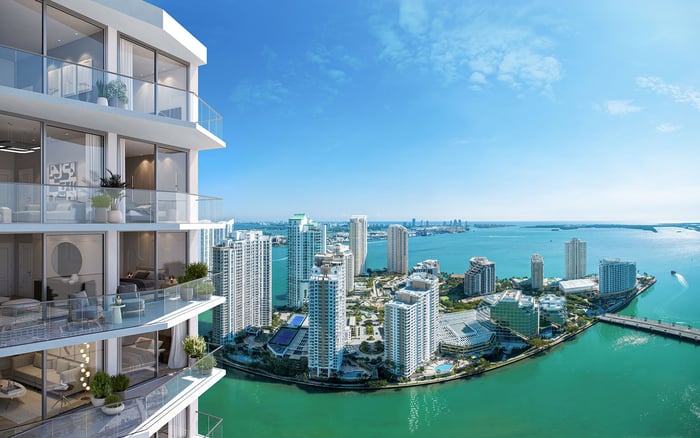
A buyer-focused comparison of Brickell and Downtown Miami for design-minded owners who also require privacy, service discipline, building governance, and everyday operational ease.

For the design-sensitive buyer, the comparison between Brickell and Downtown Miami is rarely about which neighborhood is more impressive. Both can deliver architectural presence, skyline theater, water views, and access to the city’s expanding cultural and business orbit. The more useful question is operational: which lifestyle will remain elegant on an ordinary Tuesday morning, not only during a sunset showing.
That is where the distinction becomes sharper. Brickell tends to suit buyers who want a highly choreographed daily rhythm, with residential towers, restaurants, offices, wellness, and private services arranged into a compact vertical routine. Downtown, by contrast, often appeals to buyers who want a broader urban canvas, with cultural venues, waterfront energy, and architectural variety shaping the day.
For owners weighing design pedigree against operational discipline, the right answer depends on how the home will function. A residence can be beautiful, branded, and photogenic, yet still miss the mark if elevator flow, guest arrival, parking, package management, service staffing, privacy, and building governance do not support the owner’s habits.
Brickell is often the more intuitive fit for buyers who want their Miami residence to operate with the precision of a private club. The neighborhood’s strongest argument is concentration. Daily life can feel compressed in the best sense: dining, meetings, fitness, private appointments, and evening plans sit close to the residence, reducing the friction between intention and execution.
That matters for buyers who travel often, use the home seasonally, or expect household staff, guests, drivers, and service providers to move through the building without improvisation. The ideal Brickell building is not merely tall or glamorous. It has a legible arrival sequence, a dignified lobby, strong separation between public and private zones, and an amenity program that feels useful rather than theatrical.
Projects such as St. Regis® Residences Brickell speak directly to buyers who associate design pedigree with service culture. In this context, pedigree is not limited to finishes or name recognition. It is also the expectation that the building knows how to receive, protect, and assist residents without overexposure.
Brickell also works well for the buyer who sees the residence as part of an efficient portfolio life. The property may serve as a primary home, a pied-a-terre, or a long-hold asset, but the common denominator is ease. For an investment-minded owner, operational discipline can be as important as view line or material palette, because a building that functions cleanly is easier to enjoy, maintain, and explain to future buyers.
Downtown offers a different appeal. It is less about perfect compression and more about cinematic scale. Buyers drawn to Downtown often want a residence that feels connected to Miami’s waterfront skyline, performing arts energy, major events, and evolving architectural identity. The lifestyle can feel more expansive, and sometimes more layered, than Brickell’s polished routine.
The Downtown buyer may be less concerned with being at the center of a financial district rhythm and more interested in a residence that frames the city as a living composition. This is where skyline views, bay exposure, and the emotional force of arrival carry real weight. Downtown can reward the owner who wants a dramatic sense of place, especially when the building’s operations are strong enough to keep that drama from becoming inconvenience.
A project such as Waldorf Astoria Residences Downtown Miami illustrates why Downtown resonates with buyers who want recognizable design ambition and a high-profile address experience. For some, that vertical statement is precisely the point. For others, Downtown’s appeal lies in a more residential expression of design, as seen in Casa Bella by B&B Italia Downtown Miami, where the conversation naturally turns toward interiors, atmosphere, and living experience.
The Downtown decision should be made with particular attention to circulation. Buyers should test how the residence behaves during event nights, peak arrival times, valet demand, and guest coordination. The best Downtown choice gives the owner urban intensity without forcing the owner to manage it personally.
In both neighborhoods, design pedigree can arrive through architecture, interiors, hospitality alignment, brand association, or a distinctive residential concept. Yet pedigree is only the first filter. The second is restraint. The most sophisticated buyers are increasingly alert to whether a building’s visual language is supported by day-to-day discipline.
That means studying the less glamorous details. Are amenities placed where residents will actually use them? Does the lobby feel residential rather than performative? Are service corridors, back-of-house areas, loading procedures, and staff spaces treated as part of the design problem? Does the building offer privacy without feeling sealed off from the city?
Brickell buyers may be drawn to The Residences at 1428 Brickell when the priority is architectural identity paired with a serious residential posture. Another buyer may prefer 888 Brickell by Dolce & Gabbana because the design narrative itself is central to the lifestyle proposition. In each case, the key is to separate spectacle from stewardship.
For a new-construction buyer, this evaluation is especially important before closing. Renderings can communicate mood, but operations are experienced through staffing standards, association rules, maintenance planning, delivery protocols, pet policies, elevator strategy, and the way the building handles residents who value discretion.
Choose Brickell if your Miami life is highly scheduled, service-oriented, and convenience-driven. It is generally the stronger fit for buyers who want restaurants, meetings, wellness, and private appointments to fit into a tight daily radius. Brickell also favors those who prefer a polished residential environment with clear expectations and a more predictable urban rhythm.
Choose Downtown if your priority is a broader sense of city, skyline, and cultural texture. Downtown can be the better match for buyers who want architecture with presence, a stronger feeling of urban theater, and proximity to a wider mix of civic and entertainment energy. It may also appeal to owners who use the residence for hosting, seasonal stays, or a more expressive Miami identity.
For both choices, water view is not a substitute for operational quality. A compelling outlook can elevate a residence, but it cannot correct a poorly planned arrival, weak privacy, or an amenity program that feels crowded at the wrong moments. The same is true of boutique positioning. Smaller scale can be highly desirable, but only when it brings intimacy, control, and service clarity rather than limited infrastructure.
The most disciplined buyer should tour both neighborhoods at the times they will actually use the home. Morning departures, evening returns, weekend guests, restaurant traffic, valet queues, and lobby energy reveal more than a midday private showing. Luxury is not simply what the building promises. It is what the building repeats well.
Brickell is the sharper instrument for buyers who value efficiency, service cadence, and a polished residential routine. Downtown is the more cinematic proposition for buyers who want architectural expression, urban scale, and a wider field of cultural energy. Neither is inherently superior. Each rewards a different temperament.
The best purchase will align three elements: the buyer’s daily rhythm, the building’s design intelligence, and the operational standards that protect both. When those elements meet, the residence feels effortless. When they do not, even a celebrated address can become a beautiful compromise.
Is Brickell better than Downtown for luxury condo buyers? Brickell may be better for buyers who want convenience, service rhythm, and a compact daily routine. Downtown may be better for those who value skyline drama and cultural range.
Which neighborhood has stronger design pedigree? Both neighborhoods can support strong design pedigree. The distinction is less about prestige and more about whether the building’s design language fits the owner’s lifestyle.
What does operational discipline mean in a condo building? It refers to how well the building manages arrivals, privacy, staffing, elevators, amenities, maintenance, deliveries, and the resident experience.
Should buyers prioritize brand-name residences? A brand can be meaningful when it brings service standards and design coherence. Buyers should still examine governance, privacy, and daily usability.
Is Downtown Miami too busy for a primary residence? It depends on the building and the owner’s tolerance for urban energy. A well-managed tower can make Downtown living feel controlled and elegant.
Is Brickell a better fit for executives? Brickell often suits highly scheduled buyers who want proximity, efficiency, and a polished daily environment. The best fit depends on personal routine.
How important are amenities in this decision? Amenities matter most when they are practical, well-managed, and proportionate to resident demand. Underused spectacle adds less value than daily utility.
Should seasonal owners choose differently than full-time residents? Seasonal owners may prioritize lock-and-leave ease, staff coordination, and guest arrival. Full-time residents should focus even more on daily circulation.
Can a boutique building be operationally superior? Yes, if smaller scale creates privacy, attentiveness, and clarity. Boutique alone is not enough without strong management and infrastructure.
What is the most important touring advice? Visit at the hours you will actually use the residence. Arrival, valet, lobby energy, and elevator flow are best understood in real time.
If you'd like a private walkthrough and a curated shortlist, connect with MILLION.
If branded residences are on your mind — as a home or as an allocation — we would be glad to share what we are seeing, privately.
Begin a quiet conversation