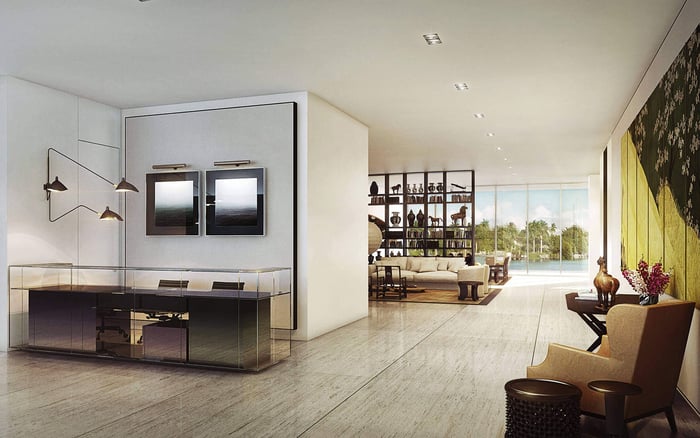
In Miami’s luxury condo market, the most compelling residence may not always be the one with the widest panorama. For buyers who work from home, acoustic privacy, calm circulation, and a properly placed office can shape daily value as much as Biscayne Bay or ocean exposure.

For years, the Miami condo search has followed a familiar hierarchy: water, elevation, exposure, and the emotional pull of a cinematic view. Those elements still matter. A sunrise over the Atlantic or a glittering evening skyline can define a residence before a buyer reaches the living room. Yet a quieter priority is moving higher in the decision stack: whether the home can support serious work without interruption.
For high-net-worth buyers, the home office is no longer a secondary nook or a flexible den waiting to be staged. It may be the room where confidential calls occur, portfolios are reviewed, deals are negotiated, and family schedules are orchestrated. In that context, acoustics become part of the luxury specification. A beautiful view may seduce in the first five minutes. A calm office proves itself every weekday.
This does not mean buyers must abandon the view. It means the most sophisticated search now evaluates the view and the soundscape together. A residence that frames Biscayne Bay beautifully but allows corridor noise, amenity activity, elevator vibration, or traffic intrusion into the work zone may feel less rare than a quieter home with a more modest outlook.
The best home offices are not simply rooms with desks. They are private, stable, and separate enough to let the rest of the residence operate normally. In a luxury condo, that distinction can be difficult to achieve. Open living rooms, glass walls, entertaining kitchens, and expansive terraces are designed for light and movement. A productive office asks for the opposite: enclosure, softness, predictable sound, and a door that functions as more than decoration.
Buyers searching in Brickell may value the immediacy of an urban lifestyle, but they should listen closely at different moments of the day. In Downtown, a higher floor may feel visually serene while still carrying sound from nearby movement or mechanical systems. In Edgewater, the promise of waterview living can be compelling, but office placement within the floor plan may matter as much as the angle of the bay.
The same logic applies to Oceanfront residences, where the sensory experience is part of the romance. Wave sound, wind, terrace exposure, and building systems can all shape how an office feels. Some buyers find that ambient character soothing. Others need a room that performs with near-studio discipline.
A view is usually evaluated in a single glance. Acoustics require patience. They reveal themselves when the air conditioning cycles, when a neighbor returns home, when service elevators are active, when a dog barks down the corridor, or when the city moves from morning rush to evening arrival. For a buyer who spends significant time on calls, those small disruptions become part of the asset.
This is why a home office deserves its own showing protocol. Stand in the proposed office with the door closed. Speak at a normal volume. Listen for corridor activity. Notice whether sound travels from the kitchen, living room, laundry area, or guest rooms. If the office sits near a terrace, consider how sliding doors, wind, and outdoor seating may affect concentration.
The most valuable office is often not the brightest room. It may be the room with the best separation, the most wall surface, the least exposure to internal circulation, and the strongest sense of retreat. In a condo, that can be a secondary bedroom, a den, a staff room, or a tucked-away library, depending on the plan.
Start with adjacency. A room beside an elevator bank, trash chute, service corridor, mechanical closet, or heavily used amenity level deserves extra scrutiny. Next, examine surfaces. Glass is magnificent for light, but an office surrounded by hard planes can feel echoic. Stone flooring, minimal upholstery, and oversized windows can create an elegant room that is not naturally forgiving to the ear.
Door quality matters. A true office needs closure, not just visual separation. Pocket doors, glass partitions, and decorative sliders may be visually appealing, but buyers should test whether they contain sound. The same is true for bedrooms that might become offices. If the room is part of a split plan, it may already have an advantage because it is physically separated from the entertaining areas.
Technology also belongs in the evaluation. A quiet room supports video calls, but so do lighting control, reliable connectivity, and a background that reads well on camera. The new executive office is both private and presentable. It should be calm enough for work and refined enough to represent the owner.
The strongest Miami residences increasingly satisfy multiple definitions of luxury at once. They offer drama without distraction, openness without exposure, and amenity access without constant intrusion. For buyers comparing similar buildings or lines, home office acoustics can become a subtle but decisive differentiator.
This is especially relevant in new-construction searches, where renderings can emphasize views, finishes, and amenity imagery more than the lived sound experience. Buyers should ask how office spaces are intended to function, where quieter rooms sit within the plan, and whether the residence offers flexibility for acoustic enhancements. Thoughtful design choices such as rugs, drapery, wall coverings, upholstered seating, and built-in millwork can soften a room without compromising elegance.
Resale buyers have a different advantage: they can experience the residence as it exists. A careful visit can reveal whether a home feels composed or restless. If the office is central to the purchase decision, it is worth touring at more than one time.
There are moments when the more intelligent purchase is not the most spectacular view. A corner residence with dazzling exposure may lose appeal if the office sits in a noisy path of the home. A lower or more protected residence may feel more usable if it offers an interior room with composure and privacy. For some buyers, the ability to conduct an uninterrupted call outweighs a marginally better angle of water.
This is not a retreat from beauty. It is a refinement of what beauty must do. The best Miami condo is not merely photogenic. It supports the owner’s rhythm. It allows the day to begin with focus, transition into family life, and return to quiet when needed. The view still creates identity. The office protects performance.
For luxury buyers, that combination is powerful. A residence that can host guests at sunset and absorb a demanding workday by morning has a deeper kind of value. It feels less like a trophy and more like an instrument, calibrated for how modern owners actually live.
Should Miami condo buyers prioritize acoustics over the view? Not always, but buyers who work from home should evaluate acoustic comfort as seriously as exposure, floor height, and finishes.
What makes a condo home office feel quiet? Separation from living areas, a solid door, softer interior finishes, and distance from busy building zones can all help.
Is a den always better than using a bedroom as an office? Not necessarily. A secondary bedroom may offer better enclosure, while a den may be more convenient but less acoustically private.
Can Oceanfront condos still work well for remote work? Yes, if the office is well placed and the buyer is comfortable with the residence’s natural and building-related sound profile.
Does a high floor guarantee a quieter condo? No. Elevation may reduce some street noise, but internal building sounds and room placement still matter.
What should buyers test during a showing? They should sit in the intended office, close the door, speak normally, and listen for sound from corridors, elevators, and living areas.
Are glass-walled offices a good idea? They can be elegant, but buyers should confirm whether the design provides true sound separation or only visual privacy.
How do Brickell and Downtown searches differ acoustically? Both can offer dynamic urban living, so buyers should pay close attention to office orientation, glazing, and adjacency within the plan.
Can interior design improve office acoustics? Yes. Rugs, drapery, upholstered furniture, millwork, and wall treatments can soften sound while preserving a refined aesthetic.
What is the best way to shortlist comparable options for touring? Start with location fit, delivery status, and daily lifestyle priorities, then compare stacks and elevations to validate views and privacy.
To compare the best-fit options with clarity, connect with MILLION.
If branded residences are on your mind — as a home or as an allocation — we would be glad to share what we are seeing, privately.
Begin a quiet conversation