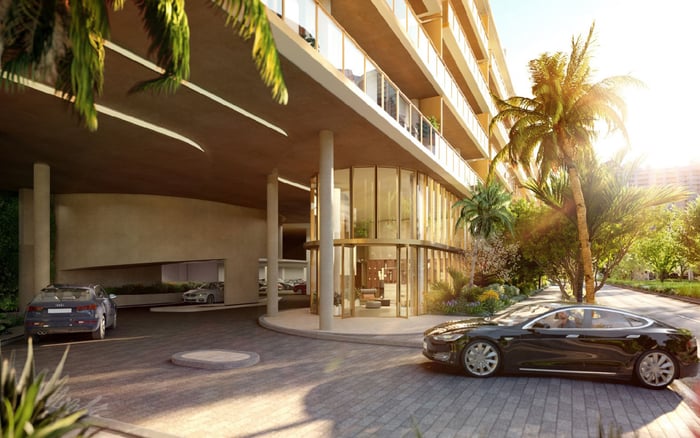
Elevator backup deserves its own due-diligence conversation because it affects comfort, access, service expectations, and day-to-day confidence in South Florida high-rise living.

In South Florida luxury real estate, due diligence often starts with the expected priorities: views, floor height, finishes, parking, assessments, reserves, and neighborhood character. Yet for buyers considering high floors in a residential tower, one less glamorous topic can become deeply personal: elevator backup.
This is not merely a mechanical issue. It is a lifestyle question, a service question, and, in certain circumstances, an access question. A residence may offer a dramatic arrival sequence, a private elevator foyer, and a lobby that feels closer to a members’ club than a condominium, but the buyer still needs to understand what happens when normal elevator service is interrupted.
That conversation should not be folded into a broad review of building systems. It deserves its own due-diligence discussion because the answers often require several perspectives: the association, building management, the developer or seller, the inspection team, and the buyer’s advisor. In markets such as Brickell, Downtown, Edgewater, Aventura, and oceanfront enclaves, vertical living is part of the appeal. That makes vertical access part of the value proposition.
Luxury buyers are trained to assess the visible experience. They tour wellness areas, evaluate ceiling heights, study kitchen specifications, and compare terraces. Elevator backup belongs in a different category because it is not about how a building impresses on a perfect day. It is about how it performs when conditions are less convenient.
A separate conversation helps prevent a common due-diligence shortcut: assuming that because a tower is prestigious, every contingency is self-evident. Prestige and preparedness are not the same inquiry. A buyer should understand whether any elevator operation may be supported during a power interruption, how that service is prioritized, whether all elevators are treated the same, and what communications residents receive during an event.
The questions need not be adversarial. The best conversations are calm, direct, and precise. A serious buyer is not trying to turn a lifestyle purchase into an engineering seminar. The goal is to know enough to make an informed decision, especially when comparing two otherwise similar residences.
The most useful questions are practical. If normal power is unavailable, what elevator service, if any, is intended to continue? Is the answer different for passenger elevators, service elevators, garage elevators, or private elevator entries? Who determines operating priority? Is there written guidance for residents? How is information shared with owners during an interruption?
Buyers should also ask about maintenance history and the process for testing or servicing backup-related components. The point is not to obtain a guarantee of uninterrupted convenience. Residential towers are complex, and every building has its own design, governance, and operating protocols. The point is to understand the building’s posture.
For a new-construction purchase, the conversation may involve planned systems, delivery documentation, and the way operational details will be handed to the association. For a resale purchase, the focus may shift toward current practices, management experience, and what residents are told when something unusual occurs. Both contexts matter, but they require different lines of inquiry.
Floor height is one of South Florida’s great luxuries. It can deliver wider water views, stronger privacy, more light, and a sense of separation from the street. It can also make elevator dependency more significant. A buyer considering a residence far above the lobby should look beyond the beauty of arrival and consider the realities of access.
This does not mean higher floors should be avoided. Quite the opposite: the most desirable residences in many towers are elevated precisely because the experience is so compelling. But a buyer who wants the penthouse lifestyle should have a penthouse-level understanding of building operations.
The same principle applies to households with older family members, young children, frequent guests, service providers, private staff, or pets. A short interruption may feel different depending on who lives in the residence and how the home is used. Elevator backup is therefore not only a systems topic. It is a household planning topic.
Two buildings with similar physical systems can feel very different in practice. One may communicate clearly, document procedures, and respond with calm professionalism. Another may offer vague assurances that leave owners unsure of what to expect. During due diligence, buyers should listen not only to the answer, but to the quality of the answer.
Does management respond with specifics, or only general confidence? Are documents available for review, or is the buyer asked to rely on verbal comfort? Does the association appear organized in how it discusses building operations? These signals can reveal the culture of the property.
In ultra-premium real estate, service is not limited to valet, concierge, spa, and restaurant-style amenities. It also includes the way a building handles less visible responsibilities. The best ownership experiences often come from properties where operational matters are treated with the same seriousness as design.
A buyer should dedicate a specific call or meeting to elevator backup rather than adding one question at the end of a general tour. The attendees may vary, but the conversation should include someone capable of speaking to building operations, not only sales language or aesthetic features.
The buyer’s advisor can frame the discussion in advance. Suggested topics include the scope of backup support, communication protocols, resident instructions, service elevator considerations, garage access, testing practices, and any known limitations that a buyer should understand before closing.
After the conversation, the buyer should request relevant written materials when available and summarize the key takeaways in writing. This creates clarity. It also helps distinguish confirmed information from assumptions. In luxury transactions, the most valuable due diligence is often not dramatic. It is simply organized.
Elevator backup rarely appears in glossy renderings. It does not sell a view, stage a terrace, or sparkle in a lobby photograph. Yet it belongs in the same thoughtful category as reserve review, insurance discussion, window systems, parking logistics, and rules governing renovations or leasing.
The most sophisticated buyers understand that luxury is not only what is visible. It is the confidence that the property has been considered from every angle. A separate elevator backup conversation reflects that mindset. It tells the seller, the association, and the buyer’s own advisory team that the acquisition is being evaluated with discipline.
South Florida’s tower market rewards beauty, brand, and location. It also rewards careful ownership. When buyers treat elevator backup as a standalone due-diligence item, they protect not just convenience, but the integrity of the living experience they are purchasing.
Why should elevator backup be discussed separately? Because it affects access, comfort, and building operations in ways that are easy to overlook during a design-focused tour.
Is elevator backup only important for very high floors? No. It can matter at any elevation, but the practical impact often becomes more meaningful as floor height increases.
Should buyers expect all elevators to operate during an interruption? Buyers should not assume that. They should ask which elevators, if any, may be supported and under what circumstances.
Who should answer elevator backup questions? Ideally, someone familiar with building operations, management procedures, and available documentation should participate.
Is a verbal assurance enough? A verbal answer is useful, but written materials or a written summary can provide better clarity before closing.
Does this apply to new-construction purchases? Yes. Buyers should ask how planned systems and operating details will be documented and transferred into daily management.
Does this apply to resale condos? Yes. Resale buyers can ask about current practices, resident communications, and how the building handles interruptions.
Can elevator backup influence resale confidence? It may. Buyers who value operational clarity may view a well-explained building environment more favorably.
Should this replace an inspection or legal review? No. It should complement the broader advisory process and help the buyer ask more precise questions.
When should this conversation happen? It should occur during due diligence, before the buyer’s review period becomes too compressed for meaningful follow-up.
For a discreet conversation and a curated building-by-building shortlist, connect with MILLION.
If branded residences are on your mind — as a home or as an allocation — we would be glad to share what we are seeing, privately.
Begin a quiet conversation