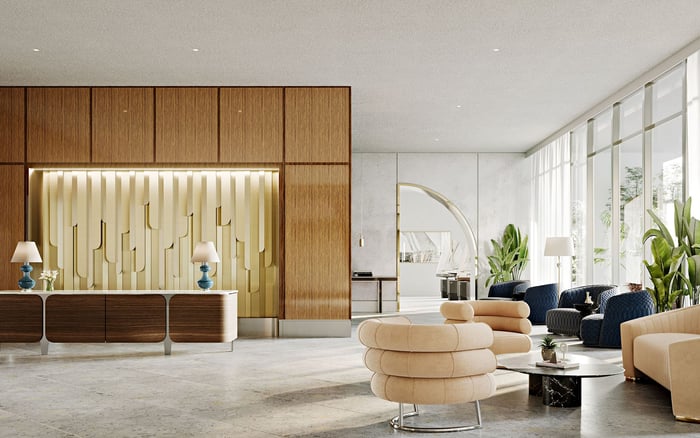
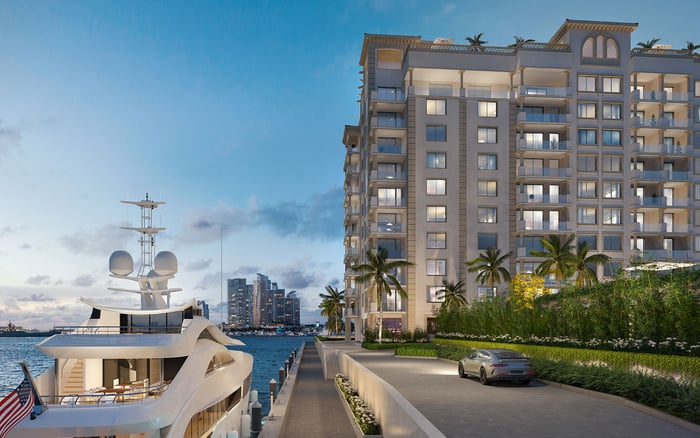
In South Florida’s upper tier, the most meaningful luxury may not be a soaring arrival hall but a calm, controlled way home. For many buyers, a discreet resident entrance delivers greater daily value through privacy, security, smoother circulation, and a more residential sense of ownership. As ultra-premium buildings refine service, elevator access, and guest separation, the quiet arrival is becoming one of the market’s most persuasive design signals.
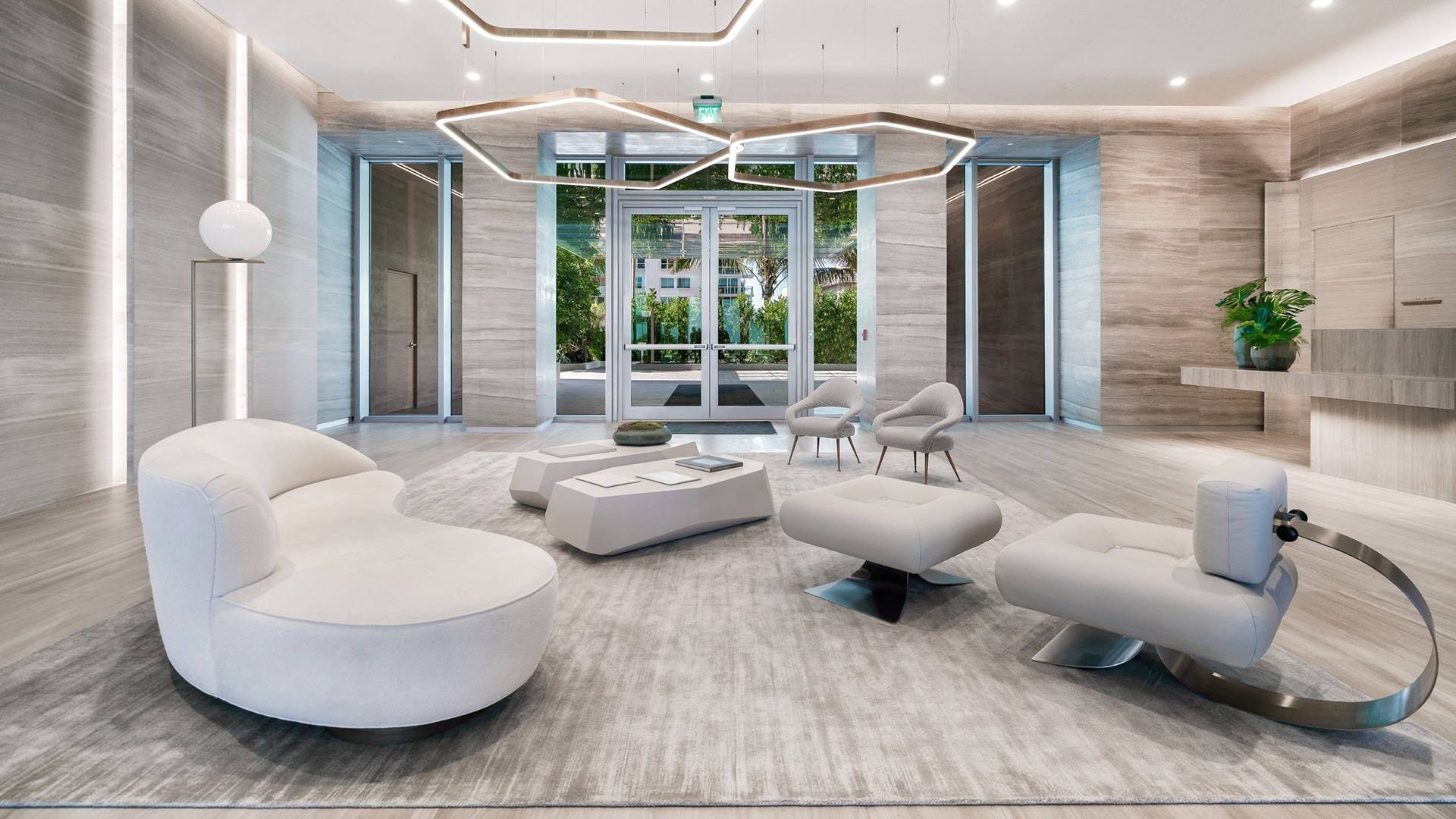
For years, luxury towers treated the grand lobby as a signature gesture: double-height ceilings, sculptural lighting, polished stone, and a sense of theater designed to impress on entry. That language still has its place. But in South Florida’s most sophisticated residential conversations, the more revealing question is no longer how dramatic the lobby looks. It is how privately, smoothly, and predictably a resident gets home.
That distinction matters because true luxury is experienced in repetition. A buyer may admire a lobby on day one, but they live the arrival sequence every day after that. In buildings serving executives, public figures, family offices, and global second-home owners, a discreet resident entrance often delivers more practical value than a lavish shared arrival hall. It reduces exposure to guest traffic, limits unnecessary observation, and gives residents greater control over how they come and go.
This shift is especially relevant in Miami Beach and Brickell, where hotel culture, tourism, and heavy visitor flow can blur the line between private residence and hospitality property. In those settings, a quieter entrance can make a building feel less performative and more genuinely residential.
At the upper end of the market, privacy has shifted from preference to expectation. Buyers are not simply paying for finishes, views, or branded amenities. They are increasingly paying for insulation from friction.
A separate resident entrance creates that insulation in several ways. It reduces contact with public and guest traffic. It makes daily routines less visible. It lowers the chance of unwanted interactions at the moments residents are most exposed: arrivals, departures, school runs, evening returns, and informal meetings in transit. For high-profile owners, that can mean fewer impromptu conversations, less visual documentation, and a lower likelihood that habits become easy to observe.
Digital privacy now reinforces the same logic. In an age of phones, social posting, and constant casual documentation, a public-facing lobby is not just a circulation space. It can also become a stage. A discreet entrance narrows that stage considerably.
This is one reason certain buyers are drawn to buildings that emphasize a more private residential cadence, whether on the ocean at 57 Ocean Miami Beach or in enclaves that privilege lower-density living such as Ocean House Surfside. The appeal is not only aesthetic. It is behavioral. These properties speak to buyers who want their homecoming to feel calm, controlled, and unobserved.
The challenge for oversized public arrival spaces is simple: residents typically spend very little time in them. They pass through, wait briefly, greet someone, or move on to the elevator. A lobby can create a strong first impression, but its daily utility is often limited when compared with the value of a well-managed private entry sequence.
That does not mean design has become less important. It means it is being judged differently. The best buildings understand that circulation is part of luxury. When resident movement is separated from guest arrival, service traffic, and delivery flow, the entire building tends to feel more composed.
This is where operational design matters as much as visual drama. Separate resident access can reduce congestion during peak periods, support better elevator performance, and limit the common frustration of sharing a glamorous room with every competing traffic stream in the building. Residents generally notice when staff workflow is clean, deliveries feel less intrusive, and common spaces show less wear from constant mixed use.
In projects redefining residential life in Brickell, that sensibility is increasingly visible. A building like The Residences at 1428 Brickell speaks to a market where buyers expect not only design pedigree, but also a more refined choreography of access, service, and privacy. In that context, the quiet efficiency of arrival can be more persuasive than spectacle.
South Florida is a particularly strong market for this evolution because its luxury audience includes international owners, entrepreneurs, athletes, seasonal residents, and buyers who already understand the difference between display and comfort. They may appreciate hospitality-level service, but many do not want a home that feels like a hotel.
In tourist-heavy neighborhoods, a discreet entrance can reinforce a crucial emotional message: this is a private residence, not a public venue with residences attached. That distinction helps shape the tone of ownership. It also supports retention, because residents who feel more in control of their arrival experience often report fewer concerns around noise, crowding, and constant visibility.
Developers have responded by moving beyond the single grand shared lobby. Dual- and triple-lobby strategies are becoming more common in the ultra-luxury tier, separating guest, resident, and service access into distinct systems. The result is not colder. It is more tailored.
That approach feels particularly aligned with markets like Coconut-grove and Bal-harbour, where lifestyle expectations often center on privacy and ease rather than public display. Consider the residential positioning of Four Seasons Residences Coconut Grove or the elevated calm associated with Rivage Bal Harbour. In both settings, buyers are responding to an idea that is subtle but powerful: luxury should reduce social friction, not increase it.
For a serious purchaser, the more useful question is not whether a lobby photographs beautifully. It is whether the building’s entry system supports the way they actually live.
A buyer comparing residences should ask: Is resident access separate from guest movement? Are deliveries and service circulation controlled independently? Do residents have a direct, legible route from drop-off to elevator? Does the arrival sequence feel exposed or protected? Is the building engineered for theatrical first impressions, or for calm repetition over many years?
Those questions can influence both experience and value. In the luxury condo market, discreet access is increasingly treated as a differentiator, not merely a background feature. In some cases, private entry systems are associated with pricing advantages versus otherwise comparable buildings with one shared lobby. They can also support liability management and access control by making circulation easier to monitor and separate.
For buyers in Aventura, Miami Beach, or Brickell, this is where sophistication shows. The most mature luxury purchase is often the one that prioritizes what improves life every single day. A grand lobby may impress visitors. A discreet entrance serves the resident.
The next phase of South Florida luxury is likely to be defined less by spectacle alone and more by calibrated experience. Designers and developers are still delivering beauty, but increasingly through control, proportion, privacy, and operational intelligence.
That means the best new residential buildings will continue to refine access hierarchies, elevator zoning, and circulation separation. They will design arrival as a residential ritual rather than a public event. They will understand that true exclusivity does not need to announce itself loudly.
For many buyers, especially those acquiring a primary residence or a heavily used second-home, the most valuable luxury is the one that disappears into the routine. The calmer the building feels at the threshold, the more successful the design is likely to be.
Why can a discreet entrance matter more than a grand lobby? Because residents use the arrival sequence every day, and private access often delivers more real value through comfort, control, and reduced exposure.
Does a separate resident entrance improve security? Yes. It can reduce interaction with guest and public traffic and make resident routines less predictable.
Is this mainly important for celebrities? No. High-profile owners may value it most visibly, but families, executives, and seasonal residents benefit as well.
Why is this especially relevant in Miami Beach? In tourism-heavy areas, a discreet entrance helps a building feel like a true residence rather than a hotel-like property.
Do residents actually use grand lobbies much? Usually not for long. Most move through them quickly, which is why daily circulation can matter more than visual drama.
Can separate entrances improve building operations? Yes. Splitting resident, guest, and service circulation can reduce congestion and support smoother staff workflow.
Do private lobby systems affect resident satisfaction? They often do, particularly when they reduce crowding, wait times, and noise around peak arrival periods.
Can discreet access influence property value? In the ultra-luxury segment, privacy-focused entry systems are increasingly treated as meaningful differentiators by buyers.
Is a quieter entrance less luxurious? Not at all. In many top-tier buildings, restraint signals confidence and a more residential standard of luxury.
What should buyers look for on a tour? Pay attention to circulation, visibility, elevator access, service separation, and whether arrival feels calm or overly public.
If you'd like a private walkthrough and a curated shortlist, connect with MILLION.
If branded residences are on your mind — as a home or as an allocation — we would be glad to share what we are seeing, privately.
Begin a quiet conversation.jpg&width=700&height=438&fit=cover)