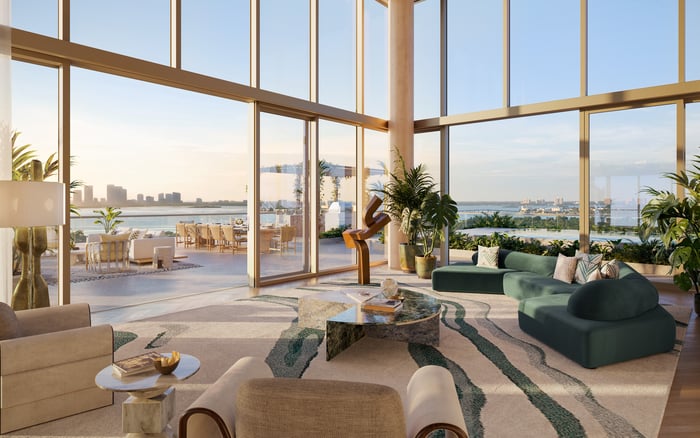
From Toronto showings that paired penthouse contracts with Porsche keys to Miami towers that treat arrival and brand affiliation as part of the floor plan, luxury residential marketing is entering an unusually theatrical chapter. Yet the most sophisticated buyers are not chasing freebies. They are evaluating what the incentive signals about absorption, product positioning, and the long-term durability of the building’s identity. In South Florida, that identity is increasingly expressed through branded residences, curated services, and car-forward architecture, with select “headline” perks used less to discount and more to differentiate.
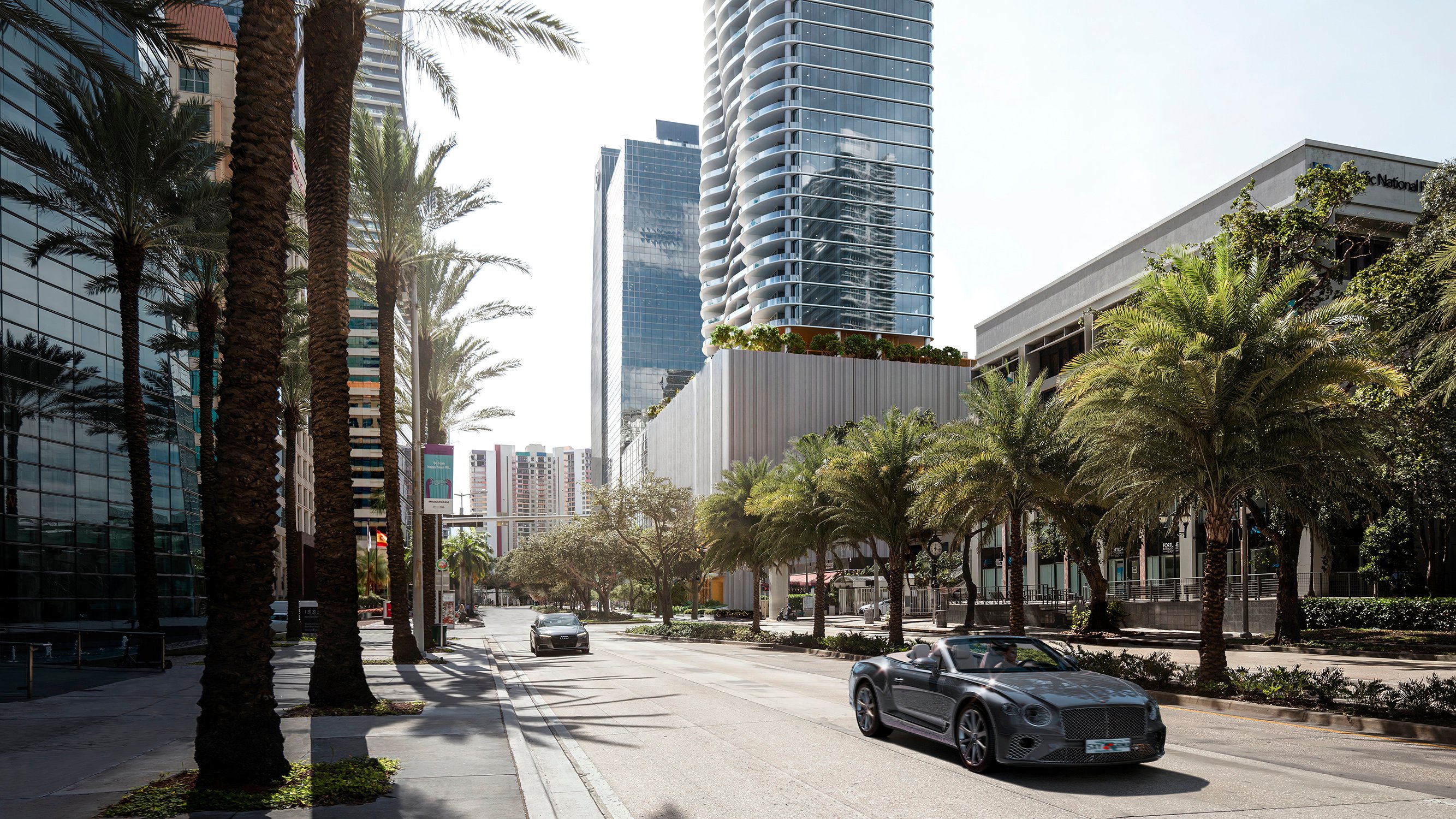
In a mature luxury market, differentiation becomes a design problem before it becomes a pricing problem. When inventory is plentiful and aesthetics are generally high, the question is rarely whether a residence is “nice.” It is whether it is unmistakable, instantly legible, and positioned with enough confidence to hold attention in a crowded field.
That is the context for the recent wave of ultra-high-end purchase incentives that read less like a conventional closing statement and more like a curated prize table. The offer itself is often the headline, engineered to travel quickly through broker networks, social feeds, and dinner-party conversation. In luxury, attention is a scarce commodity, and the incentive has become a way to buy it.
Examples outside South Florida illustrate the playbook. In Toronto, the outlet Storeys reported that Westbank’s King Toronto hosted a buyers event where incentives included Porsche 911s, Rolex watches, Holt Renfrew shopping sprees, and Hermès Birkin bags, with the most dramatic perks tied to higher purchase prices. Storeys also reported that during that promotion, King Toronto condo prices ranged from the high $800,000s to about $8 million. In the same reporting, Central Condos in downtown Toronto was said to offer penthouse buyers a free all-electric Porsche Taycan, with the promotion described as running until August 2025.
The logic is not limited to condo towers. In Henderson, Nevada, the Las Vegas Review-Journal reported a listing promotion that included a 2010 Ferrari California with the purchase of a $4.8 million home. It is a striking message: luxury marketing now uses accessories as punctuation, not as an afterthought.
South Florida buyers, especially those accustomed to Miami Beach and Sunny Isles transactions, tend to read past the spectacle and into the subtext. A perk can be a sweetener, but more often it is a signal. It can broadcast urgency, amplify a narrative, or pull a project into the center of a conversation when the most valuable currency is not square footage, but mindshare.
The most useful way to interpret these incentives is to treat them as strategy, not generosity. Storeys quoted marketing executive Elliott Taube describing giveaways as low-risk for developers because the incentive is typically delivered only after a unit sells. Put plainly, if no one buys, the incentive costs nothing. If a buyer does transact, the expense can be absorbed within the economics of a sale that was already structured for a luxury margin.
Taube also questioned whether high-end buyers truly need the “free car” to close, suggesting the perk functions more as a headline driver than a meaningful affordability lever at the top tiers. That distinction matters in South Florida, where many purchasers are not stretching to qualify. They are optimizing: for lifestyle fit, privacy, long-term value preservation, and a building’s cultural position within Miami’s luxury ecosystem.
A well-timed perk can accomplish several things quickly, even when the buyer is not remotely price constrained.
First, it can compress decision cycles. A time-bound offer introduces mild urgency without cutting the stated price, which protects the developer’s positioning and helps maintain the appearance of strength.
Second, it gives brokers and buyers a story that is easy to repeat. A residence is always easier to sell when it is easy to describe, and incentives can provide a one-line narrative that travels faster than a list of specifications.
Third, it reframes the purchase discussion. Instead of negotiating strictly on price per square foot, the conversation shifts to “the package,” which can feel more aspirational and less transactional, especially when the package aligns with the buyer’s self-image.
At the same time, sophisticated buyers recognize the risk. A market that needs theatrics can sometimes be a market searching for traction. The incentive itself is not automatically a red flag. The real concern is when the perk is doing more work than the product, or when the offer appears disconnected from a coherent identity.
In South Florida, where luxury is often defined by service, privacy, and arrival, incentives land differently. The most powerful “freebie” is frequently not an object. It is a system: the way the building functions, the standards it maintains, and the lifestyle it makes effortless after the initial excitement fades.
In Miami, the most credible incentive is rarely a watch, a handbag, or a one-time gift. It is architecture that changes the daily ritual of living, plus branding that reliably translates into service, access, and social signaling.
Consider how the region has leaned into brand as infrastructure. Mercedes-Benz publicly positions Mercedes-Benz Places in Miami as a “beyond automotive” extension into the built environment, effectively treating real estate as a design product rather than a neutral container. For buyers who move at the intersection of global mobility and global capital, that framing resonates. It implies systems, consistency, and a lifestyle curated by intention, not merely accommodated by management. In Brickell, the appeal is not novelty for novelty’s sake. It is the premise that a brand-led project can deliver a cohesive experience from the lobby and common areas to the private residence and resident programming. That is part of why Mercedes-Benz Places Miami draws attention from buyers who want a home that reads as deliberate.
Miami’s luxury skyline has also proven that car culture can be translated into built form, not simply celebrated in marketing copy. The Porsche Design Tower in Sunny Isles Beach is marketed around an in-building car elevator system that brings residents and their vehicles directly to private garages adjacent to their residences. The elevator’s name, “Dezervator,” has become shorthand for a specific kind of Miami aspiration: arrival that is private, frictionless, and theatrical, while remaining security-forward.
This same lens explains the market interest around Bentley Residences Miami. Bentley’s own announcement disclosed a marquee penthouse priced at $37.5 million, described as a two-storey residence with four bedrooms and seven bathrooms, plus both indoor and outdoor pools. Even without discussing incentives, that level of specification signals a market where the top unit is not merely a premium option. It is a flagship, designed to set the tone for the building’s identity. For buyers drawn to Sunny Isles, the broader proposition is a tower engineered around brand expression and lifestyle choreography. In that context, Bentley Residences Sunny Isles reads as part of an evolving category: residences positioned to be collected as much as inhabited.
On Miami Beach, the luxury pitch often centers on discretion and service rather than automotive spectacle. Still, arrival remains a defining amenity, and the highest end of the market continues to treat access as part of the product. A marketing page for The Ritz-Carlton Residences, Miami Beach describes a “marine helistop” concept as an ultra-luxury arrival amenity. Whether framed as marketed or planned, the idea itself is revealing. In the top tier, convenience is not merely convenience. It is exclusivity made visible, and a signal of how seriously a project takes privacy and logistics. That helps explain the draw of The Ritz-Carlton Residences® Miami Beach for buyers who want hotel-grade standards without hotel exposure.
Miami’s cultural districts show another version of the same theme. Here, “amenity” is often less about quantity and more about tone, curation, and confidence of address. Faena House Miami Beach speaks to a form of luxury oriented toward art, design, and the gravity of a recognizable environment. In settings like this, incentives are rarely inserted into a contract as a one-time object. The real value is the daily removal of friction: staffing, security choreography, and the feeling that the building belongs to a larger world.
Fashion branding carries its own gravitational pull, particularly for buyers who see their residence as an extension of personal style. Fendi Château Residences Surfside positions itself as a boutique, oceanfront branded residence. In Surfside, where discretion is part of the appeal, boutique scale paired with fashion-house identity can act as its own incentive. The pitch is not “more.” It is “fewer”: fewer neighbors, a more controlled environment, and a design language that is instantly legible.
Beyond South Florida, the most extreme version of the “car with the condo” headline has already surfaced in Miami’s own lore. Jalopnik reported that a $59 million penthouse at Aston Martin Residences in Miami came with an Aston Martin Vulcan included in the deal. The significance is not that every Miami buyer expects a hypercar. It is that the market has demonstrated an appetite for residences packaged as collector’s objects, where the building becomes part of the brand ecosystem and the purchase becomes a statement.
These headlines intersect with a broader financial reality. CoStar reported that developers use branded condo residences to help finance luxury hotels, particularly as some lenders have backed off. Branding, in other words, is not only marketing. It can be capital strategy. Realtor.com has also noted the rise of luxury branded developments as a prominent feature in high-end projects. In that light, the “incentive” conversation shifts. It becomes less about gifting and more about de-risking: a signal that the project can stand out, sell through, and sustain the service model implied by its brand promise.
A luxury buyer should evaluate any incentive with the same discipline applied to views, governance, and reserve strength. The checklist is straightforward, yet it is often skipped because the perk feels like a bonus rather than part of the transaction.
First, confirm timing and conditions. Incentives are commonly structured to be delivered after closing, not at contract. That approach is practical, but it also means the perk is only as real as the closing itself. Understand precisely what triggers delivery and what happens if timelines shift.
Second, understand substitution and valuation. If the incentive is a vehicle or a branded asset, ask whether it is specified by model year, trim, and configuration, or whether it is described loosely. Ambiguity is where disappointment lives, and where friction can arise at precisely the moment a buyer wants the process to feel effortless.
Third, consider optics and resale narrative. A building known primarily for aggressive giveaways can develop a reputation that impacts how the project is described in future listings. Your goal is not necessarily to avoid incentives. It is to avoid being anchored to a story that does not age well, or to a perception that the product required outsized promotion to move.
Fourth, ensure the perk does not distract from fundamentals. In South Florida, the fundamentals still win. Service quality, privacy, arrival experience, and governance determine how a residence feels three years after the grand opening, once the marketing cycle has moved on and the building has become a lived-in community.
Fifth, separate perk from identity. The most durable luxury projects are not remembered for what they gave away. They are remembered for what they made possible. In a region where yacht slips, private arrivals, and car-forward architecture are already part of the landscape, the strongest projects treat lifestyle as a system rather than a stunt.
Practically, that means asking a simple question: if the incentive disappeared, would the residence still feel inevitable for the buyer profile it targets? If the answer is yes, the perk is a flourish. If the answer is no, it may be compensating for an identity that has not fully landed.
The next phase of luxury residential marketing in South Florida is likely to appear calmer on the surface and more sophisticated underneath. The market has already shown that headline moments can generate awareness, but long-term strength is built through embedded value, not promotional noise.
Instead of one-off giveaways, expect more “embedded incentives” that do not read as incentives at all. Arrival infrastructure is a prime example. The Porsche Design Tower’s car elevator concept established a template for a certain buyer profile, and the broader market has taken note: privacy and choreography can be as compelling as ocean views, particularly for residents who value control over their daily experience.
Branded service is another. Here, the value is not an object but a standard, repeated day after day. Waldorf Astoria’s residential messaging, for example, emphasizes “white glove” services and amenities, illustrating how the condo and hotel worlds are converging. For the buyer, that convergence can be the most meaningful incentive of all: a predictable level of care, and an operating culture designed for consistency.
A third direction is waterfront programming that behaves like a private club, built into the project’s daily rhythm. Pagani’s press release for Pagani Residences in North Bay Village says the first Pagani residential tower will include 70 residences and highlights waterfront-oriented amenities including a waterfront boardwalk and private boat slips. This kind of promise is not a giveaway. It is an invitation to a lifestyle with limited access, which in luxury is often the most persuasive form of value.
For buyers navigating Brickell, Surfside, Miami Beach, and Sunny Isles, the practical takeaway is to read incentives as part of a larger narrative. If the narrative is coherent, the perk simply adds a touch of theater to an already strong product. If the narrative is thin, the perk may be doing too much work, and that imbalance should prompt deeper due diligence.
The smartest purchases in this market rarely hinge on a headline. They hinge on whether a building’s identity is credible, whether its service model is viable, and whether the day-to-day experience will still feel exclusive once the ribbon-cutting is long past.
Are luxury incentives a sign that a project is struggling? Not automatically. Incentives can be used to drive attention and accelerate decision-making, but buyers should assess whether the project’s fundamentals stand on their own.
Why do branded residences keep gaining ground in South Florida? Brand partnerships can differentiate a project and, as widely reported, can support marketing and financing strategies, especially where hotel-style services are part of the pitch.
Do “car with the condo” deals really happen in Miami? They have been publicly reported, including a high-profile example tied to Aston Martin Residences Downtown Miami, but they are best understood as headline moments rather than an everyday market norm.
What matters more than the perk in a top-tier condo purchase? Privacy, arrival experience, service quality, governance, and long-term brand durability usually matter more than any one-time incentive.
For discreet guidance on South Florida’s most design-forward residences, connect with MILLION Luxury.
If branded residences are on your mind — as a home or as an allocation — we would be glad to share what we are seeing, privately.
Begin a quiet conversation