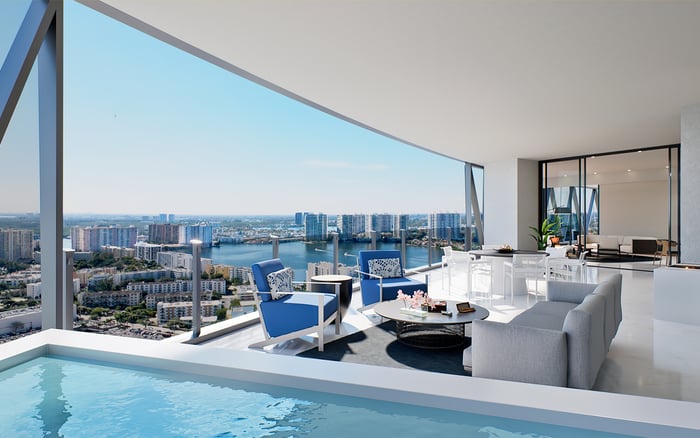
Valet is one of the most visible luxuries in a high-service tower, yet its real value is measured in daily usability, not in brochure language. For South Florida buyers who drive regularly, queue times deserve the same scrutiny as views, floor plans, and amenity design. The smartest approach is to test operations during peak windows, study circulation at the arrival court, and understand whether staffing, guest demand, and mixed-use traffic could turn convenience into friction.

In South Florida’s most polished towers, valet is often framed as part of an effortless residential experience. Yet for buyers who drive often, the real question is not whether valet exists, but whether the system performs smoothly under pressure.
Queue time is a daily usability issue. A building can feature excellent finishes, attentive staff, and a memorable lobby, yet still create recurring friction if residents routinely wait too long for vehicle retrieval or if the porte-cochère backs up during common departure windows. High-service branding does not automatically translate into high-capacity operations. In some cases, more attention is given to visual arrival than to the mechanics of vehicle flow.
That is why experienced buyers treat valet as an operating system, not a brochure amenity. In markets where towers such as St. Regis® Residences Brickell and The Perigon Miami Beach signal a lifestyle of elevated service, the practical test remains the same: how quickly and smoothly does the building move cars when many residents want them at once?
Valet performance is shaped by three factors: physical layout, labor quality, and demand spikes.
First is circulation design. Buildings with limited curbside stacking, a single valet lane, or constrained internal garage flow are more vulnerable to backups. A small cluster of simultaneous requests can block the arrival court, delay handoffs, and create disorder at the front door. By contrast, separate ingress and egress paths, larger staging areas, and cleaner internal circulation generally improve throughput.
Second is staffing. Valet is partly a labor question, especially in towers where most resident parking is handled by attendants. Training quality, turnover, and day-to-day oversight can determine whether an operation feels seamless or inconsistent. Buyers should notice not only how many attendants are visible, but also whether the team appears coordinated when several vehicles are moving at once.
Third is timing. Morning departures and evening returns are often the heaviest windows. A building that feels calm at 2 p.m. may perform very differently at 8 a.m. or just after work. In South Florida, winter high season can place additional pressure on the system as owners, guests, and household staff return in greater numbers.
The most useful due diligence is practical. Visit during a known busy window, request a car, and time the full experience from request to handoff. Observe what happens at the curb before you enter the lobby and after you step back outside with keys in hand.
Look closely at the driveway. Is there enough stacking depth for multiple arriving cars without blocking the street? Is there one active lane or more than one? Do attendants have room to stage vehicles without interrupting incoming traffic? If the building relies on valet for nearly all resident parking, these visible details often predict daily friction better than polished language ever will.
Technology can improve the experience, but buyers should interpret it correctly. App-based requests can reduce perceived wait time by allowing residents to summon a vehicle before reaching the lobby. Vehicle-tracking and parking-guidance systems can also help attendants locate cars more efficiently in larger garages. Still, no software can fully solve a constrained physical layout. If the arrival court is undersized or internal circulation is awkward, the bottleneck remains.
This is especially relevant when evaluating towers in dense neighborhoods such as Una Residences Brickell or highly visible beachfront settings such as Bentley Residences Sunny Isles, where expectations are understandably high and the cadence of arrivals can be intense.
A buyer does not need operational reports to ask intelligent questions. Start with the basics.
Ask whether valet is mandatory or optional. Mandatory valet can lock owners into recurring costs even if they drive infrequently or would prefer some self-parking flexibility. If a building offers any self-parking capacity, that can relieve pressure on valet operations and give residents another option for routine trips.
Ask how guest arrivals are handled. Resident service often deteriorates when guests are processed through the same queue, particularly on weekends, holiday periods, or social evenings. In mixed-use towers, the question becomes even more important. Hotel guests, restaurant patrons, or event traffic can compete with residents for the same curb space and the same attendants.
Ask whether condo documents describe valet only as an amenity expense or whether there is any actual service standard. Many buildings charge for the amenity without promising a retrieval time. Buyers should not assume a premium monthly budget guarantees fast execution.
Ask current residents, not just sales teams. Repeated complaints about delays often circulate informally long before they appear anywhere in writing. Owners can usually tell you whether the problem is occasional, seasonal, weather-related, or simply part of everyday life.
In this market, valet performance is rarely static. Weather matters. Severe rain, flooding conditions, and storm disruptions can sharply complicate arrival-court operations, particularly at properties where access roads, ramps, or staging areas are exposed to the elements.
Seasonality matters too. A tower that feels beautifully efficient in late summer may face materially different pressure in winter, when more owners are in residence and guest volume rises. Special events can also distort normal rhythms, especially in neighborhoods where nearby restaurants, hospitality components, or destination traffic add curbside demand.
For buyers considering prominent coastal and urban addresses like Oceana Bal Harbour and Aston Martin Residences Downtown Miami, this is where observation becomes essential. A tower may appear visually serene while still carrying operational pressure points that reveal themselves only at the driveway.
The best residential valet experience is not theatrical. It is predictable.
Cars are retrieved without repeated follow-up. The front drive remains composed even when several residents arrive at once. Guest processing does not overwhelm resident service. Attendants appear properly staffed for the moment, and the handoff feels orderly rather than improvised.
For a buyer, this level of performance signals more than convenience. It suggests that management understands operations, that the building’s design supports service, and that luxury is being delivered in the places residents feel every day. Over time, that may matter more than a dramatic lobby installation or a longer amenity deck.
A tower should make departures easy on ordinary mornings, not just on a carefully choreographed tour. If you expect to drive often, valet is part of the residence itself. Evaluate it with the same rigor you would apply to layout, privacy, security, and carrying costs.
Why do valet wait times vary so much between luxury towers? Queue times usually reflect layout, staffing, and demand peaks more than the elegance of the amenity package.
When should I test a building’s valet service? Morning departure hours and evening return windows tend to reveal the truest operating conditions.
Is app-based valet enough to guarantee fast retrieval? No. It can improve convenience, but it cannot overcome a poor driveway or garage configuration.
What should I look for at the porte-cochère? Pay attention to stacking depth, the number of active lanes, attendant coordination, and whether cars block arrivals.
Can mixed-use buildings have slower valet service? Yes. Hotel, restaurant, or event traffic can compete directly with residents for curb space and staff attention.
Should I ask if valet is mandatory? Absolutely. Mandatory valet can add recurring costs whether or not you use the service often.
Do condo documents usually promise a retrieval time? Not necessarily. Many describe valet as an amenity expense without committing to a service standard.
Can guest parking affect resident service? Yes. When guests enter the same queue, residents often feel the slowdown first.
Does seasonality matter in South Florida? It can. Winter occupancy and guest volume may strain a system that feels smooth in quieter months.
What is the simplest buyer test? Arrive at a busy time, request a car, and measure the full retrieval from request to vehicle handoff.
If you'd like a private walkthrough and a curated shortlist, connect with MILLION.
If branded residences are on your mind — as a home or as an allocation — we would be glad to share what we are seeing, privately.
Begin a quiet conversation