A buyer-oriented comparison of how two branded oceanfront residences express very different cultures through arrival design, lobby scale, porte-cochère privacy, and valet choreography.
In ultra-prime South Florida real estate, the most revealing space is often not the penthouse terrace or the oceanfront pool deck. It is the first thirty seconds of arrival. The driveway, porte-cochère, valet stand, lobby volume, sightlines, and staff choreography quietly disclose what a building believes luxury should feel like.
That distinction is especially clear when comparing W Pompano Beach Hotel & Residences with Rosewood Residences Hillsboro Beach. Both are branded oceanfront projects, yet their cultural codes are fundamentally different. One leans into the kinetic language of lifestyle hospitality. The other is shaped around restraint, sanctuary, privacy, and an estate-style residential atmosphere.
For buyers, this is not an abstract design conversation. It affects daily life. It determines how visible an arrival feels after dinner, how much public energy surrounds the lobby, how valet teams manage overlapping users, and whether the front door functions as a stage or a filter.
W Pompano Beach Hotel & Residences is positioned as a branded oceanfront hotel-and-residences project in Pompano Beach. Its building culture is not organized around silence. It is framed around lifestyle hospitality, where arrival spaces operate as active social zones rather than purely private thresholds.
The lobby concept is best understood as activated social theater. It is expected to serve residence owners, hotel guests, staff, and destination food-and-beverage patrons. That mix naturally calls for larger, more expressive lobby volume, because the space must support continuous movement rather than a narrow resident-only cadence.
This does not make the building less luxurious. It simply defines luxury differently. For a W buyer, value is tied to branded programming, design-forward hospitality energy, and access to a more active resort-residential environment. The lobby is not only a place to pass through. It becomes part of the lifestyle proposition.
A Pompano Beach buyer considering this model should be comfortable with visibility. The front-of-house experience is likely to feel alive, with people arriving for different reasons at different times of day. That energy can be desirable for owners who want a property that feels connected to resort life rather than withdrawn from it.
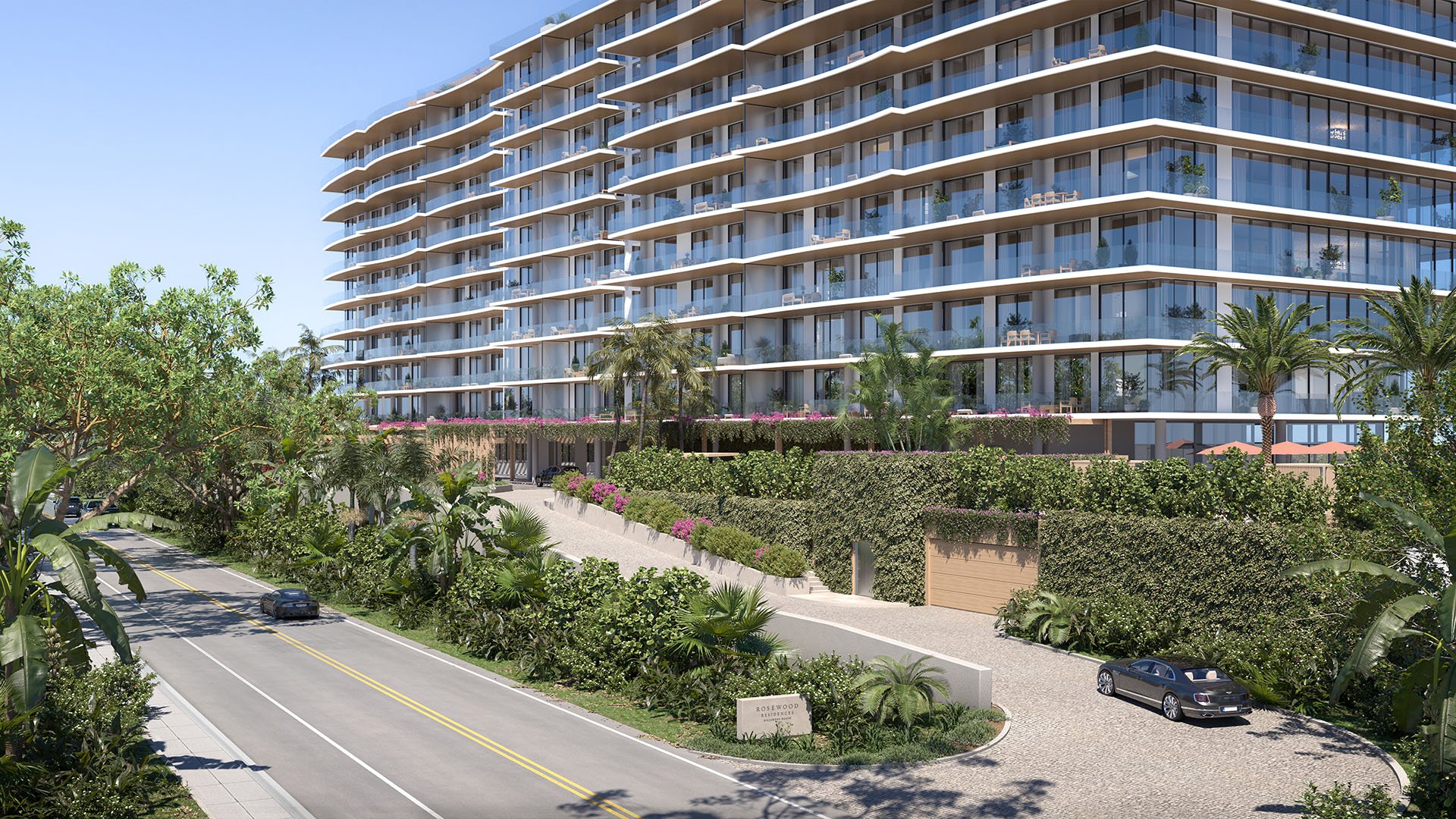
Rosewood Residences Hillsboro Beach begins from a different premise. It is presented as a branded oceanfront residential project in Hillsboro Beach, with a culture built around restraint, sanctuary, privacy, and an estate-style atmosphere.
The arrival sequence is characterized as filtered and discreet, emphasizing privacy before residents or guests reach the lobby. That matters. In a highly private building, the true luxury is not merely what happens inside the lobby. It is the fact that the approach itself has already reduced exposure, controlled movement, and softened the transition from public road to residential domain.
Rosewood’s lobby is intentionally residential in scale rather than institutional or hotel-like. The goal is not to create a grand public room that absorbs constant traffic. The goal is to preserve a quieter, more controlled everyday arrival experience. The result is a different emotional register: less spectacle, more sanctuary.
For a Hillsboro Beach buyer, this culture may be the primary appeal. The service ambition can still be high, but the resident does not have to accept the exposure of a high-traffic hotel front-of-house. In this model, privacy is not an amenity added later. It is embedded in the sequence of arrival.
Lobby volume is rarely just an aesthetic choice. It reflects the number of user groups a building expects to serve, the frequency of movement, and the desired social temperature of the address.
At W Pompano Beach Hotel & Residences, a larger, more expressive lobby makes sense because the building culture supports overlap. Hotel arrivals, residential arrivals, restaurant visitors, amenity users, and staff movements can all intersect at the front of house. The architecture must absorb and dramatize that motion.
At Rosewood Residences Hillsboro Beach, residential scale communicates a different set of priorities. The lobby is not trying to perform as a destination environment for a wide range of public and semi-public users. It is meant to feel like a composed extension of home, with fewer people passing through and a more private daily rhythm.
This is where buyers should look beyond finishes. Stone, millwork, lighting, and furnishings matter, but circulation matters more. A beautiful lobby with constant cross-traffic feels different from a quieter lobby where arrivals are more predictable. Oceanfront living can be socially animated or deeply secluded, and the lobby usually tells the truth first.
The porte-cochère is the handshake between the building and the outside world. It determines who sees whom, how cars queue, how staff greet residents, and how quickly the arrival dissolves into privacy.
At W, the porte-cochère is positioned as a dynamic interface. Hotel arrivals, residential arrivals, and restaurant or amenity traffic may overlap. That produces a more public-facing arrival with visible choreography. It can feel glamorous, energetic, and branded, but it also implies higher social exposure than a purely private condominium model.
At Rosewood, the porte-cochère strategy is centered on privacy and controlled movement rather than public arrival drama. The sequence is less about making an entrance and more about preserving composure. Residents are not necessarily seeking anonymity in an absolute sense. They are seeking a building where the front door does not continually place them in a shared hospitality scene.
For some buyers, the W model is the point. It creates a sense of pulse, occasion, and resort energy. For others, the Rosewood model will feel more valuable precisely because it minimizes theater. The difference is not better or worse. It is cultural fit.
Valet is often discussed as a service, but in buildings of this caliber it is also choreography. The question is not only whether a car is retrieved efficiently. The question is how many constituencies the valet operation must coordinate, how visible that coordination becomes, and whether the resident feels observed or protected during the process.
At W Pompano Beach Hotel & Residences, valet operations are best understood as part of a visible hospitality performance. The team may be coordinating multiple user groups rather than only discreet resident arrivals. The energy of movement is part of the branded experience. It belongs to the same world as the activated lobby and dynamic porte-cochère.
At Rosewood Residences Hillsboro Beach, valet choreography is framed as seamless, quiet, and privacy-driven rather than theatrical. Ideally, service appears before it is requested, then recedes. The luxury is in the absence of friction and the avoidance of unnecessary exposure.
This distinction matters for second-home owners, full-time residents, and anyone who entertains frequently. A condo-hotel environment can make arrival feel connected to a broader hospitality ecosystem. A private residential environment can make arrival feel more controlled, with fewer unknown variables in the foreground.
The best choice depends on how the buyer wants to live. W Pompano Beach Hotel & Residences suits an owner who values branded energy, hospitality programming, and a more animated resort-residential setting. It is for those who see arrival as part of the social experience of the property.
Rosewood Residences Hillsboro Beach speaks to a different instinct. It is for buyers who want hotel-level service without the exposure of a busy hotel front-of-house. Its culture suggests lower lobby traffic, more controlled movement, and a quieter sense of arrival.
Both models sit within the broader South Florida appetite for branded, service-rich oceanfront living. Yet they answer different emotional questions. Do you want the building to greet you with energy, recognition, and scene? Or do you want it to edit the world away before you reach the lobby?
For sophisticated buyers, the deciding factor may not be the brand name alone. It may be the rhythm of the driveway at peak hours, the way valet staff manage competing arrivals, the scale of the lobby relative to its users, and the degree of privacy established before the front door opens.
What is the core difference between W Pompano Beach Hotel & Residences and Rosewood Residences Hillsboro Beach? W is framed around lifestyle hospitality and social energy, while Rosewood is framed around privacy, restraint, and an estate-style residential atmosphere.
Why does lobby volume matter in a luxury residence? Lobby volume reflects how many users the space must support and whether the building culture is social, transitional, or deeply private.
Is W Pompano Beach Hotel & Residences more public in feel? Its arrival model implies higher visibility because hotel guests, residents, and destination visitors may overlap at the front of house.
Is Rosewood Residences Hillsboro Beach designed to feel like a hotel lobby? No. Its lobby is described as intentionally residential in scale rather than institutional or hotel-like.
How should buyers evaluate porte-cochère privacy? They should consider sightlines, traffic overlap, valet staging, and how quickly the arrival sequence transitions into privacy.
Does a more active lobby reduce luxury? Not necessarily. For some buyers, energy, programming, and hospitality visibility are central parts of the luxury experience.
Who is the likely W buyer? The W buyer is likely drawn to branded programming, design-forward hospitality, and a more active resort-residential environment.
Who is the likely Rosewood buyer? The Rosewood buyer is likely privacy-oriented and wants high-touch service without the exposure of a busy hotel front-of-house.
Why is valet choreography important? Valet reveals how a building manages privacy, traffic, staff timing, and the visibility of resident arrivals.
What is the best way to shortlist comparable options for touring? Start with location fit, delivery status, and daily lifestyle priorities, then compare stacks and elevations to validate views and privacy.
If you'd like a private walkthrough and a curated shortlist, connect with MILLION.
If branded residences are on your mind — as a home or as an allocation — we would be glad to share what we are seeing, privately.
Begin a quiet conversation