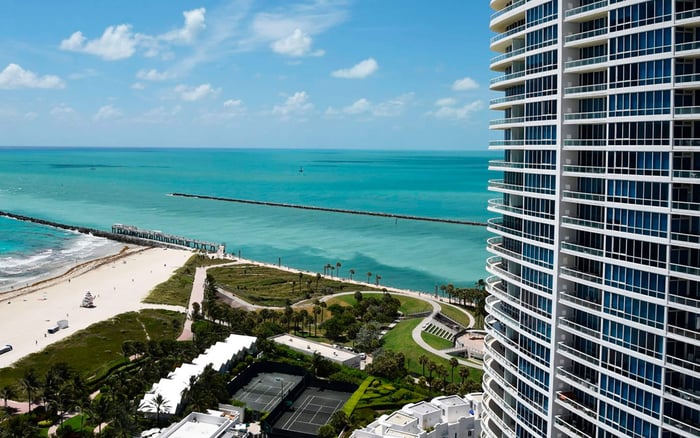
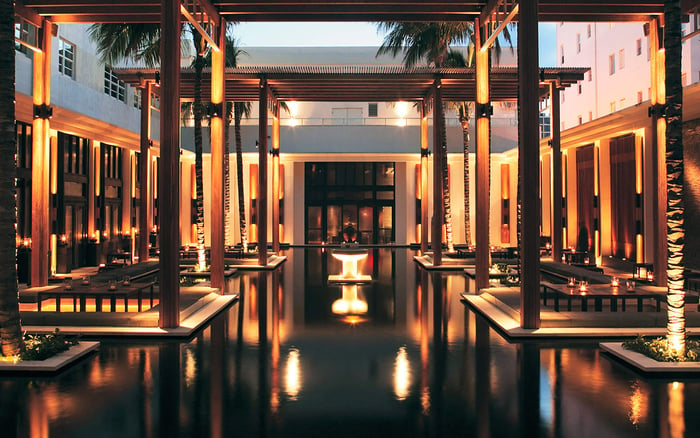
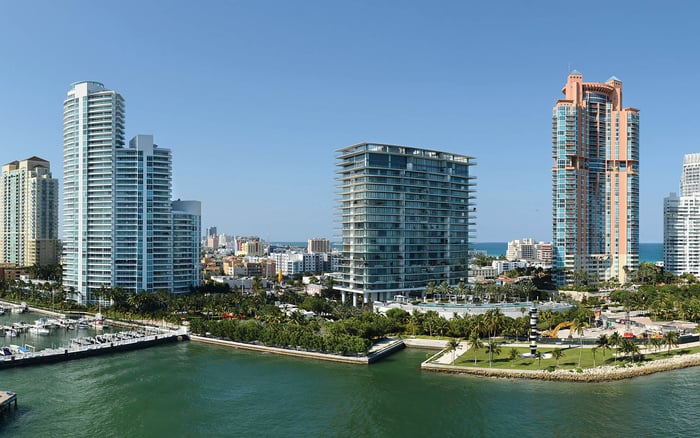
A buyer-focused guide to choosing between Miami Beach and South of Fifth when the goal is sophisticated amenity depth, privacy, and service without a hotel-like atmosphere.
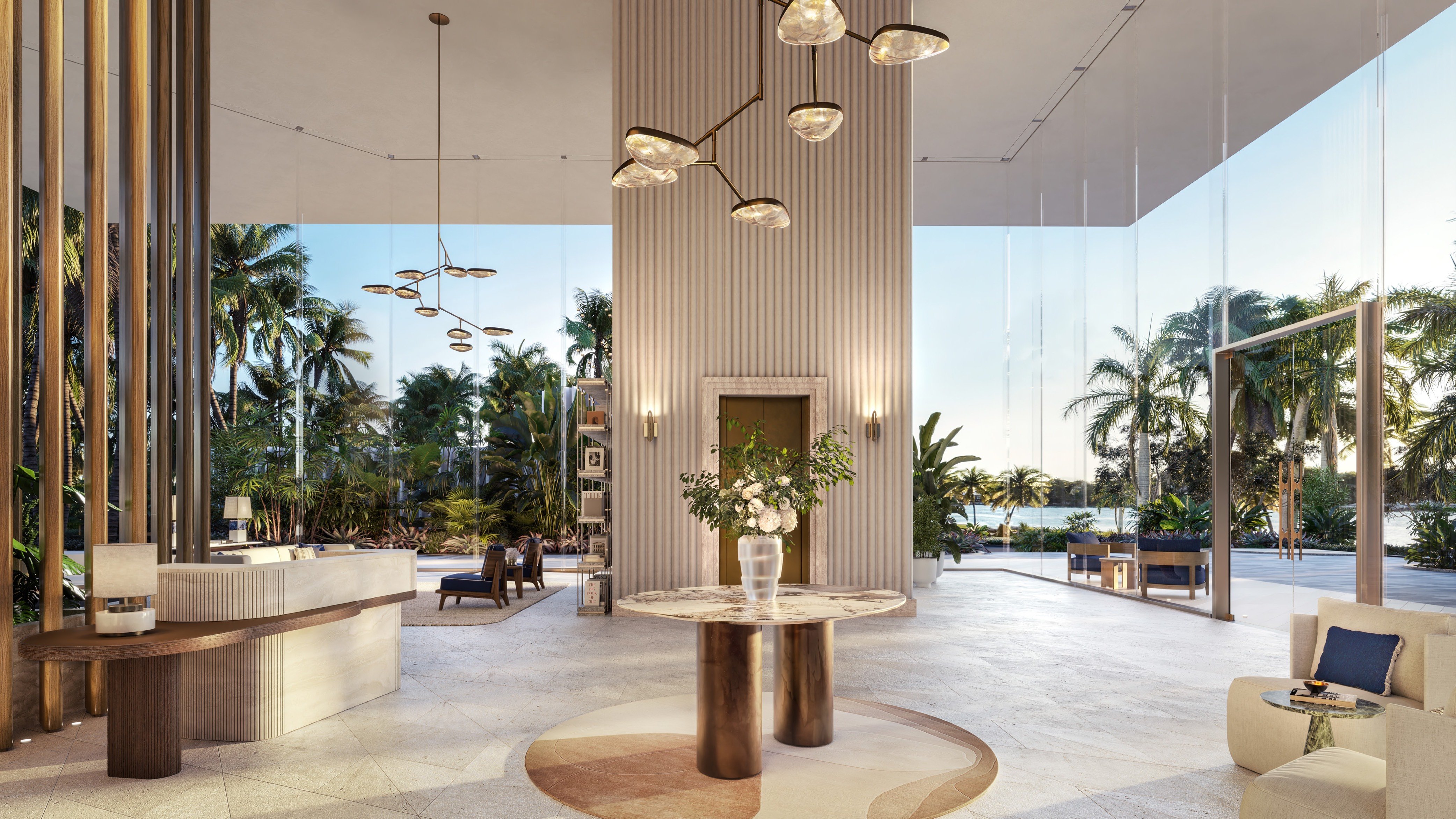
For many ultra-prime buyers, the question is no longer whether a building offers amenities. It is whether those amenities support a refined private life without making home feel like a resort lobby. That distinction matters in Miami Beach, where the same ocean light, cultural access, and architectural ambition can produce very different residential experiences.
The choice between the wider Miami Beach market and South of Fifth is therefore not a simple comparison of more versus less. It is a question of cadence. One buyer may want a complete wellness environment, generous social spaces, precise valet service, and beach proximity in a building that still feels residential. Another may prefer fewer but better-calibrated services, shorter paths from residence to street, and a quieter sense of arrival.
In this context, amenity depth should be understood as usable depth. A long menu has little value if the spaces are crowded, overly visible, or designed primarily to impress guests. The more important test is whether the building lets you move through the day with privacy, ease, and control.
Amenity depth is often misunderstood as accumulation: more pools, more lounges, more wellness rooms, more programmed spaces. For a primary or frequent-use residence, the stronger definition is continuity. Can you train, swim, host, work, recover, receive guests, and move to the beach without friction? Can staff manage the invisible parts of ownership without making the building feel institutional?
Buyers who dislike a resort feeling should focus on four things. First, scale: the number of residents sharing the amenity environment shapes the mood more than the brochure language does. Second, circulation: separate paths for residents, guests, service, pets, deliveries, and beach movement can preserve discretion. Third, programming: highly activated spaces may suit seasonal owners but feel excessive for those who want calm. Fourth, finish quality: quiet materials, acoustic control, lighting, and staff culture are often more important than square footage.
This is where boutique living can be a real advantage, but only when paired with operational strength. A small building with weak service can feel inconvenient. A larger building with disciplined management can feel private. The point is not to reject amenities. It is to choose amenities that recede into the lifestyle.
Miami Beach gives buyers the broader field. It can accommodate those who want oceanfront presence, sophisticated wellness, dining access, cultural proximity, and a building profile with architectural identity. The tradeoff is that the buyer must be more selective about where the energy concentrates.
A residence such as The Perigon Miami Beach may enter the conversation for buyers who want the Miami Beach experience through a design-forward lens, while The Ritz-Carlton Residences® Miami Beach appeals to those weighing service culture alongside privacy. The key is not to assume that a recognized name automatically means a hotel feeling. The buyer should study how the building separates private residential life from hospitality-style activity.
The wider Miami Beach decision is strongest for those who want choice. You can refine by shoreline character, unit orientation, building scale, garage experience, lobby intimacy, wellness depth, and proximity to the daily places you actually use. Beach access may be essential for one buyer, while another may prefer a quieter residential approach with less constant movement at the sand line.
Miami Beach also allows for a wider range of social preferences. Some owners want a polished building where the lobby has presence and the amenity level can receive guests gracefully. Others want a more discreet address where the best luxury is not being seen at all. The neighborhood can support both, but the building has to be matched with precision.
South of Fifth, often searched as Sofi or South of Fifth, has a more concentrated residential identity. For buyers who want to remain close to the energy of Miami Beach while feeling slightly removed from it, the neighborhood offers a compelling framework. The appeal is not a lack of amenities. It is the possibility of amenity depth within a smaller, more private daily radius.
Buildings such as Apogee South Beach and Continuum on South Beach are often part of the South of Fifth discussion because buyers associate the area with privacy, walkability, and a more contained luxury experience. Here, the question becomes whether the building’s amenity environment supports an owner who values access but does not want constant activation.
South of Fifth tends to suit buyers who measure luxury through ease. The short walk to dining, the ability to leave the car behind more often, the sense of neighborhood compression, and the feeling of returning to a more residential enclave all matter. If the broader Miami Beach market offers range, South of Fifth offers focus.
The limitation is that focus can reduce optionality. Inventory, building style, view profile, and floor plan fit may narrow the field quickly. A buyer seeking a very specific combination of privacy, scale, parking, outdoor space, service, and beach adjacency may find the right answer in South of Fifth, but should be prepared to be patient and exacting.
The resort feeling usually comes from three sources: too much public energy, too much programming, and too little separation between residential life and guest-facing spaces. The antidote is not minimalism. It is proportion.
Start with arrival. A discreet lobby, calm valet sequence, and intuitive elevator path can make even an amenity-rich building feel private. Then study the wellness areas. Are they designed for daily residents or for spectacle? A gym, spa, pool, or lounge should feel available rather than performative. If every amenity space is built like a stage, the building may become tiring over time.
Next, consider the pool environment. Some buyers love an active pool deck, but others want a place to read, recover, or swim without feeling observed. Ask how peak seasonal use changes the character of the building. A property that feels serene on a quiet weekday may feel very different during holidays or high season.
Finally, think about hospitality language. Service is essential in the ultra-premium market, but there is a difference between anticipatory residential service and hotel-style choreography. The best buildings know when to appear and when to recede.
If you are choosing between Miami Beach and South of Fifth, begin with your weekly life rather than your occasional life. Where will you have coffee? How often will you use the beach? Do you host formally or casually? Do you want a building that can entertain for you, or a residence that keeps entertainment inside the home? Do you value a larger wellness platform, or would you rather have fewer shared spaces and a more private floor plan?
Choose the broader Miami Beach market if you want range, architectural variety, and the ability to calibrate between quiet and highly serviced living. Choose South of Fifth if you want compression, intimacy, and a residential rhythm that feels close to the best of Miami Beach without absorbing all of its energy.
For many buyers, the winning answer is a hybrid: robust amenities, discreet operations, excellent beach access, and a building culture that feels residential first. That balance is rare, but it is the real definition of luxury in this category.
Is South of Fifth better than Miami Beach for privacy? It can be, especially for buyers who prefer a more concentrated residential setting. The building’s scale and operations matter as much as the neighborhood.
Does more amenity space always mean a better condo? No. The best amenity plan is the one you will use often without feeling exposed or managed.
How can I tell if a building will feel like a resort? Study arrival, pool culture, guest movement, programming, and how visible the shared spaces feel during busy periods.
Is boutique living the safest way to avoid crowds? Not always. Boutique buildings can feel private, but service depth and staffing quality are essential.
Why do buyers still choose larger amenity buildings? Larger buildings can offer broader wellness, hospitality, and service platforms when they are well managed.
Should beach access be the deciding factor? It should be a major factor if you will use it weekly. If not, privacy, floor plan, and building culture may matter more.
Is Sofi mainly for primary residents or seasonal owners? It can work for both, depending on the building and the buyer’s daily rhythm. The area often appeals to those who value walkability and discretion.
Can Miami Beach feel quiet enough for full-time living? Yes, if the building, exposure, and immediate setting are chosen carefully. The neighborhood is varied, so micro-location matters.
What should I ask before buying in an amenity-rich building? Ask how spaces are used in peak season, how guests are managed, and whether residential privacy is protected.
What is the best first step in choosing between the two? Define your daily routine, then tour buildings at different times of day to understand the true residential atmosphere.
For a tailored shortlist and next-step guidance, connect with MILLION.
If branded residences are on your mind — as a home or as an allocation — we would be glad to share what we are seeing, privately.
Begin a quiet conversation