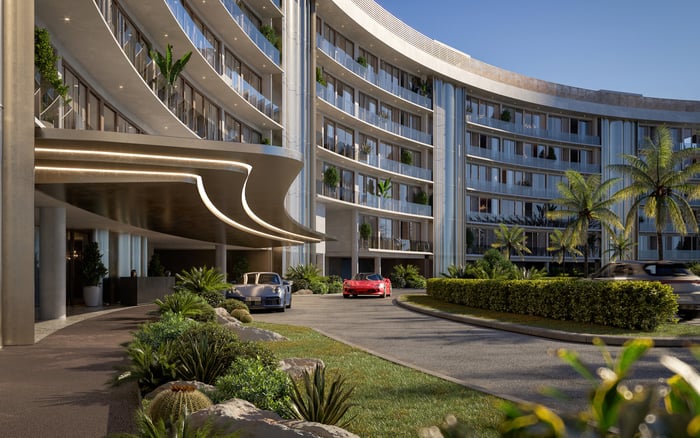
A buyer-oriented editorial on how concierge depth at Vita at Grove Isle should be evaluated through governance, carrying costs, service control, and long-term ownership quality.

For discerning buyers, Vita at Grove Isle is not simply a conversation about finishes, views, or the appeal of a residential address. It is a sharper question about how luxury is owned. In South Florida’s most competitive condominium market, concierge depth has become part of the architecture of value. The strongest buildings do not merely promise service. They organize it, fund it, protect it, and make accountability clear when expectations rise.
That distinction matters. A concierge desk can be beautiful, but the deeper issue is operational authority. Who decides staffing levels? Who sets service standards? Who approves future changes? Who pays when residents want more coverage, more personalization, or a broader hospitality layer? For an ultra-premium buyer, those questions are not administrative footnotes. They are part of the acquisition itself.
Vita at Grove Isle sits within a buyer mindset that values discretion as much as display. The ownership question behind concierge depth is whether the lifestyle is embedded in the condominium’s governance or dependent on a softer promise. In a market where buyers often compare boutique privacy, water-view serenity, and new-construction polish, the most durable form of luxury is clarity.
Concierge service sounds simple until ownership begins. A doorman, front desk, reservation assistance, package handling, guest coordination, arrival management, vendor access, and resident requests all require people, policies, budgets, and supervision. When those elements are not clearly understood, residents may discover that the experience they imagined depends on future votes, cost increases, or management discretion.
For a buyer considering Vita at Grove Isle, the first step is to separate atmosphere from enforceability. Service language can be elegant, but ownership documents, association budgets, staffing plans, and management structures determine how that service functions after closing. A residence may feel private and polished on day one, yet the real test is how consistently the building performs across weekends, holidays, guest arrivals, maintenance needs, and seasonal occupancy.
This is especially relevant for a second-home buyer. Owners who are not in residence year-round often rely more heavily on the building’s service culture. They want confidence that deliveries are handled, guests are expected, vendors are managed, and the residence remains effortless even when the owner is elsewhere. In that scenario, concierge depth is not a flourish. It is a risk-management feature.
A sophisticated buyer should begin with governance. Is the concierge program controlled by the condominium association, a master association, a contracted hospitality provider, or another management structure? Each model can work, but each carries different implications for cost, flexibility, and accountability. What matters is not the label, but the chain of command.
Next comes scope. Buyers should ask what services are included as part of standard building operations and what services may be billed separately. A luxury building may provide strong front-of-house coordination, but private errands, in-residence services, event staffing, pet care, or transportation assistance may fall outside the base structure. That distinction should be understood before a buyer equates concierge depth with unlimited personal assistance.
Staffing is equally important. Service quality depends on people, training, retention, and coverage. A building can have an impressive amenity plan, but if staffing is thin during peak periods, the resident experience may feel uneven. The reverse is also true. A more intimate building with carefully controlled service may feel more refined than a larger property with a longer amenity list.
For buyers using Coconut Grove as an area lens, the emotional draw is often quiet luxury rather than spectacle. That makes the service question more nuanced. The best concierge experience may be the one that feels almost invisible: arrivals are smooth, privacy is protected, and residents do not need to explain preferences repeatedly.
Concierge depth has a cost, and that cost should be reviewed with the same seriousness as the floor plan. Monthly charges are not simply an expense. They are the operating capital behind the experience. The question is whether the amount being paid aligns with the level of service the buyer expects, and whether the budget appears built for consistency.
A high carrying cost is not automatically negative. In a true luxury building, proper staffing, maintenance, security, insurance, reserves, management, and amenity operations require meaningful funding. The concern is not cost alone. The concern is opacity. Buyers should understand what the monthly obligation supports, how increases are handled, and whether the building has the financial discipline to preserve service quality over time.
There is also a resale dimension. Future buyers may be willing to pay for a building whose service culture is stable, elegant, and well governed. They may be less forgiving of a building where service feels aspirational but underfunded. In the ultra-premium tier, the market often rewards confidence. A clear service model can become part of the property’s liquidity story.
The most compelling luxury condominiums in South Florida now balance hospitality with residential calm. Buyers want convenience, but they do not want the feeling of a transient hotel lobby. They want service, but they also want to know who has access, how guests are managed, and how the building protects resident discretion.
That is why Vita at Grove Isle should be evaluated through the lens of ownership experience rather than amenity count. The question is not whether the building sounds luxurious. The question is whether the ownership framework can preserve that luxury as residents’ needs evolve.
Privacy also has a procedural side. How are vendors admitted? How are guests announced? How are deliveries stored? How are recurring preferences handled? How are service requests documented? These operational questions may seem small during a tour, yet they shape daily life more than many dramatic design gestures.
For the buyer comparing South Florida residences, the strongest buildings often have a point of view. They know whether they are formal or relaxed, highly staffed or deliberately intimate, socially active or deeply private. A building that tries to be everything can become operationally confused. A building that understands its resident profile can deliver a more coherent ownership experience.
The ownership question behind concierge depth becomes even more important over time. Service expectations are not static. Residents may want broader wellness coordination, more robust package management, improved technology, or more sophisticated arrival protocols. A well-governed condominium can adapt without losing its identity. A poorly governed one may struggle to reconcile cost, consensus, and execution.
Buyers should consider how decisions are made. Does the association have a clear process for evaluating service changes? Are operating standards reviewed regularly? Is there a professional management structure capable of translating resident expectations into daily performance? These questions help determine whether concierge depth is an enduring value proposition or a fragile first impression.
There is also the matter of buyer psychology. At the top of the market, purchasers are often less impressed by overstatement than by precision. They want to know what is included, what is optional, what is private, what is shared, and what can change. The more expensive the residence, the less tolerance there is for ambiguity.
In that sense, Vita at Grove Isle belongs in a larger conversation about how South Florida luxury is maturing. The new standard is not simply a beautiful building with attentive staff. It is a residence where governance, service, privacy, and cost all align. That alignment is where confidence lives.
What is the main ownership question at Vita at Grove Isle? The key question is how concierge service is controlled, funded, staffed, and protected over time.
Why does concierge depth matter to luxury buyers? It shapes daily convenience, privacy, guest management, vendor access, and the overall ownership experience.
Should buyers focus only on the amenity list? No. Buyers should examine how amenities and services are governed, staffed, and paid for after closing.
How can concierge service affect resale value? Consistent service can support confidence among future buyers, while unclear operations may weaken perceived value.
What should second-home owners pay special attention to? They should review how the building handles deliveries, guests, vendors, and owner requests when they are away.
Is a higher monthly fee always a problem? Not necessarily. The important issue is whether the fee supports a clearly defined and well-run service model.
Why is governance important in a new-construction condominium? Governance determines how the early promise of service becomes a durable operating standard for residents.
How does boutique living influence concierge expectations? Boutique living often places greater emphasis on discretion, familiarity, and personalized service rather than scale.
Why does water-view ownership require operational discipline? A serene setting feels most valuable when arrivals, maintenance, guests, and everyday logistics remain effortless.
What is the best way to shortlist comparable options for touring? Start with location fit, delivery status, and daily lifestyle priorities, then compare stacks and elevations to validate views and privacy.
When you're ready to tour or underwrite the options, connect with MILLION.
If branded residences are on your mind — as a home or as an allocation — we would be glad to share what we are seeing, privately.
Begin a quiet conversation