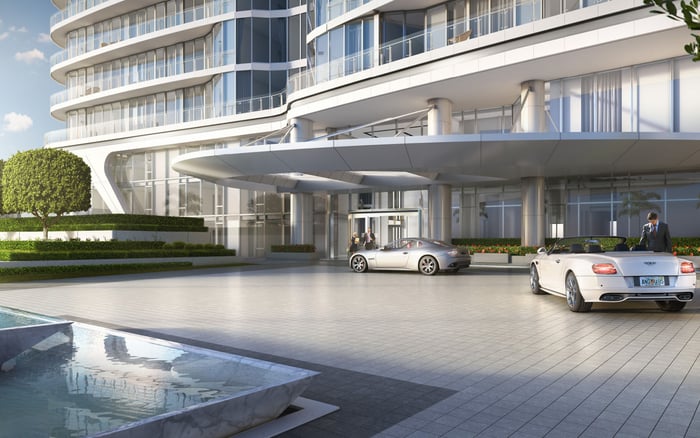
A discreet buyer’s guide to evaluating South Florida residences where service elevators, staff access, vendor routes, and delivery logistics matter as much as views and finishes.

For many luxury buyers, the most revealing elevator in a residence is not the one guests see. It is the service elevator: the staff route, the path for flowers, groceries, luggage, catering, art handlers, housekeeping teams, and the quiet choreography of daily life. In South Florida, where primary homes, seasonal residences, and hospitality-caliber condominiums often operate with regular support, this circulation is not a secondary detail. It is part of the home’s operating system.
A strong service-elevator plan protects privacy, reduces friction, and keeps front-of-house spaces composed. It allows a household to receive deliveries without interrupting a dinner, move luggage without crowding the main lobby, and support staff access without compromising security. For buyers comparing residences across Brickell, Surfside, Fort Lauderdale, Coconut Grove, West Palm Beach, and Palm Beach, the question is not simply whether a building has a service elevator. The better question is whether the elevator, loading path, receiving protocol, and unit-level access work together.
1. Full-service condominium - dedicated service core
The most practical choice for buyers with regular staff, frequent deliveries, or a serious entertaining calendar is a full-service condominium with a clearly separated service core. The ideal arrangement allows vendors and household teams to move from receiving to elevator to residence without crossing the primary arrival sequence.
In this category, buyers should focus on how the service elevator is actually used. A dedicated elevator is strongest when paired with controlled loading, staff check-in, building management oversight, and sensible hours that reflect real household needs rather than theoretical convenience.
2. Waterfront estate-style condominium - discreet loading sequence
A waterfront residence can offer privacy at the front door while still failing operationally if deliveries must pass through visible amenity or lobby zones. The better estate-style condominium experience keeps the water-facing glamour separate from the practical movement of goods and people.
For buyers who entertain often, the service route should accommodate caterers, floral teams, audiovisual technicians, and luggage without turning the private elevator lobby into a staging area. The strongest residences make that movement feel routine, not improvised.
3. Private-island or gated condominium - controlled vendor arrival
In gated or private-island settings, the service elevator is only one layer of the experience. The first filter is arrival control. A vendor may need clearance at an entry gate, check-in at the building, access to the service elevator, and final permission at the residence.
This layered sequence can be excellent for privacy when it is well managed. Buyers should confirm that protocols are efficient enough for daily life. Too much control without coordination can make simple deliveries feel formal and slow.
4. Hospitality-serviced residence - back-of-house discipline
Hospitality-serviced residences can be compelling for buyers who expect hotel-level ease in a private-home setting. The best examples treat back-of-house movement as part of the brand experience, not an afterthought. Staff, housekeeping, room service, maintenance, and deliveries should have a coherent operational path.
For owners who travel frequently, this discipline can be especially valuable. The residence can be stocked, refreshed, serviced, and prepared before arrival, while the visible living spaces remain serene.
5. Boutique luxury building - direct accountability
A boutique building may not have the scale of a major tower, but it can offer something equally important: accountability. With fewer residences and a more intimate staff structure, management may understand each owner’s preferences, delivery rhythm, and household expectations more personally.
The tradeoff is that buyers must inspect capacity carefully. A single service elevator or compact receiving area can work beautifully in a quiet building, but it may feel constrained when several owners are renovating, hosting events, or receiving large deliveries at the same time.
The service elevator should be tested as deliberately as the terrace, kitchen, and primary suite. Ask where a caterer parks, where groceries are received, how large items are handled, and whether staff can access the residence without moving through guest-facing areas. A beautiful lobby is not enough if every operational need depends on exception handling.
Pay close attention to the relationship between the loading area and the residence. A long, exposed, or awkward path can create daily irritation. A short, secure, and intuitive path can make a large home feel effortless. For households with live-in or daily staff, the distinction is material.
Buyers should also consider whether the residence has a service entrance, staff corridor, secondary vestibule, or separate access point near the kitchen or utility zone. Not every luxury home needs all of these features, but households with frequent support often benefit from a plan that separates formal arrival from workflow.
South Florida homes live with a distinctive rhythm. There are seasonal arrivals, visiting family, boating weekends, wellness appointments, private chefs, event preparation, storm-season logistics, and a high volume of parcel deliveries. The service elevator must support that rhythm without turning the residence into a receiving dock.
The best test is simple: imagine a Friday afternoon before guests arrive. Luggage is coming up, flowers are being delivered, groceries are arriving, housekeeping is finishing, and a maintenance technician needs access. In a well-planned residence, these activities remain invisible to guests and manageable for staff. In a poorly planned one, they converge at the front door.
Privacy is also a security consideration. A properly controlled service elevator should not create an unmonitored route into the residence. Buyers should understand how access is granted, whether elevator permissions are destination-controlled, and how building staff document vendor movement.
Marketing language often celebrates concierge service, valet, and private elevators, but the service-elevator question sits deeper. It belongs in the due-diligence conversation with building management, not only in the sales presentation. Buyers should ask for the actual procedure, then imagine using it weekly.
Important questions include whether oversized deliveries require reservations, whether elevator pads are available, whether there are blackout hours for moves, and how the building handles simultaneous deliveries. For owners planning renovations, art installations, or frequent entertaining, these rules can be just as important as ceiling height.
It is also worth distinguishing between a service elevator and a true service ecosystem. The elevator matters, but so do loading bays, package rooms, staff credentials, freight scheduling, and the distance to the residence. Luxury is not only what is visible. It is what functions gracefully when no one is watching.
A residence that handles staff and deliveries well tends to feel calmer, cleaner, and more private. It allows owners to host generously, travel easily, and maintain the home without constant coordination. For ultra-premium buyers, this is not a niche concern. It is a daily quality-of-life issue.
The most compelling South Florida residences combine architectural beauty with operational intelligence. They understand that the entrance for a dinner guest and the route for a floral delivery should not feel like the same path. They protect the owner’s time, the staff’s efficiency, and the home’s atmosphere.
Why is a service elevator important in a luxury residence? It separates household operations from guest arrival, helping preserve privacy, efficiency, and the visual calm of the home.
Is a private elevator the same as a service elevator? No. A private elevator is typically for owner and guest arrival, while a service elevator is intended for staff, deliveries, maintenance, and freight movement.
What should buyers ask before purchasing? Ask how deliveries are received, how vendors are cleared, whether oversized items require scheduling, and how staff reach the residence.
Do boutique buildings handle deliveries as well as large towers? They can, especially when management is attentive, but buyers should confirm capacity during busy periods, renovations, and high-season weeks.
Does service-elevator access affect privacy? Yes. A well-controlled service route can enhance privacy, while a poorly monitored one can create unnecessary exposure.
Should seasonal owners care about this feature? Absolutely. Seasonal owners often rely on staff to prepare, stock, clean, and maintain the home before and after arrival.
What is the biggest red flag? A service route that forces staff or deliveries through the main lobby, amenity areas, or formal residential entry sequence.
How does this matter for entertaining? Catering, flowers, rentals, luggage, and cleanup all move more smoothly when the building has a disciplined back-of-house plan.
Can rules be as important as the elevator itself? Yes. Freight hours, vendor registration, loading access, and delivery scheduling can determine whether the elevator is genuinely useful.
What is the best way to shortlist comparable options for touring? Start with location fit, delivery status, and daily lifestyle priorities, then compare stacks and elevations to validate views and privacy.
For a discreet conversation and a curated building-by-building shortlist, connect with MILLION.
If branded residences are on your mind — as a home or as an allocation — we would be glad to share what we are seeing, privately.
Begin a quiet conversation